
7. Lata, a mother of two children, was admitted to a hospital for acute abdominal pain. Her sister-in-law, Sujatha, accompanied her. Dr. Mansi examined Lata and recommended a diagnostic laparoscopy. Lata’s consent was taken to conduct the medical procedure under general anesthesia. During the laparoscopy, Dr. Mansi’s team discovered a tumor in Lata’s uterus. A closer examination suggested that the tumor could be malignant. One option before Dr. Mansi was to extract a sample for biopsy. In that case, if the tumor was malignant, Lata would have to undergo another surgery for removal of the uterus. An alternative was to remove the uterus immediately. Dr. Mansi had to take a quick decision. As Lata was under general anesthesia, Dr. Mansi explained the situation to Sujatha. Sujatha agreed with Dr. Mansi’s recommendations for a hysterectomy, wherein Lata’s uterus would be removed to avoid the risk and pain of undergoing another surgery. Dr. Mansi removed Lata’s uterus after receiving Sujatha’s consent in writing. Lata was informed of this the next day. She was very upset and felt betrayed as she had not consented to the removal of her uterus. Lata complained to the police who tried to convince her that Dr. Mansi had acted with good intention to help a patient. Sujatha was of the same opinion, however Lata was not convinced and decided to approach the court.
(a) Discuss the ethical issues involved in this case.
(b) Discuss the moral conduct of the doctor in this situation. (Answer in 250 words)
Introduction
The case reflects a difficult conflict between a doctor’s duty to protect the patient and the patient’s right to decide for herself. Dr. Mansi may have genuinely wanted to avoid a second surgery and possible cancer-related complications, but the irreversible nature of hysterectomy makes informed consent and patient autonomy central to the case.
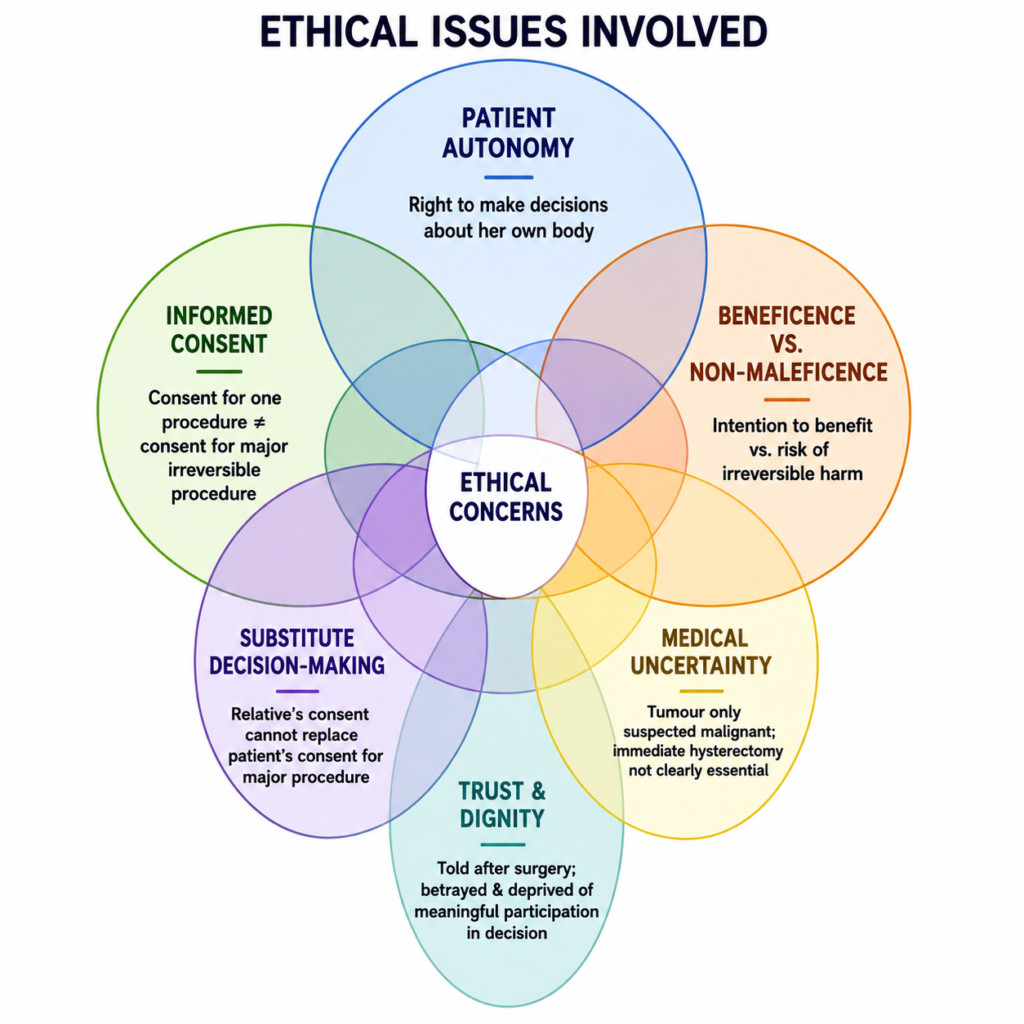



(a) Ethical Issues Involved
- Informed consent: Lata consented to diagnostic laparoscopy, but no prior consent for hysterectomy is mentioned. Consent for one procedure cannot automatically be treated as consent for a major, irreversible procedure.
- Patient autonomy: As a competent adult, Lata had the right to make decisions regarding her own body after being informed of the risks, benefits and alternatives.
- Beneficence vs. non-maleficence: Dr. Mansi intended to protect Lata from a possible malignancy and avoid another surgery. However, removing the uterus without her consent could cause irreversible physical and emotional harm.
- Substitute decision-making: Sujatha’s consent cannot ordinarily replace Lata’s consent for such a major procedure when no prior authorisation is mentioned.
- Medical uncertainty: The tumour was suspected to be malignant. The case does not establish that immediate hysterectomy was essential to save Lata’s life.
- Trust and dignity: Telling Lata about the hysterectomy only after the operation left her feeling betrayed and deprived her of meaningful participation in the decision.
Example: In Samira Kohli v. Dr. Prabha Manchanda, the Supreme Court emphasised the importance of informed consent and the patient’s right to decide about medical treatment. The case illustrates why medical expertise cannot automatically substitute for patient choice.
(b) Moral Conduct of the Doctor
Dr. Mansi’s intention appears beneficent, but her method was paternalistic. Her decision may have been motivated by concern for Lata’s health rather than personal gain, which is ethically relevant. However, the good intention does not remove the obligation to respect Lata’s autonomy.
If immediate intervention was not genuinely unavoidable, the ethically preferable course would have been to take a biopsy, allow Lata to regain consciousness, explain the findings, discuss the risks and alternatives, and obtain her informed consent before performing an irreversible procedure.
At the same time, if there had been a genuine and immediate threat to Lata’s life where delay would cause serious harm, emergency intervention could be ethically justified under the principle of necessity and beneficence.
Conclusion
The case demonstrates that “good intentions are important, but good intentions alone are not enough.” Ethical medical practice requires balancing beneficence with autonomy, non-maleficence, informed consent and dignity.





 Ravi Raaz
 Hassan Khan
 Shadab Ali