
3. (a) Dr. B. R. Ambedkar had cautioned that employing civil disobedience within a constitutional democracy equates to endorsing ‘anarchy’. How should modern democracies navigate the ethical dilemmas posed by civil disobedience movements that aim to promote social justice against policies that may raise genuine concerns? (Answer in 150 words)
Introduction
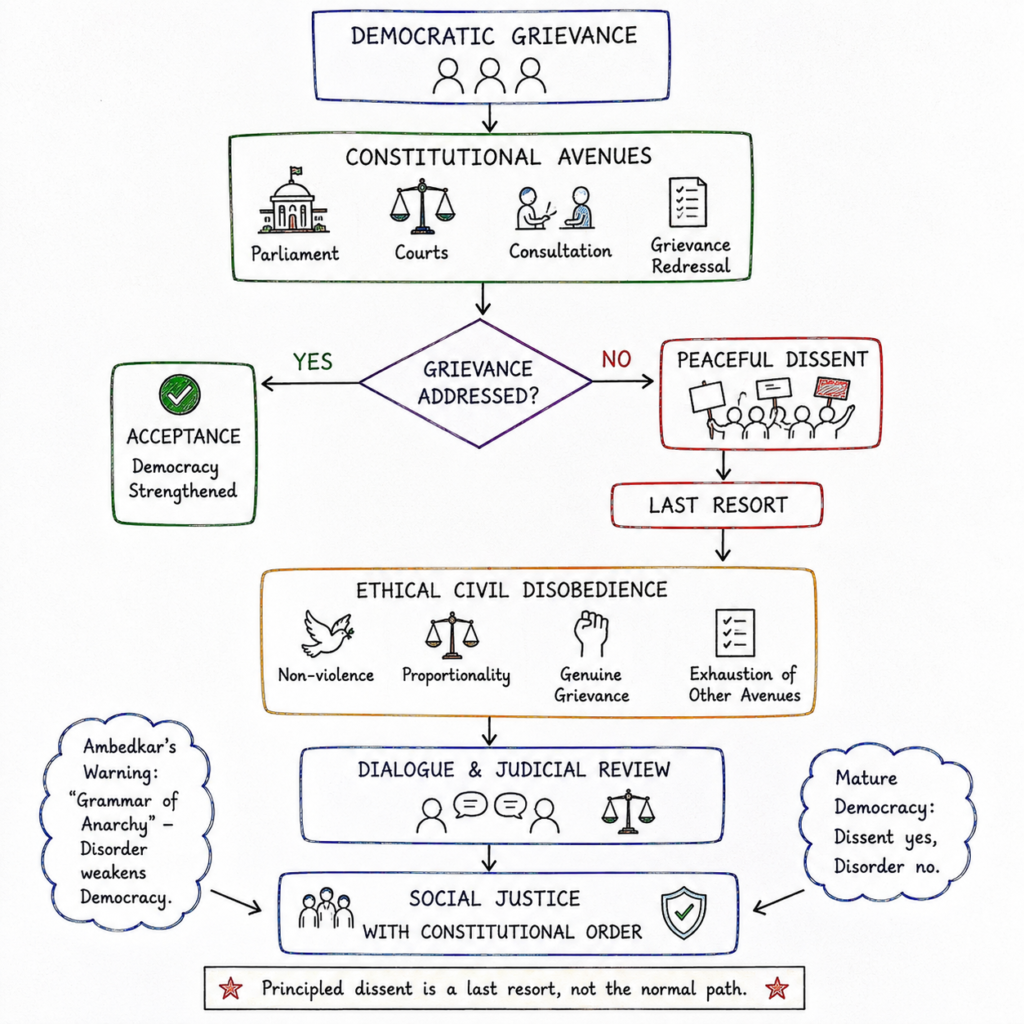
Ambedkar’s warning about the “Grammar of Anarchy” reflected his belief that democratic grievances should normally be addressed through constitutional institutions. At the same time, peaceful dissent can serve as an important moral check on unjust policies when people feel unheard.
Navigating the Ethical Dilemma
- Responsive institutions: Governments should keep Parliament, courts, consultations and grievance mechanisms accessible so citizens have meaningful constitutional avenues.
- Respect for dissent: Peaceful protest should be recognised as a legitimate expression of democratic disagreement, especially when affected groups feel ignored.
- Last resort: Civil disobedience gains greater ethical justification when reasonable constitutional avenues have been exhausted or have failed to address a genuine grievance.
- Non-violence: Protest should remain peaceful and avoid violence, intimidation and destruction of public property.
- Proportionality: State action should maintain public order without unnecessarily restricting peaceful assembly and expression.
- Dialogue over suppression: Governments should engage with protesters rather than dismissing every movement as anti-national or disruptive.
- Judicial review: Courts can examine whether government policies violate fundamental rights or constitutional principles.
- Accountability: Both the State and protesters must remain responsible for unlawful actions.
- Protection of minorities: Democratic majorities should not use their numerical strength to silence legitimate minority concerns.



Example: Mahatma Gandhi’s Salt Satyagraha demonstrated how peaceful civil disobedience could challenge an unjust policy while maintaining non-violence and moral discipline. In a constitutional democracy, however, such methods should not become the routine substitute for institutional processes.
Conclusion
A mature democracy should neither criminalise dissent nor romanticise disorder. It should make constitutional institutions responsive enough that civil disobedience remains a principled last resort, rather than becoming the normal language of democratic politics.





 Ravi Raaz
 Hassan Khan
 Shadab Ali