
3. (b) In what ways can an Indian Administrative Officer apply Gandhi’s notion of ‘trusteeship’ to ensure fairness in governance? (Answer in 150 words)
Introduction
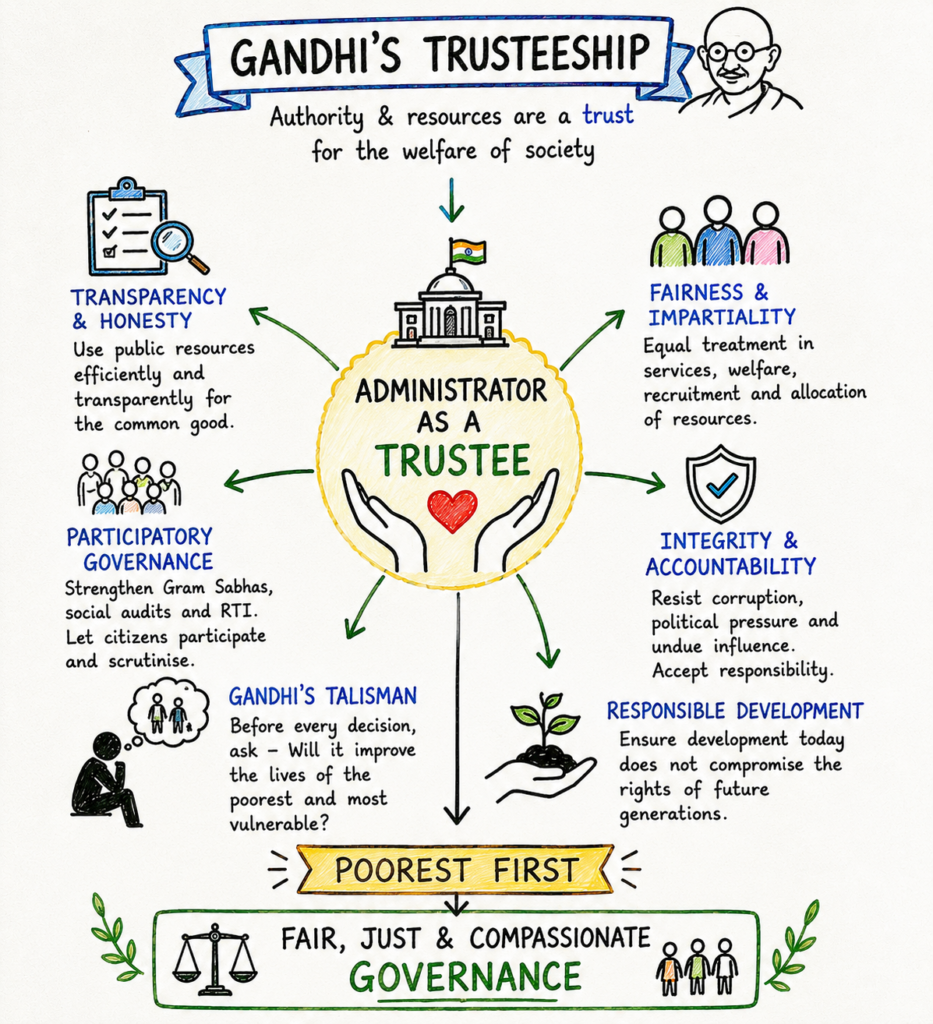
Gandhi’s idea of trusteeship means that wealth, authority and resources should be treated as a trust for the welfare of society, rather than as instruments of personal gain. For an administrator, it means using public office as a responsibility to serve citizens, especially the weakest.
Application in Governance
- Public resources as a trust: Use public money, land and natural resources honestly, efficiently and transparently for the common good.
- Gandhi’s Talisman: Before implementing a policy, ask whether it improves the lives of the poorest and most vulnerable.
- Fairness and impartiality: Ensure equal treatment in welfare delivery, recruitment and allocation of resources, without favouritism or discrimination.
- Participatory governance: Strengthen Gram Sabhas, social audits and RTI so citizens can participate in and scrutinise decisions.
- Personal integrity: Resist corruption, political pressure and undue influence, and accept responsibility for administrative decisions.
- Citizen-centric administration: Treat citizens with dignity and empathy, rather than seeing them merely as beneficiaries of government schemes.
- Responsible development: Ensure that industries and private interests do not exploit public resources or unfairly burden weaker sections.
- Future generations: Use natural resources responsibly so that present development does not compromise the interests of those who come after us.



Example: An administrator deciding the allocation of scarce land or water can apply the trusteeship principle by giving priority to public welfare and vulnerable communities, while ensuring that private interests are accommodated only within a fair and transparent framework.
Conclusion
Trusteeship can transform public office from a position of power into a responsibility to serve society. For a civil servant, it means ensuring that authority, resources and opportunities are used with integrity, fairness, compassion and a sense of public ownership.
3. (c) Shakespeare in Henry IV says, “The arms are fair when the intent of bearing them is just”. What ethical implications does this have in governance? (Answer in 150 words)
Introduction
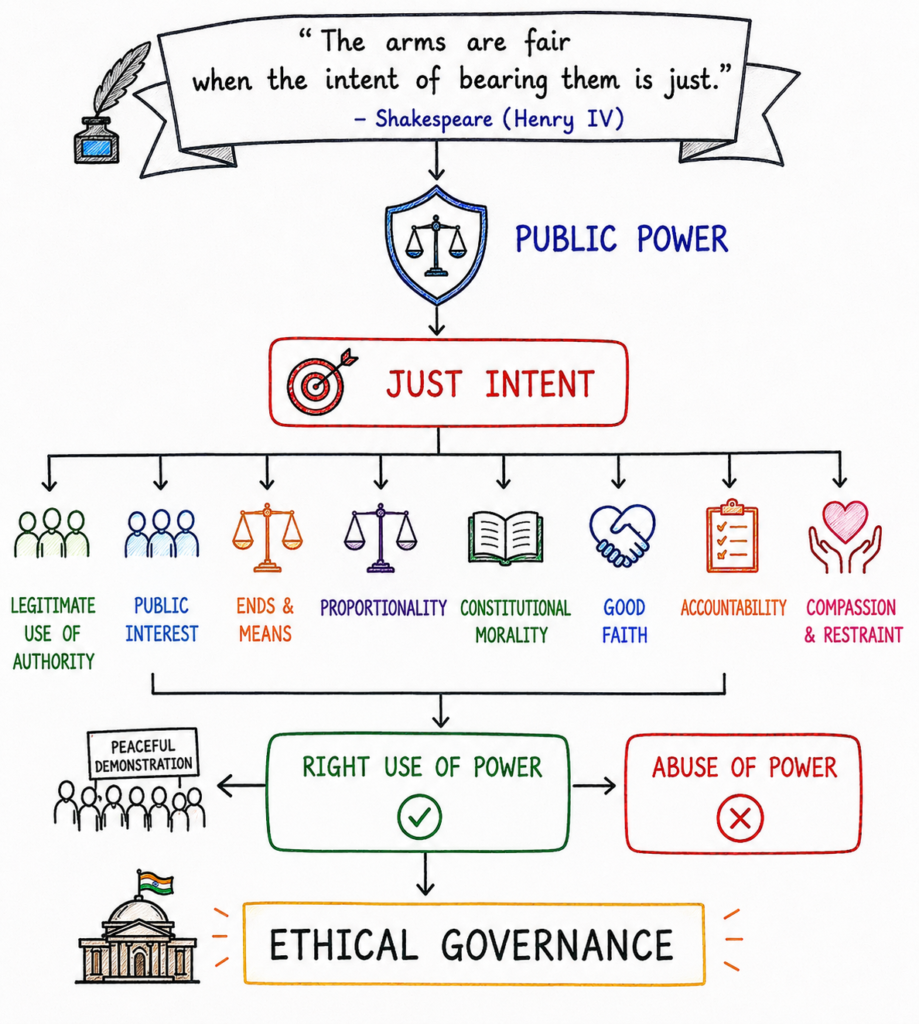
Shakespeare’s statement suggests that power becomes morally legitimate when it is used for a just purpose. In governance, however, a good intention alone is not enough; the exercise of power must also be lawful, fair and proportionate.
Ethical Implications
- Legitimate use of authority: Public power should protect citizens, maintain order and uphold rights rather than serve personal or political interests.
- Public interest: Administrative decisions should aim at genuine public welfare, not favouritism, corruption or political convenience.
- Ends and means: A desirable objective cannot justify unlawful or unethical methods. Both the purpose and the process matter.
- Proportionality: Even when coercive action is necessary, the administration should use the least restrictive means capable of achieving the objective.
- Constitutional morality: Executive power must remain within the Constitution, rule of law and principles of equality and dignity.
- Good faith: Decisions should be taken honestly, without malice, bias or hidden motives.
- Accountability: Officials exercising public authority must be answerable for both their decisions and their consequences.
- Compassion and restraint: Enforcement should solve the problem without causing unnecessary hardship to citizens.
Example: During a law-and-order situation, imposing reasonable restrictions to prevent violence may be justified when the intent is to protect lives. However, using the same situation to suppress peaceful dissent would turn legitimate authority into an abuse of power.
Conclusion
Thus, just intent gives direction to power, while law, fairness and proportionality give it legitimacy. Ethical governance requires public authority to be used as an instrument of justice and public welfare, rather than domination.
“Good governance is not merely about having the right intention; it is about using the right means to achieve it.”




 Ravi Raaz
 Hassan Khan
 Shadab Ali