
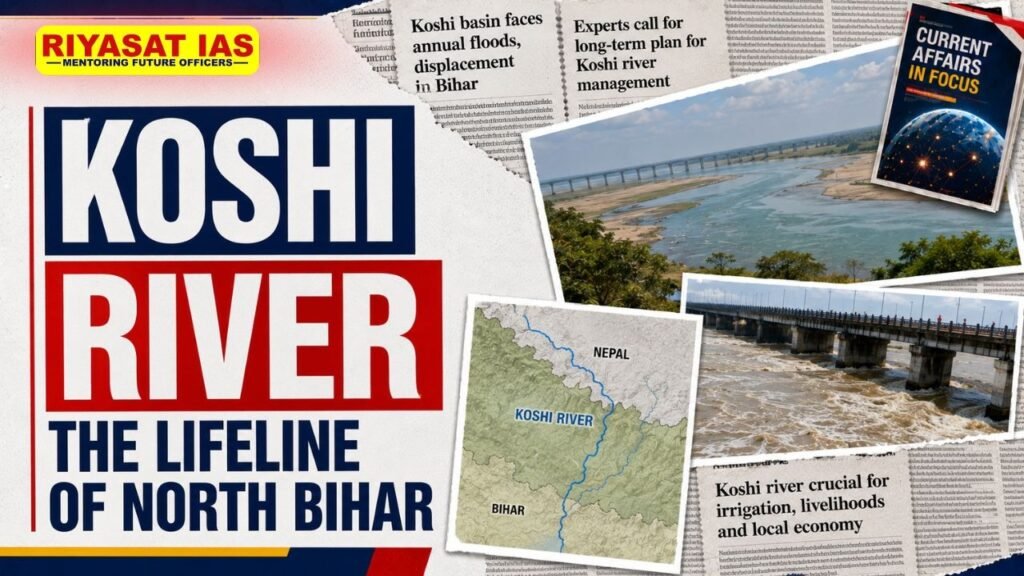
· Origin: The Koshi River system originates in the Himalayas of Tibet and Nepal and is formed by several major tributaries.
- Major Tributaries: The three major tributaries traditionally associated with the upper Koshi system are Sun Koshi, Arun and Tamor.
- Confluence: These rivers converge in eastern Nepal to form the Koshi (Saptakoshi).
- India Entry: The Koshi enters India through Bihar and flows through the northern part of the State.
- Tributary of Ganga: The Koshi is a left-bank tributary of the Ganga.
- High Sediment Load: It carries enormous quantities of sediment from the young and rapidly eroding Himalayas.
- “Sorrow of Bihar”: Frequent changes in its course and devastating floods have earned the Koshi the name “Sorrow of Bihar.”
- Floodplain: Its large sediment load causes channel shifting and floodplain formation, increasing flood vulnerability in Bihar.
- Transboundary River: The Koshi basin is shared by China (Tibet), Nepal and India.
- Hydropower Potential: Its steep Himalayan tributaries provide significant hydropower potential.
- Koshi Agreement: India and Nepal signed the Kosi Agreement in 1954, subsequently amended in 1966, concerning flood control, irrigation and related works.



UPSC Prelims Practice Question — English
Q. With reference to the Koshi River, consider the following statements:
- The Koshi is a left-bank tributary of the Ganga.
- Arun, Sun Koshi and Tamor are major rivers associated with the Koshi system.
- The Koshi enters India through Bihar.
- Its high sediment load contributes to frequent changes in its course.
Which of the statements given above are correct?
A. 1, 2 and 3 only
B. 1, 3 and 4 only
C. 2 and 4 only
D. 1, 2, 3 and 4
Answer: D
Explanation
- Statement 1 — Correct: Koshi is a left-bank tributary of the Ganga.
- Statement 2 — Correct: Arun, Sun Koshi and Tamor are the principal rivers that form the Saptakoshi system.
- Statement 3 — Correct: The Koshi crosses into Bihar, India, after flowing through Nepal.
- Statement 4 — Correct: Its enormous sediment load promotes channel shifting and contributes significantly to flooding in Bihar.





 Ravi Raaz
 Hassan Khan
 Shadab Ali