
GS-III: Disaster Management | Environment | Climate Change | Geography | International Relations
Context
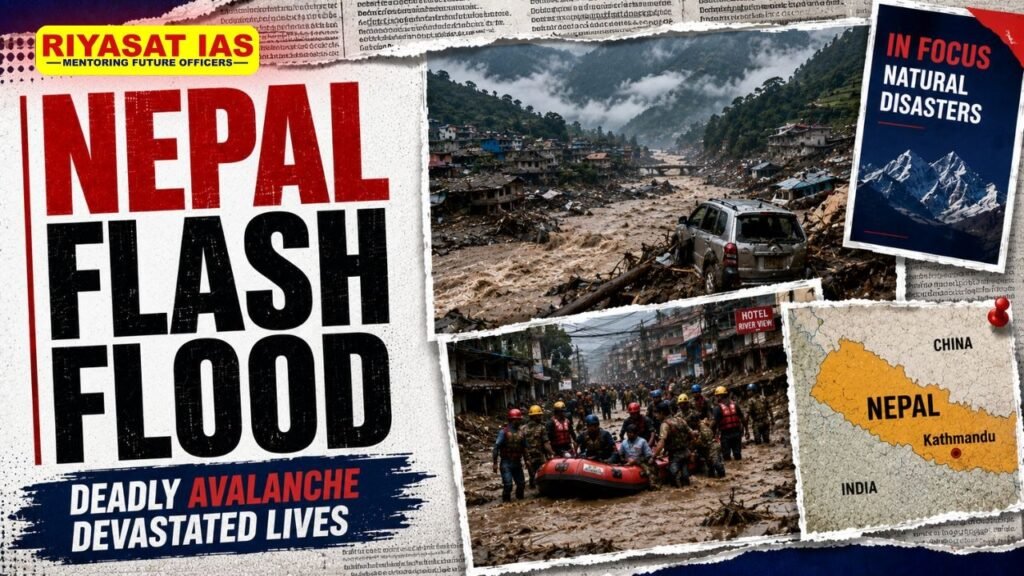
- Major Disaster: A devastating flash flood struck Nepal’s northern border region with China on 26 August 2026, killing at least 157 people in Nepal, while hundreds remain missing.
- Worst-Affected Areas: Rasuwa, Nuwakot and Dhading districts were among the severely affected areas.
- International Dimension: The disaster also affected China’s Tibet region, where casualties and hundreds of missing persons were reported.
- Indian Connection: A significant number of missing people are Indian nationals, including pilgrims travelling towards Kailash Mansarovar.
What Triggered the Flash Flood?
- Ice-Rock Avalanche: Preliminary assessments indicate that an ice-and-rock avalanche/glacial collapse caused a sudden surge of water into the river system.
- River System: The flood affected the Lhende Khola–Bhote Koshi–Trishuli river system.
- Transboundary River: The Bhote Koshi originates in Tibet and enters Nepal, eventually joining the Trishuli River, which forms part of the river system flowing towards India.
- Sudden Onset: The extremely rapid rise in water and debris gave communities little time to evacuate.
Why Was the Disaster So Destructive?
- Mountainous Terrain: Steep Himalayan slopes accelerate the movement of water, debris and landslides.
- Glacial Instability: Rising temperatures can destabilise glaciers, snowpacks and glacial lakes, increasing the risk of GLOFs and ice-rock avalanches.
- Infrastructure Vulnerability: Roads, bridges, hydropower projects and settlements located close to river valleys are particularly exposed.
- Limited Early Warning: Flash floods generated by sudden upstream events can occur with very little warning.
- Cascading Hazards: A single event can trigger avalanche → river blockage → sudden release → flash flood → landslide, creating a compound disaster.



Climate Change Dimension
- Himalayan Vulnerability: The Hindu Kush Himalayan region is highly sensitive to climate change.
- Cryosphere Impact: Rising temperatures contribute to glacier retreat, permafrost degradation and instability of high-altitude slopes.
- Increasing Extremes: Climate change can intensify the frequency and severity of extreme precipitation and other hydrometeorological hazards.
- Important Caveat: A particular flood cannot automatically be attributed solely to climate change; event-specific scientific attribution is necessary.
India–Nepal Dimension
- Transboundary Rivers: The disaster highlights the importance of cooperation over shared Himalayan river systems.
- Downstream Risk: Changes in upstream river discharge can affect downstream regions, including Bihar and the wider Ganga basin. India had also moved to evacuate vulnerable populations in Bihar amid concerns over flooding.
- Disaster Diplomacy: Nepal sought assistance from India and China for rescue operations.
- Humanitarian Assistance: India has begun providing relief assistance to flood-hit Nepal.
- Strategic Significance: Disaster management can become an important component of India–Nepal neighbourhood cooperation.
Disaster Management Lessons
- Early Warning Systems: Develop real-time monitoring of glaciers, avalanches, glacial lakes and river discharge.
- Last-Mile Connectivity: Warnings must reach remote Himalayan communities through sirens, mobile alerts, satellite communication and local networks.
- Hazard Mapping: Prepare detailed GLOF, avalanche, landslide and flash-flood vulnerability maps.
- Climate-Resilient Infrastructure: Roads, bridges, hydropower projects and settlements should incorporate Himalayan-specific disaster risks.
- Community Preparedness: Local communities should be trained in evacuation, first aid and emergency communication.
- Transboundary Data Sharing: India, Nepal and China should improve sharing of hydrological, meteorological and cryospheric data.
Way Forward
- Integrated Himalayan Risk Management: Treat floods, landslides, avalanches, GLOFs and earthquakes as interconnected hazards rather than isolated events.
- Strengthen Regional Cooperation: Establish robust mechanisms for real-time sharing of upstream rainfall, river-flow and glacial-risk information.
- Risk-Sensitive Planning: Avoid construction and dense habitation in highly vulnerable river corridors.
- Improve Forecasting: Combine satellite imagery + remote sensing + AI-based forecasting + ground sensors.
- International Cooperation: Strengthen regional mechanisms under frameworks such as SAARC, BIMSTEC and ICIMOD for Himalayan disaster-risk reduction.
- Build Back Better: Reconstruction should focus on resilience, not merely replacing damaged infrastructure.
Conclusion
The Nepal flash flood demonstrates that Himalayan disasters are increasingly transboundary, cascading and climate-sensitive. The combination of fragile mountain terrain, glacial instability, extreme weather and infrastructure vulnerability can transform a local hazard into a regional humanitarian crisis.
For India and Nepal, the priority should therefore shift from a reactive relief-centric approach to anticipatory disaster governance, based on early warning, resilient infrastructure, scientific monitoring and transboundary cooperation.
UPSC Mains Practice Question
Q. “The increasing incidence of flash floods in the Himalayan region highlights the need to shift from reactive disaster relief to anticipatory and risk-informed disaster management.” Discuss with special reference to Nepal and its implications for India. (250 words, 15 marks)





 Ravi Raaz
 Hassan Khan
 Shadab Ali