
Consequences of Following Ethics
Individual Level
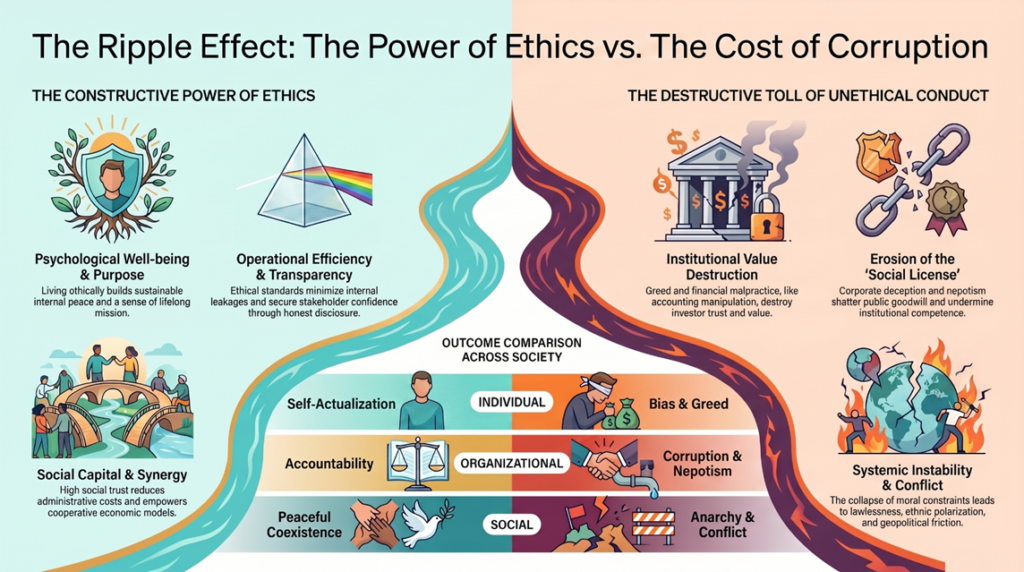
● Satisfaction of Human Growth Needs: Ethics fulfill higher-order psychological and existential needs like self-actualization. For example, Mahatma Gandhi’s unyielding dedication to truth and non-violence illustrates how alignment with moral principles satisfies the human quest for higher meaning.
● Happiness: Ethical behavior generates sustainable internal peace and life satisfaction. According to Martin Seligman, “The belief that we can rely on our integrity and kindness is the bedrock of our psychological well-being.”
● Sense of Purpose: Living ethically builds a coherent moral identity and deep lifelong mission. Nelson Mandela’s fight against apartheid reflects this dimension. Mandela noted, “What counts in life is not the mere fact that we have lived. It is what difference we have made to the lives of others that will determine the significance of the life we lead.”
● Selflessness: Sound moral values foster an internal orientation toward altruism and public welfare over personal gain.
❖ Example: Climate-resilient innovations, such as community-driven water conservation initiatives across arid zones in India, demonstrate how local ecological leaders channel selflessness into community resource security. Similarly, innovators like Jadav Payeng, who single-handedly planted a forest over decades to safeguard river island ecosystems, show how selflessness builds enduring environmental legacies.
● Empathy: Practicing ethics sharpens one’s emotional resonance with human suffering, driving systemic reform. For example, Kailash Satyarthi’s global campaigns to end child labor and rescue trafficked children highlight empathy translated into structural rescue and policy action.
Organizational Level
❖ Transparency: Openness secures stakeholder confidence and minimizes operational vulnerabilities. Warren Buffett noted, “It takes 20 years to build a reputation and five minutes to ruin it. If you think about that, you’ll do things differently.” For example, Infosys established strong standards for transparent corporate governance under N. R. Narayana Murthy, who emphasized, “When in doubt, disclose. That is what transparency is all about.”
❖ Efficiency: Ethics minimize internal leakages, transactional costs, and friction by ensuring strict honesty and institutional accountability. For example, the Tata Group’s long-standing reputation for principled business conduct demonstrates how an ethical brand equity secures sustainable operational success.
❖ Responsibility and Accountability: Ethical institutions actively fulfill their social and environmental obligations rather than treating them as external liabilities.
❖ Example: The growing alignment of global enterprises with strict Science Based Targets initiatives (SBTi) to reduce carbon footprints, echoing the philosophy of Patagonia founder Yvon Chouinard by embedding ecological accountability directly into the core corporate balance sheet. Another example is the global rise of “B-Corps” (Benefit Corporations), which legally bind companies to balance profit with a positive impact on workers, community, and the environment.



Social Level
● Harmony: Shared moral norms minimize friction, ensuring stable peaceful coexistence among diverse sociological groups. For example, Kerala’s historical traditions of syncretism and grass-roots communal harmony reflect how social ethics can suppress divisive forces.
● Trust: Adherence to systemic ethical standards fosters high social trust, which underpins clean governance. For example, the high trust levels in Scandinavian local governance minimize administrative costs and maximize public policy compliance.
● Brotherhood: Ethical frameworks promote mutual respect, transcending narrow parochial identities. For example, Auroville’s communal living experiment is grounded in shared ethical values. The community’s charter states, “Auroville belongs to nobody in particular. Auroville belongs to humanity as a whole.”
● Teamwork: A highly ethical society encourages cooperative synergy and collaborative crisis management. For example, the historic success of the Amul cooperative model in Gujarat illustrates how ethical economic cooperation empowers millions of small farmers.
● Social Capital: Ethics build the dense socio-economic networks of trust that sustain institutions. Robert Putnam’s research highlights that “Communities with higher social capital enjoy better governance and greater economic prosperity.”
Consequences of Not Following Ethics
Individual Level
● Bias and Discrimination: The decay of individual moral frameworks causes cognitive distortions and social fragmentation. For example, despite comprehensive constitutional and statutory protections, deep-seated structural discrimination against lower castes, such as Dalits, continues to persist due to moral blindspots.
● Envy: Unethical actions driven by deep malice and professional envy create a toxic, litigious environment. For example, intense corporate rivalries, such as the patent lawsuits between major tech companies like Apple and Samsung over copying smartphone designs, highlight how aggressive friction replaces collaborative innovation.
● Greed: Unchecked self-interest leads directly to financial malpractice, destroying institutional value. For example, the historic Satyam scandal exposed how systemic accounting manipulation was driven by greed to artificially inflate corporate stock valuations, hurting thousands of small investors.
Societal Level
● Rise in Crime Rates: The breakdown of internal moral constraints causes a surge in lawlessness and predatory activities.
❖ Example: The exponential rise in AI-driven cybercrimes, financial deepfakes, and automated ransomware syndicates, showcasing how a vacuum of digital ethics creates unsafe cyber ecosystems. Similarly, the surge in global digital extortion rackets targeting critical infrastructure like hospitals illustrates how a loss of basic moral constraints directly endangers innocent human lives.
● Communal Conflict: The absence of mutual respect and ethical restraint escalates structural polarization into violence. For example, the tragic ethnic conflicts in Manipur reflect how a collapse of social trust and dialogue leads to civil devastation.
● Stereotypes: Unethical cognitive shortcuts perpetuate institutionalized prejudice and racial profiling. Civil rights activist Angela Davis argues, “In a racist society, it is not enough to be non-racist, we must be anti-racist.”
● Instability: Geopolitical structures devoid of moral moorings face permanent friction and conflict. For example, ongoing global conflicts like the Russia-Ukraine war and the West Asian crises showcase this failure. As former UN Secretary-General Ban Ki-moon remarked, “The world is over-armed and peace is under-funded.”
● No Rule of Law: Complete moral collapse dissolves civil order into absolute anarchy and institutional breakdown. For example, the systemic breakdown of human conscience during the 1994 Rwandan Genocide resulted in rapid mass violence.
● Moral Corruption: Widespread ethical degradation can lead to total state capture by regressive forces. For example, the oppressive regime of the Taliban in Afghanistan has led to the systemic erasure of basic human rights and gender-based segregation.
Organizational Level
● Corruption: Institutionalizing unethical short-cuts causes operational decay and public exploitation. For example, the Enron collapse remains a textbook warning of how top executives engaging in structural accounting fraud can destroy an enterprise.
● Criminalization: Chronic ethical failures push legal entities into organized illegal enterprises. For example, Brazil’s extensive Operation Car Wash investigation uncovered how systemic collusion between political elites and corporate executives corrupted public procurement infrastructure.
● Nepotism: Preferring familial lineages over genuine merit undermines institutional competence and causes brain drain. For example, global family-run conglomerates, including public criticisms faced by South Korean Chaebols like Samsung, have been scrutinized for prioritizing familial transitions over independent professional talent.
● Violation of Public Trust: Malpractice deliberately erodes an institution’s fundamental social license to operate. For example, the Volkswagen emissions scandal—where software was installed to cheat laboratory emissions tests—proves how corporate deception completely shatters public goodwill and brand loyalty.
❖ Example: The Wirecard scandal in Europe, where top executives engaged in billions of euros of phantom accounting, shows how corporate deception destroys investor trust and erodes faith in regulatory watchdogs.
Previous Year Questions
● Q. The current society is plagued with widespread trust–deficit. What are the consequences of this situation for personal well-being and for societal well-being? What can you do at the personal level to make yourself trustworthy?
● Q. Explain how ethics contributes to social and human well-being.
Practice Questions
Question 1 How does ethical behaviour in public service influence citizen trust in government institutions, and what measures can governments take to ensure ethical governance? (10 marks, 150 words)
Question 2 “The cost of corporate unethical choices is rarely borne by the boardroom; it is externalized onto vulnerable communities and the environment.” Analyze this statement with respect to the consequences of unethical organizational behavior. (10 marks, 150 words)



 Ravi Raaz
 Hassan Khan
 Shadab Ali