
Ethics govern our behavior and are influenced by various factors shaping how we live within society. Understanding the determinants of ethics is essential for fostering a morally conscious and just society.
Psychological Determinants
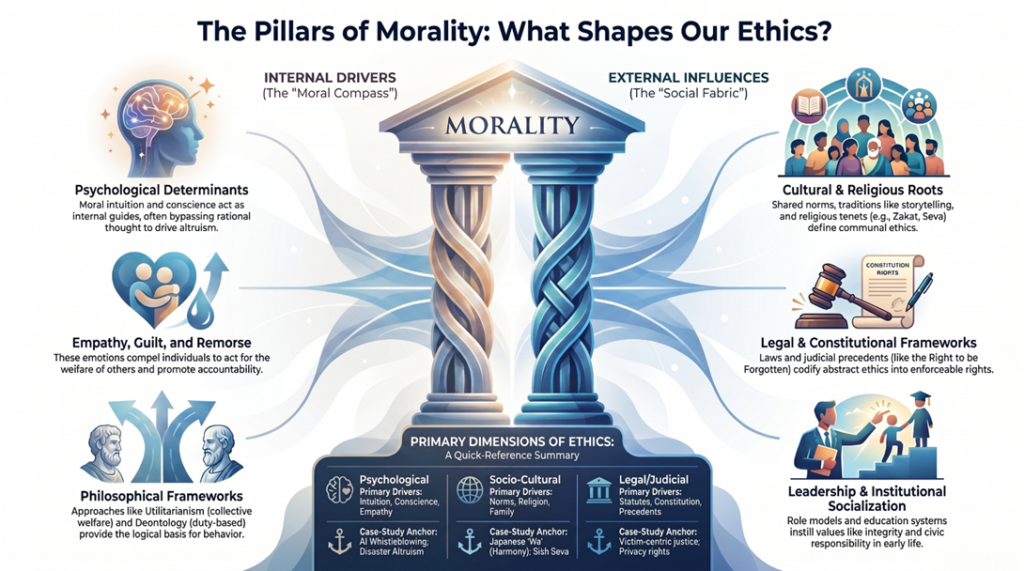
Moral Intuition
According to Dr. Jonathan Haidt, “Intuitive ethics lead us to moral choices naturally, often bypassing rational deliberation.”
Example: Disaster Response Altruism: During sudden crises like the 2024 Wayanad landslides or global flash floods, local citizens and fishermen instinctively risking their lives to rescue strangers and distribute rations before any official administration or monetary compensation is announced. This highlights an innate, intuitive altruistic drive to protect human life.
Conscience
Conscience is a person’s internal moral sense about right and wrong, acting as a sovereign guide to one’s behaviour.
Example: Whistleblowing in Artificial Intelligence: Modern tech researchers and safety executives resigning from leading AI labs to expose the hasty deployment of unvetted algorithms, driven by a deep moral conscience regarding public safety and digital manipulation, despite facing immense career risks and non-disclosure consequences.
Empathy
Empathy is a foundational element driving ethical behavior, compelling individuals to act for the welfare of vulnerable others.
Updated Example: Global Refugee Support Movements: Citizen-led networks across the world organizing community kitchens, translation services, and housing for displaced families fleeing conflicts. This highlights how a shared sense of humanitarian empathy transcends national boundaries to advocate for social justice.
Guilt and Remorse
Feelings of guilt act as a powerful internal motivator for ethical behavior, promoting accountability and moral reformation.
Example: Corporate Restitution for Environmental Harms: Industrial bodies voluntarily undergoing expensive eco-restoration and issuing public apologies after identifying structural toxic run-offs, proving that institutional remorse can drive significant positive behavioral changes and restitution.
Cultural Determinants
Cultural Norms
Prof. Geert Hofstede highlights, “Cultural norms deeply embed what is perceived as ethical within a society.” Culture acts as a prescription for correct and moral behaviour.
● Collectivist Cultures: In societies like Japan, the emphasis on group harmony (Wa) and community welfare strongly shapes ethical decision-making over individual desire.
● Work Ethic: Cultural attitudes toward responsibility, like the ethos of individualism and professional accountability, define baseline ethical behavior in professional spheres.



Religious Beliefs
Every major religion advocates ethical living and lays down moral principles. However, ethics cannot be completely confined to religion; for instance, an atheist can derive a high standard of morality purely from an enlightened conscience.
● Sikhism’s Seva: Drives communities to engage in selfless, institutionalized community service and continuous charitable acts.
● Islamic Zakat: Mandates individuals to give a dedicated portion of their wealth to charity, reinforcing distributive justice and social responsibility.
Traditions and Customs
● Storytelling and Folklore: Cultural narratives, such as tales from the Panchatantra or epics, convey deep moral lessons, shaping the childhood ethical perceptions of a society.
● Conflict Resolution: Traditional dispute resolution mechanisms, like indigenous tribal councils or local mediation circles, emphasize restorative justice and community harmony over adversarial litigations.
Socio-political Determinants
Societal Standards
Societal standards can sometimes deviate from objective ethical principles, leading to systemic moral decay or positive evolution:
Updated Example: Ethical Accountability in Sport Governance: The global crackdown on systemic corruption, doping syndicates, and administrative harassment within major sports federations. Driven by public outrage and investigative journalism, this reflects a major shift toward institutional transparency, gender equity, and human dignity in professional spaces.
Influence of Family
● Parental Values: Parents act as the primary locus of socialization, instilling fundamental values like honesty, integrity, and kindness in early childhood.
Education Systems
● Empathy in Pedagogy: Countries like Finland embed social-emotional learning and civic responsibility directly into their core curriculum, cultivating a deeply ethical generation.
● Extracurricular Programs: Youth organizations like the National Cadet Corps (NCC) or National Service Scheme (NSS) channel student energy into nation-building, social solidarity, and ethical leadership.
Media and Technology
Example: Crowdsourced Justice and Digital Activism: Online investigative collectives utilizing open-source intelligence to unearth human rights violations, financial fraud, and environmental crimes. While social media carries risks of misinformation, it acts as a tool for public accountability and digital ethics by giving a voice to marginalized struggles.
Legal Determinants
Legal Framework
Governments create statutes that incentivize ethical actions while penalizing deviations. As William Gladstone noted: “It is the duty of the government to make it difficult for people to do wrong and easy for them to do right.”
Example: The Bharatiya Nyaya Sanhita (BNS): The legal overhaul replacing colonial-era criminal laws to prioritize victim-centric justice, stringent timelines for sexual offenses, and the legal introduction of community service as a punishment for petty crimes. This legally codifies the ethical principles of reformative and speedy justice.
Constitutional Values
A country’s Constitution serves as its supreme moral document, translating abstract ethics into enforceable governance guidelines.
● Indian Constitution: Embodying principles of Preamble-driven morality—Justice, Liberty, Equality, and Fraternity—which guide the nation’s socio-legal conscience.
Judicial Precedents
The judiciary continuously refines and elevates societal ethical benchmarks through pathbreaking pronouncements.
Example: The Right to Be Forgotten Judgments: The Supreme Court of India validating that an individual’s right to life and dignity includes the ethical right to have their past, non-relevant legal or personal records erased from public internet domains, balancing digital transparency with personal privacy and rehabilitation.
Philosophical Determinants
● Utilitarianism: Focuses on the consequences of an action, aiming to maximize collective welfare (e.g., progressive taxation or public health interventions).
● Deontological Ethics: Emphasizes absolute adherence to duty, rules, and rights, regardless of the outcome (e.g., protecting absolute free speech or human rights).
● Virtue Ethics: Concentrates on the internal moral character of the actor, prioritizing inner virtues like compassion, rectitude, and justice.
Other Determinants
Leadership and Role Models
Dr. John C. Maxwell states, “Ethical leadership involves making the right decisions and inspiring others to follow suit.”
● Administrative Archetypes: The enduring legacy of leaders like Lal Bahadur Shastri, whose absolute simplicity, public accountability, and unyielding financial integrity remain the golden standard for civil servants.
Conclusion
Each determinant contributes uniquely to shaping individual and collective moral behaviors, guiding societies toward ethical decision-making and practices. By understanding these complex, intersecting influences, we can actively foster a more morally conscious and just world.
Practice Questions:
Question 1 What role does cultural diversity play in shaping ethical norms, and how can multicultural societies navigate ethical conflicts arising from diverse value systems? (10 marks, 150 words)
Question 2 “Law can clean the external environment, but it requires a robust psychological and cultural ecosystem to purify the internal conscience of a society.” Critically analyze this statement with respect to the limits of legal determinants in establishing absolute ethical compliance in public administration. (10 marks, 150 words)



 Ravi Raaz
 Hassan Khan
 Shadab Ali