
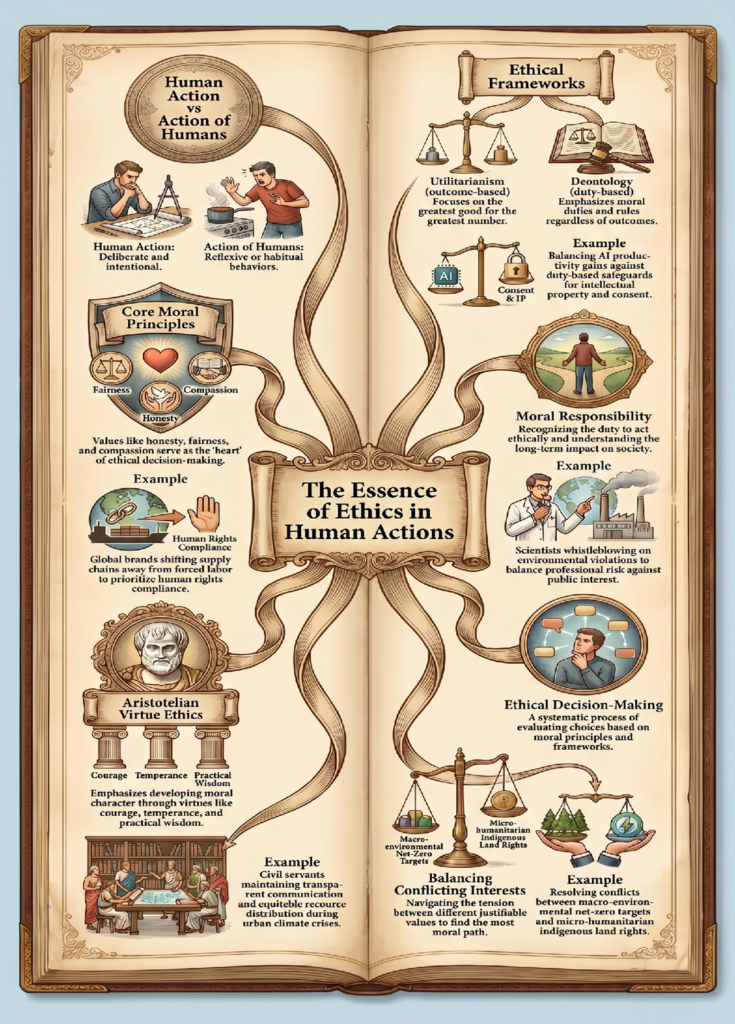
Human Action vs Action of Humans
● Human Action: Refers to deliberate, intentional acts carried out by individuals with conscious thought and decision-making. It involves a purposeful approach to achieving specific goals or objectives. It is the primary domain subjected to ethical evaluation.
● Action of Humans: Encompasses all types of behavior performed by people, whether intentional or automatic. It includes actions driven by habit, reflexes, or biological external stimuli.
Essence of Ethics
Ethics is fundamentally about establishing a framework for moral behaviour that aligns with the values necessary for societal well-being.
Core Moral Principles and Values
At the heart of ethics are values such as honesty, fairness, and compassion which guide individuals in making morally sound decisions.
Example:
Corporate Supply Chain Ethics: Leading global tech conglomerates and apparel brands pulling operations or shifting supply chains away from regions utilizing forced labor or exploiting child workers in cobalt mines (such as the Democratic Republic of Congo). Prioritizing human rights compliance over cheap manufacturing costs demonstrates a commitment to ethical sourcing over pure profitability.
Aristotelian Virtue Ethics
It emphasizes developing moral character through virtues like courage, temperance, and practical wisdom.
Example:
Administrative Leadership in Crisis: Municipal commissioners and civil servants managing severe climate-induced urban crises, such as extreme heatwaves or flash floods. Officers demonstrate courage and temperance by maintaining on-field deployment, ensuring equitable resource distribution, and using transparent communication to manage public distress.



Distinguishing Right from Wrong
Ethical frameworks such as utilitarianism, deontology, and virtue ethics offer different analytical approaches to evaluating complex moral choices.
Example:
Ethical Governance of Generative AI: The deployment of advanced generative artificial intelligence and autonomous content generation systems. A utilitarian approach supports rapid deployment to boost productivity and economic efficiency, whereas a deontological (duty-based) approach objects to its use without strict safeguards due to systematic issues regarding intellectual property theft, deepfakes, and the violation of structural data consent.
Moral Responsibility
Moral responsibility involves recognizing the duty to act ethically and completely understanding the long-term impact of one’s actions on society.
Example:
Big Tech and Algorithmic Accountability: Executive whistleblowers and ethical technology boards testifying before legislative panels regarding the harmful psychological impacts of algorithmic engagement loops on the mental health of minors. This highlights a growing global insistence on holding platforms morally accountable for systemic behavioral manipulation.
Ethical Decision-Making
Ethical decision-making involves evaluating deep dilemmas and choosing the most morally appropriate action using models like consequentialism and deontology.
Example:
Whistleblowing in Modern Governance: Healthcare professionals, data analysts, or environmental scientists leaking concealed institutional reports regarding severe environmental violations or public health figures. They actively balance their immediate personal and professional risks against the greater public interest of bringing truth to light.
Balancing Conflicting Interests
Ethical dilemmas often involve balancing conflicting interests and values to determine the most justifiable actions.
Example:
Green Energy Transition vs Indigenous Displacement: The development of massive mega-solar fields or lithium extraction mines in ecologically sensitive habitats. This creates a direct conflict between macro-environmental conservation (achieving global net-zero targets) and micro-humanitarian ethics (protecting indigenous land rights and local biodiversity).
Previous Year Questions
Q. The crisis of ethical values in modern times is traced to a narrow perception of the good life. Discuss.
Practice Questions
Question 1 “Ethics is what transforms human behaviour into conscious, responsible human action.” Discuss the role of ethical principles and moral reasoning in guiding human actions, with suitable examples. (150 words / 10 Marks)
Question 2
“In contemporary administrative setups, the ‘Action of Humans’ is increasingly being automated by algorithmic systems, yet the ultimate ‘Moral Responsibility’ of ‘Human Action’ cannot be abdicated by the civil servant.” Critically analyze this statement in the context of technological adoption in public service delivery. (250 words / 15 Marks)



 Ravi Raaz
 Hassan Khan
 Shadab Ali