
14. Discuss the different types of subsidies and supports provided by the Government of India to agricultural sector. Examine the related issues pertaining to Agreement on Agriculture of World Trade Organisation (WTO). (Answer in 250 words)
Introduction
Agricultural subsidies in India are aimed at protecting farmers from market risks, keeping essential inputs affordable, improving productivity and ensuring food security. However, some forms of government support are regulated under the WTO’s Agreement on Agriculture (AoA), creating a challenge for India to balance farmer welfare with international trade commitments.
1. Major Agricultural Subsidies and Supports
- Direct income support: PM-KISAN provides ₹6,000 annually to eligible farmer families, helping them meet cultivation and household expenses.
- Credit and insurance support: Interest subvention on Kisan Credit Cards (KCC) and premium support under PM Fasal Bima Yojana (PMFBY) reduce farmers’ financial risks.
- Input subsidies: Subsidised fertilisers, electricity and irrigation, along with support for farm machinery, help reduce the cost of cultivation.
- Price and market support: MSP and government procurement through FCI, along with buffer stocking and the PDS/NFSA, support farm incomes while ensuring food availability for consumers.
- Infrastructure support: Government investment in irrigation, storage, agricultural research, rural roads and extension services strengthens the productive capacity of agriculture.



2. WTO-Related Concerns
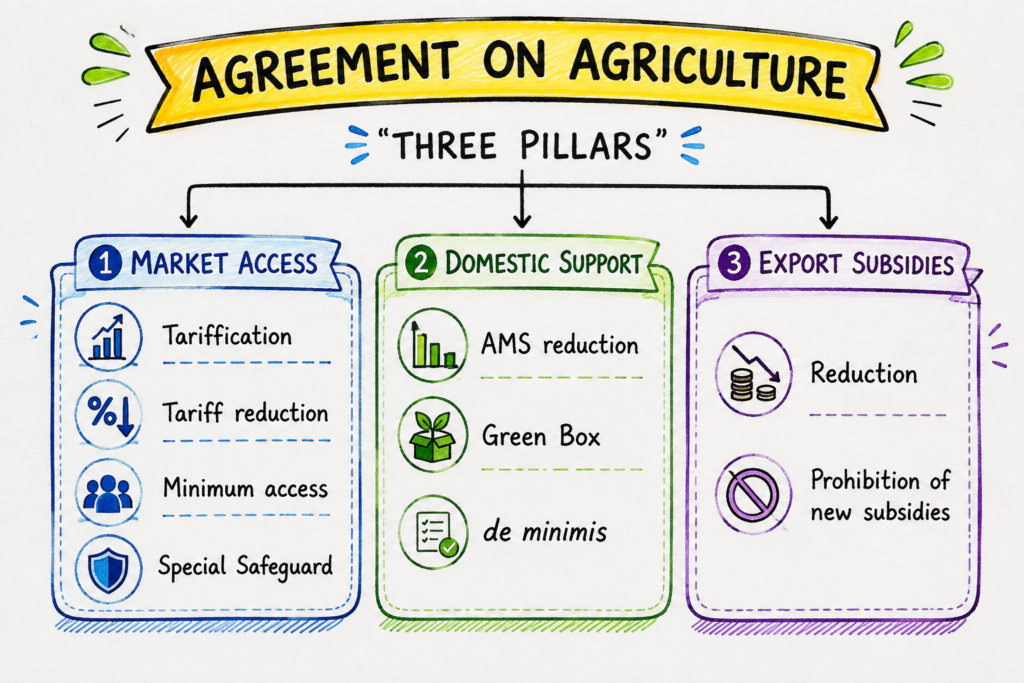
- De minimis limit: For developing countries, trade-distorting support covered by Current AMS is generally subject to a 10% de minimis limit. India faces concerns particularly over the calculation of support arising from MSP-based procurement.
- Outdated reference price: WTO calculations use the 1986–88 external reference price, which India argues does not reflect today’s prices and inflation, thereby potentially overstating its support.
- Public stockholding: India’s procurement of foodgrains at administered prices for food security and PDS distribution remains a major area of disagreement at the WTO.
- Peace Clause: The 2013 Bali Decision provides temporary protection to eligible developing countries from certain WTO disputes concerning public stockholding, but India continues to seek a permanent solution.
- Unequal policy space: Developed countries have historically provided substantial support through categories such as the Green Box, while developing countries seek greater flexibility to protect small and vulnerable farmers.
Conclusion
India needs to protect the interests of its small and marginal farmers and food security, while gradually moving towards less trade-distorting forms of support. A permanent solution on public stockholding, realistic reference prices, better agricultural infrastructure, R&D and direct income support can help India balance WTO commitments with domestic agricultural priorities.


 Ravi Raaz
 Hassan Khan
 Shadab Ali