
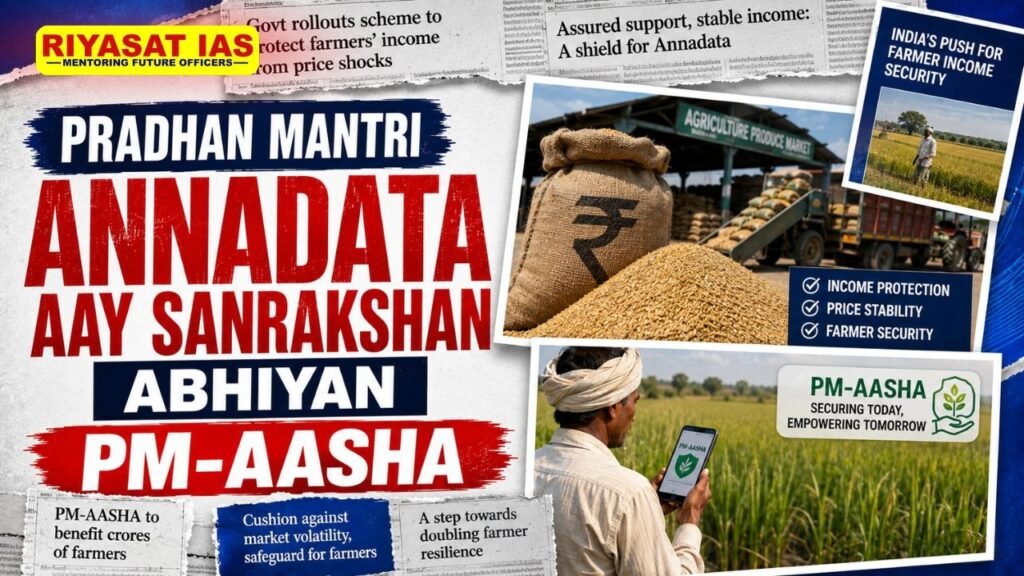
- PM-AASHA was launched in 2018 to ensure that farmers receive remunerative prices for their produce, particularly when market prices fall below the Minimum Support Price (MSP).
- Nodal Ministry: Ministry of Agriculture & Farmers Welfare.
- The scheme primarily focuses on pulses, oilseeds and copra.
- It seeks to strengthen the effectiveness of the MSP system beyond procurement of wheat and rice.
Key Components
1. Price Support Scheme (PSS)
- Government agencies procure notified pulses, oilseeds and copra at MSP.
- Procurement is undertaken when market prices fall below MSP, subject to applicable conditions.
- NAFED and NCCF are important procurement agencies.
2. Price Deficiency Payment Scheme (PDPS)
- Farmers are compensated for the difference between the MSP and the market/modal price.
- Unlike PSS, the government does not necessarily physically procure the produce.
- It is particularly relevant for oilseeds.
3. Price Stabilization Fund / Market Intervention
- Supports measures aimed at price stabilisation and protecting farmers from sharp price fluctuations.
- The broader framework has evolved through subsequent modifications of PM-AASHA.
4. Private Procurement & Stockist Scheme (PPSS)
- Allows private agencies to participate in procurement of notified oilseeds in selected areas.
- Intended to supplement government procurement capacity.



Why PM-AASHA Is Important
- MSP Protection: Provides a mechanism to protect farmers when market prices fall.
- Income Security: Helps reduce price-related income uncertainty.
- Crop Diversification: Greater support for pulses and oilseeds can encourage diversification away from cereal-centric farming.
- Import Dependence: Higher domestic production of pulses and oilseeds can help reduce dependence on imports.
- Consumer Interest: Better supply management can also contribute to price stability for consumers.
Prelims MCQ
Q. With reference to PM-AASHA, consider the following statements:
- It seeks to provide price protection to farmers.
- Price Support Scheme (PSS) involves procurement of notified crops at MSP.
- Price Deficiency Payment Scheme (PDPS) necessarily requires physical procurement of the produce by the government.
- Pulses and oilseeds are among the major crops covered under the scheme.
Which of the statements given above are correct?
(a) 1, 2 and 4 only
(b) 1 and 3 only
(c) 2 and 3 only
(d) 1, 2, 3 and 4
Answer: (a) 1, 2 and 4 only
Explanation: Under PDPS, farmers receive compensation for the price difference; physical procurement is not necessary.




 Ravi Raaz
 Hassan Khan
 Shadab Ali