
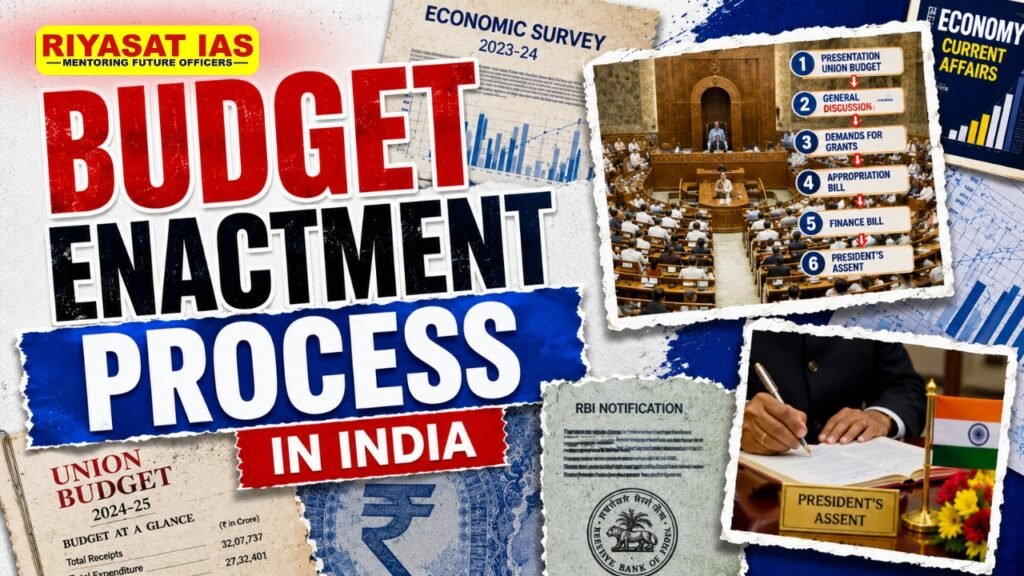
The Union Budget is not passed in one go. It goes through several stages in Parliament, where the government’s spending plans are discussed, examined and finally approved.
How Is the Union Budget Passed?
1. Presentation of the Budget
- The Union Finance Minister presents the Union Budget in the Lok Sabha along with the Budget Speech.
- The speech generally covers the state of the economy, the government’s priorities, spending plans and proposed tax changes.
- Since 2017, the Railway Budget has been merged with the General Budget.
- There is normally no voting or detailed discussion on the day of presentation.
2. General Discussion
- After the Budget is presented, MPs discuss its broader approach.
- The discussion covers issues such as economic growth, taxation, government spending and fiscal policy. At this stage, individual expenditure demands are not voted upon.
3. Examination by Parliamentary Committees
- The 24 Departmentally Related Standing Committees examine the Demands for Grants of different ministries.
- This gives Parliament an opportunity to look more closely at proposed allocations and the priorities of individual ministries.
4. Voting on Demands for Grants
The Lok Sabha votes on the expenditure demands of different ministries under Article 113.
The Rajya Sabha can discuss these demands but does not vote on them.
Cut Motions allow MPs to question or propose a reduction in government expenditure.
- Policy Cut: Proposes reducing the demand to Re. 1, expressing disapproval of the policy behind the expenditure.
- Economy Cut: Seeks to reduce the amount of expenditure.
- Token Cut: Proposes a small reduction, usually ₹100, to raise a particular issue.
Guillotine: If some demands remain undecided by the final allotted day, they are put to vote together so that the Budget process can be completed on time.
5. Appropriation Bill
Once the Lok Sabha approves the Demands for Grants, the government needs legal permission to withdraw money from the Consolidated Fund of India.



This is provided through the Appropriation Bill.
The Bill is treated as a Money Bill and, after the required parliamentary process and Presidential assent, allows the government to spend the approved amounts.
6. Finance Bill
The Finance Bill deals with the government’s taxation proposals announced in the Budget.
It gives legal effect to changes involving the imposition, removal or alteration of taxes.
Once it receives the required approval and Presidential assent, the proposed tax measures become law.
Types of Government Budgeting
Line-Item Budgeting: Looks at individual expenses such as salaries, equipment and administrative costs. It is useful for controlling expenditure but gives less information about results.
Performance Budgeting: Connects government spending with the work performed by a programme or department.
Zero-Based Budgeting: Requires programmes and expenditures to be reviewed and justified afresh, rather than automatically carrying forward previous allocations.
Outcome Budgeting: Looks at what government spending actually achieves, rather than only how much is spent. India introduced the Outcome Budget in 2005.
Gender Budgeting: Examines government spending from a gender perspective to ensure that policies and programmes adequately address women’s needs.
Union Budget 2026–27: Key Points
The figures provided in the source material highlight the following priorities:
- Fiscal deficit: Targeted at 4.3% of GDP
- Capital expenditure: Around ₹12.2 lakh crore
- Total expenditure: About ₹53.47 lakh crore
- Debt consolidation: The government aims to move towards a debt-to-GDP ratio of around 50% ±1% by 2030–31
The Budget also gives attention to manufacturing, MSMEs, semiconductors, infrastructure, transport and urban development.
Objectives of Government Budgeting
- Resource Allocation: Directing money towards sectors and programmes that need public support.
- Economic Stability: Using government spending and taxation to respond to economic slowdowns or inflation.
- Reducing Inequality: Using taxation and welfare programmes to support lower-income and vulnerable groups.
- Public Welfare: Funding healthcare, education, infrastructure and other essential services.
- Economic Growth: Supporting investment and productive activities that can strengthen the economy over the long term.
Challenges in Government Budgeting
- Uncertain Revenue: Actual tax collections may not always match the government’s estimates.
- Focus on Spending: Allocating funds does not necessarily mean that a programme will deliver the expected results.
- Subsidy Pressure: Large subsidy commitments can reduce the money available for other priorities.
- Year-End Spending: If a large amount of money is spent towards the end of the financial year, there can be concerns about the quality and efficiency of expenditure.
- Competing Priorities: The government has to balance immediate needs with longer-term goals such as infrastructure, climate action and economic growth.
Conclusion
The Budget enactment process allows Parliament to examine and approve the government’s financial plans. However, a good Budget is not just about getting approval—it is also about using public money wisely, achieving the intended results, maintaining fiscal discipline and ensuring accountability.
Frequently Asked Questions
Who presents the Union Budget?
The Union Finance Minister presents the Budget in the Lok Sabha.
Who votes on Demands for Grants?
The Lok Sabha votes on Demands for Grants. The Rajya Sabha can discuss them but cannot vote.
What is a Cut Motion?
A Cut Motion is a parliamentary device through which MPs can question or propose a reduction in a particular expenditure demand.
What is the Appropriation Bill?
It gives the government legal authority to withdraw money from the Consolidated Fund of India for approved expenditure.
What is the Finance Bill?
The Finance Bill gives legal effect to the government’s taxation proposals announced in the Union Budget.


 Ravi Raaz
 Hassan Khan
 Shadab Ali