
About
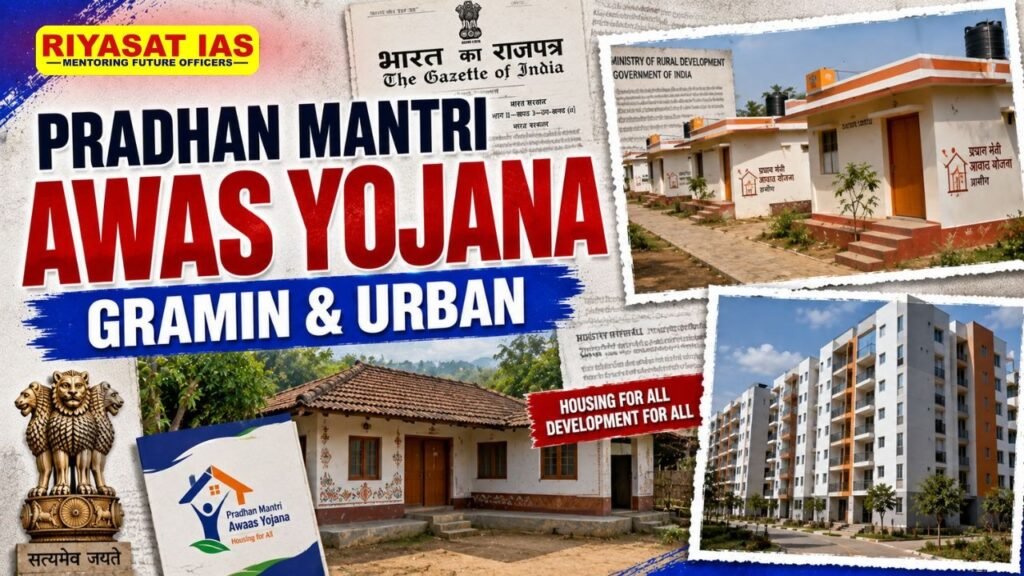
Pradhan Mantri Awas Yojana (PMAY) is the Government of India’s flagship affordable-housing programme aimed at achieving the vision of “Housing for All” by providing pucca houses with basic amenities to eligible households. It has two major components: PMAY-Gramin (PMAY-G) for rural areas and PMAY-Urban (PMAY-U) for urban areas. PMAY-U was launched in 2015, while PMAY-G was launched in 2016 after restructuring the earlier Indira Awaas Yojana.
PMAY-Gramin (PMAY-G)
Launch & Ministry
· PMAY-G was launched on 1 April 2016 by the Ministry of Rural Development (MoRD) by restructuring the erstwhile Indira Awaas Yojana.
· Its objective is to provide a pucca house with basic amenities to rural households that are houseless or living in inadequate housing.
Aim: The scheme aims to:
- Provide pucca houses with basic amenities to eligible rural households.
- Improve the quality of rural housing and living conditions.
- Promote women’s ownership/participation in housing assets.
- Converge housing with other basic services such as toilets, electricity, LPG, water and wage employment.
PMAY-G has now been extended with the broader target of 4.95 crore rural houses by March 2029.
Beneficiaries & Selection
Beneficiaries are identified primarily using housing deprivation and socio-economic criteria derived from SECC data, supplemented by the Awaas+ lists and verification through the Gram Sabha. Priority is given to households that are:
- Houseless or living in kutcha/dilapidated houses.
- From vulnerable and deprived groups.
- Belonging to SC/ST communities, subject to eligibility and priority criteria.
- Women-headed households and other vulnerable categories identified under the scheme.
Cost Sharing & Assistance
· The standard unit assistance is ₹1.20 lakh per house in plain areas and ₹1.30 lakh per house in North-Eastern and specified hilly areas, including Jammu & Kashmir and Ladakh.
· In addition, beneficiaries receive ₹12,000 for toilet construction through convergence with SBM-G and are entitled to the prescribed MGNREGS wage employment for house construction.
Funding Pattern: The Centre-State funding ratio is generally 60:40 for most States and 90:10 for North-Eastern and specified Himalayan States/UTs, while State Governments and UT Administrations serve as the primary implementing authorities at the ground level.
Current Status of PMAY-G
· As on 03.08.2026, against the total target of 4.18 crore houses allocated to the States/UTs under PMAY-G, 3.91 crore houses have been sanctioned, and 3.12 crore houses have been completed. The remaining 79 lakh sanctioned houses are under construction.
· The Union Cabinet has approved the proposal for the continuation of the PMAY-G during FY 2024-25 to 2028-29 for construction of 2 crore additional houses in the new phase of the scheme.
PMAY-Urban (PMAY-U)
Launch & Ministry
PMAY-U was launched on 25 June 2015 by the Ministry of Housing and Urban Affairs (MoHUA) to provide all-weather pucca houses with basic civic amenities to eligible urban households.
Aim: PMAY-U aims to:
- Provide affordable pucca housing to eligible urban households.
- Address housing shortages among EWS, LIG and other eligible income groups.
- Improve access to basic amenities such as water, electricity, kitchen and toilet.
- Promote women’s ownership of housing assets.
- Provide affordable housing options for urban migrants, homeless persons and economically weaker groups.



Beneficiaries & Selection
PMAY-U primarily targets eligible urban households belonging to economically weaker and low-income groups, subject to the conditions of the relevant vertical. The scheme is demand-driven. States/UTs and implementing agencies submit proposals based on identified eligible beneficiaries and housing demand. Under PMAY-U 2.0, eligible beneficiary families generally belong to:
- EWS: annual household income up to ₹3 lakh.
- LIG: up to ₹6 lakh.
- MIG: up to ₹9 lakh, particularly under the Interest Subsidy Scheme.
PMAY-U 1.0 to PMAY-U 2.0
· PMAY-U 1.0: It was extended to facilitate completion of already-sanctioned houses, while the Government launched PMAY-U 2.0 from 1 September 2024 based on lessons from the first phase.
· PMAY-U 2.0: It aims to support 1 crore additional eligible urban households over five years with an overall investment of ₹10 lakh crore, including ₹1.6 lakh crore of Central Assistance.
Four Verticals
· Beneficiary Led Construction (BLC): Eligible EWS families can receive assistance to construct a pucca house on their own land.
· Affordable Housing in Partnership (AHP): Affordable EWS housing is developed through partnerships involving public/private agencies.
· Affordable Rental Housing (ARH): Provides affordable rental housing for groups such as urban migrants, homeless persons, working women and industrial workers.
· Interest Subsidy Scheme (ISS): Provides interest subsidy on eligible housing loans for EWS, LIG and MIG beneficiaries.
Cost Sharing – PMAY-U 2.0
PMAY-U 2.0 is primarily a Centrally Sponsored Scheme, while the Interest Subsidy Scheme is a Central Sector Scheme. For eligible EWS houses, Central Assistance is:
- ₹2.25 lakh per house in specified Himalayan/North-Eastern States and UTs with legislature.
- ₹2.50 lakh per house in UTs without legislature.
- ₹1.50 lakh per house in other States.
The remaining financing is mobilised through the prescribed State/UT/ULB and beneficiary/institutional contributions, depending on the vertical.
Current Status of PMAY-U
· As of 13 July 2026, PMAY-U and PMAY-U 2.0 had 1.2768 crore houses sanctioned, 1.2102 crore houses grounded for construction, and 99.07 lakh houses completed and delivered.
· By August 2026, the Government reported that the programme had crossed the milestone of 1.25 crore houses sanctioned and more than 1 crore houses completed and delivered under PMAY-U and PMAY-U 2.0.
· Around 96% of houses under PMAY-U 2.0 have been allotted to women, strengthening women’s asset ownership and financial security.
Major Challenges
· Landlessness Landless rural households may not be able to construct houses even after being identified as beneficiaries. The Government itself has identified delay in allotment of land to landless beneficiaries as a cause of delays.
· Delayed Construction: PMAY-G reports identify several causes of delays, including:
o Beneficiary unwillingness.
o Permanent migration.
o Disputed succession after death of beneficiaries.
o Delay in land allotment.
o Elections.
o Non-availability of construction materials.
o Delayed fund release from State Treasury to State Nodal Accounts.
· Rising Construction Costs: The prescribed unit assistance may not always keep pace with local construction costs, inflation and regional variations.
· Difficult Geography: Hilly, tribal, remote and disaster-prone regions face higher costs and logistical difficulties.
· Urban Land Prices: In cities, high land prices and limited availability of affordable land make housing for EWS/LIG groups particularly difficult.
· Migrant and Rental Housing: Urban migrants often need affordable rental housing rather than ownership, making the ARH component important.
· Identification Errors: Targeting schemes based on deprivation and demand can face exclusion errors and inclusion errors, particularly among mobile, homeless and migrant populations.
· Housing Alone is Not Enough: A house without water, sanitation, electricity, roads, livelihood opportunities and social infrastructure may not deliver complete housing security.
Way Forward
· Move from “House” to “Housing Ecosystem”: PMAY should adopt an integrated housing approach by converging housing with water supply, sanitation, electricity, LPG, road connectivity and livelihood opportunities. PMAY-G already follows this convergence-based approach by linking housing with programmes such as SBM-G, MGNREGS, Jal Jeevan Mission and other government schemes.
· Address Rural Landlessness: States should establish time-bound mechanisms for identifying and allotting land to eligible landless households.
· Climate-Resilient Housing: Promote disaster-resistant, locally suitable and climate-responsive housing technologies, particularly in flood-, cyclone-, earthquake- and landslide-prone areas.
· Strengthen Affordable Rental Housing: In urban areas, PMAY-U 2.0’s ARH component should be expanded for migrants, workers, students, working women and homeless populations.
· Improve Monitoring: Geo-tagging, DBT, Aadhaar authentication, AI-based anomaly detection and social audits should be combined with independent field verification.
· Women’s Ownership: The strong focus on women’s ownership of houses should continue because housing assets can improve women’s economic security and bargaining power.
· Update Assistance with Costs: Housing assistance should periodically reflect regional construction costs, inflation and climate-resilient construction requirements.
Conclusion
PMAY represents a shift from housing as mere physical shelter to housing as an instrument of human development, dignity and social security. PMAY-G focuses on rural housing deprivation, while PMAY-U combines affordable ownership, partnership, rental housing and credit support in urban areas. The experience of the Housing for All by 2022 mission shows that the challenge is not merely constructing houses but ensuring that every eligible household receives a safe, affordable, resilient and well-connected home.
FAQs
1. What is the main objective of PMAY?
Ans: PMAY aims to provide pucca houses with basic amenities to eligible rural and urban households, thereby advancing the goal of Housing for All.
2. Which ministries implement PMAY-G and PMAY-U?
Ans: PMAY-G is implemented by the Ministry of Rural Development, while PMAY-U is implemented by the Ministry of Housing and Urban Affairs.
3. How are PMAY-G beneficiaries identified?
Ans: PMAY-G beneficiaries are identified using SECC-based deprivation criteria, Awaas+ data and Gram Sabha verification, subject to scheme guidelines.
4. What is the current target under PMAY-G?
Ans: The broader target is to achieve 4.95 crore rural houses by March 2029, including the additional 2 crore houses approved for 2024–25 to 2028–29.
5. What is PMAY-U 2.0?
Ans: PMAY-U 2.0 is the revamped urban housing mission launched from 1 September 2024 to support 1 crore additional eligible urban households over five years.
6. What are the four components of PMAY-U 2.0?
Ans: The four components are Beneficiary Led Construction (BLC), Affordable Housing in Partnership (AHP), Affordable Rental Housing (ARH) and Interest Subsidy Scheme (ISS).


 Ravi Raaz
 Hassan Khan
 Shadab Ali