
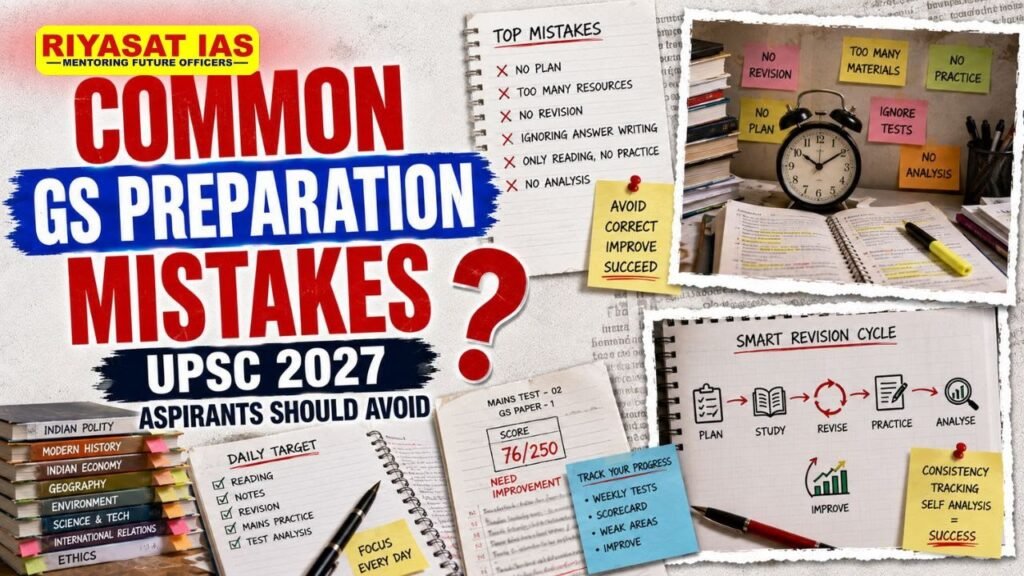
UPSC GS preparation for the 2027 cycle is being started by thousands of aspirants right now. Many of them will make the same identifiable mistakes — not because they are uninformed, but because these mistakes feel like good preparation decisions in the moment they are made. They only reveal their cost months later, when the preparation is difficult or impossible to correct.
This guide identifies nine of the most common and most costly GS preparation mistakes, explains why each feels right when it is made, and gives the specific correction that prevents each from compounding into a larger problem.
Mistake 1: Reading Multiple Primary Sources on the Same Subject Simultaneously
Why it feels right: ‘More books means more comprehensive coverage.’ Why it is wrong: multiple sources on the same GS subject read simultaneously produce broad familiarity without examination-level depth in any single source. An aspirant who has read Laxmikanth to Chapter 10 and Subhash Kashyap to Chapter 8 and DD Basu selectively has read extensively about Indian Polity without mastering any source at the precision that UPSC’s Polity questions require.
Correction: one primary source per GS subject, read completely, revised multiple times, practised with PYQs. A second source is added only if PYQ accuracy on the first source remains below 65% after two revision cycles — signalling that the first source has specific coverage gaps that a second source might fill. Not because ‘more is better’.
Mistake 2: Not Starting Current Affairs from Day 1
Why it feels right: ‘I’ll start current affairs once I have some static background — otherwise I won’t understand the context.’ Why it is wrong: the current affairs system’s value is compounding. An aspirant who starts in Month 7 arrives at Prelims with 5 months of organised current affairs; one who starts in Month 1 arrives with 12. The context understanding improves naturally as static coverage and current affairs run in parallel — and parallel running is precisely what builds the static-current affairs connections that Mains answers require.
Correction: begin the daily 45-minute current affairs session on Day 1 of preparation — four-part Mains-oriented notes from the beginning, paper-wise organisation from Week 2.
Mistake 3: Treating Mains and Prelims as Separate Sequential Stages
Why it feels right: ‘First I clear Prelims, then I prepare for Mains — otherwise I’m spreading myself too thin.’ Why it is wrong: Answer writing, Optional Subject development, Ethics case study practice, and Essay evaluation all require 6–9 months to reach competitive Mains standard. Beginning them after Prelims clearance gives 3–5 months — less than half the required development time. The sequential model structurally guarantees under-prepared Mains performance for most aspirants who follow it.
Correction: integrated preparation from Month 3 — answer writing in parallel with GS coverage, Optional protected daily slot from Month 4, Ethics practice from Month 5–6, Essay bimonthly from Month 4.
| Want to avoid these mistakes with a structured mentorship plan for 2027? → Apply for Riyasat IAS Mentorship |



Mistake 4: Changing Sources Midway Through Coverage
Why it feels right: ‘I heard that source X covers this topic better than what I’m using.’ Why it is wrong: changing primary sources mid-coverage discards the conceptual framework built in the first half and requires re-establishing it with the new source — producing repetition of already-covered material without the depth that multiple revision cycles of one source would have produced. The new source’s coverage of previously-covered topics is effectively wasted preparation time.
Correction: stay with the chosen primary source through completion. If the source has a specific coverage gap identified through PYQ practice (certain topics consistently produce wrong answers that the source does not address), supplement specifically with a targeted read of those topics from a secondary source — not by switching sources wholesale.
Mistake 5: Skipping Revision to Cover More New Material
Why it feels right: ‘I have so much to cover — I can’t afford to spend 40 minutes revising old material when I haven’t even finished the new.’ Why it is wrong: covering new material without revising old material compounds the forgetting curve across the entire preparation. By Month 8, the aspirant has covered everything once and retained 15% of the first three months at exam-reliable depth. The preparation is simultaneously broad and shallow — exactly the combination that UPSC’s depth-testing questions penalise.
Correction: revision is allocated before new coverage in the daily schedule, not as a residual if time remains. 40–60 minutes of daily revision is protected even on busy days; new coverage is reduced before revision is cut.
Mistake 6: Writing Answers Without Ever Getting External Evaluation
Why it feels right: ‘I’m writing 2 answers every day — surely I’m improving.’ Why it is wrong: writing without external evaluation reinforces existing habits — both strong ones and weak ones. The specific analytical and structural weaknesses that cost marks in GS Mains answers (demand misidentification, generic evidence, restatement conclusions) are structurally invisible from inside the writing. An aspirant who has written 300 answers over 12 months without external evaluation may have practised and solidified weak habits across all 300 of them.
Correction: two answers per week submitted for specific external evaluation from someone who reads them as an examiner would. Not model answer comparison — specific, written feedback on your sentences.
Mistake 7: Neglecting Optional Subject Until ‘After Prelims’
Why it feels right: ‘I need to clear Prelims first — Optional is for after that.’ Why it is wrong: Optional carries 500 marks and needs 18+ months of preparation to reach the analytical depth that competitive Optional scores require. Deferring Optional until after Prelims clearance leaves 3–5 months — insufficient for either paper to reach competitive standard. The Mains total that suffers from under-prepared Optional cannot be rescued by strong GS performance.
Correction: Optional selection finalised by Month 1; fixed daily Optional slot (1.5–2 hours) established by Month 3 and protected from GS encroachment across the entire preparation cycle.
Mistakes 8 and 9: Two Common Current Affairs Errors
| Mistake | Why It Feels Right | Actual Cost | Correction |
| Reading multiple current affairs sources daily to ensure comprehensive coverage | ‘More sources = more comprehensive’ | 3 sources producing 2.5 hours of reading creates exhaustion, poor note quality, and zero time for the note-making that makes reading useful | One quality source, 30–35 minutes, hard stop; 15–20 minutes four-part note-making on significant developments |
| Noting current affairs as headlines only — no GS connection | ‘I’ll remember what this means when the time comes’ | 12 months of headline notes produce familiarity with events but no organised, tagged, revision-ready evidence usable in GS Mains answers | Four-part note format from Day 1: event + GS paper tag + static connection + analytical GS angle; the analytical angle is the entire value-add of the current affairs preparation |
Frequently Asked Questions
Which of these nine mistakes is most difficult to correct once it has been made?
Mistake 3 (sequential Prelims-then-Mains preparation) and Mistake 6 (12 months of unreviewed answer writing) are the hardest to correct. Sequential preparation is a structural choice that cannot be recovered within the remaining Mains preparation window — 3 months cannot substitute for 8–9 months of answer writing development. Unreviewed answer writing entrenches habits that take longer to correct than they would have taken to build correctly from the beginning. Both are most efficiently prevented, not corrected.
How early in UPSC 2027 preparation should I take stock of whether I am making any of these mistakes?
After Month 2 of preparation — early enough that significant habits have not yet been established, but late enough that you have actually experienced your own preparation patterns and can assess honestly. A Month 2 honest audit of these nine mistakes produces a course correction that can reshape the remaining 10 months of preparation. A Month 8 audit produces a correction that has significantly less time to compound.
Can mentorship prevent all nine of these mistakes or only address them after they are made?
Both — but prevention is significantly more efficient. A mentorship that begins in Month 1 establishes the correct preparation architecture before any of these mistakes can form into habits. A mentorship that begins in Month 6 identifies the mistakes that have been made and produces corrections — but the corrections must overcome already-established habits, which takes longer. This is the core argument for beginning mentorship at the start of the 2027 preparation cycle rather than waiting until problems are visible.
Conclusion
Nine common GS preparation mistakes consistently cost UPSC 2027 aspirants months of preparation quality: multiple simultaneous sources, delayed current affairs, sequential Prelims-Mains preparation, source-switching mid-coverage, revision skipped for new coverage, unreviewed answer writing, deferred Optional, two current affairs format errors. Each feels like a reasonable preparation decision in the moment it is made. Each reveals its cost months later — when habits are entrenched, time is limited, and correction is possible but expensive. Identifying which of these apply to your current preparation — and making the specific correction now — is the highest-return preparation action available before these mistakes compound into the examination.
| Riyasat IAS Mentorship — Personal Guidance for UPSC CSE Direct mentorship from Riyasat Ali Sir │ Hindi & English Medium │ 100% Online — Apply Now |


 Ravi Raaz
 Hassan Khan
 Shadab Ali