
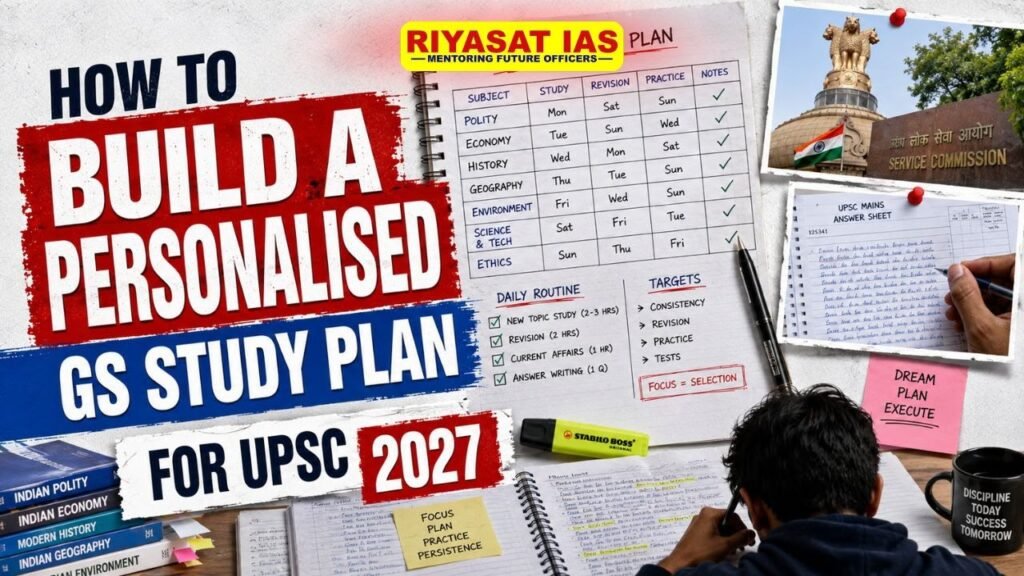
A generic UPSC GS study plan — the same schedule and source framework applied to every aspirant regardless of background, available hours, Optional Subject, or medium — is better than no plan. But it consistently under-serves individual aspirants in specific, predictable ways: the engineer follows a plan calibrated for a Social Sciences graduate and over-reads in subjects their academic background already covers; the Hindi medium aspirant follows an English-medium plan with translated sources; the working professional attempts a full-time aspirant’s daily hour commitment and fails to sustain it.
A personalised GS study plan for UPSC 2027 is built from a diagnostic of the specific aspirant’s situation and adjusted as that situation evolves. This guide walks you through exactly how to build one.
Step 1: The Diagnostic — Four Questions That Define Your Plan
Before any source is opened or any schedule is committed to, four diagnostic questions must be answered honestly. The answers to these four questions produce a preparation profile that makes the subsequent planning decisions specific rather than generic:
| Diagnostic Question | Why It Matters | How It Changes the Plan |
| What is your academic background in relation to the GS syllabus? | Social Sciences graduates have significant overlap with GS I and GS II; Engineering graduates have overlap with GS III Science and Technology but gaps in History and Society; Economics graduates have GS III Economy depth but need GS I and II coverage | Background-matched subjects receive lighter primary reference reading (sometimes NCERT + capsule sufficient); unfamiliar subjects receive full primary reference depth + additional PYQ practice time |
| How many daily hours are genuinely available for preparation? | A working professional with 5 hours is building a different plan from a full-time aspirant with 9. The honest answer matters because a plan that requires 9 hours will fail in Week 3 for a 5-hour aspirant — with worse consequences than a correctly calibrated 5-hour plan | Source reading rate, phase lengths, and the number of subjects covered per week are all calibrated to actual available hours, not ideal available hours |
| Hindi or English medium? | Source framework, answer writing register, current affairs approach, and revision format differ natively between the two media | Hindi medium aspirants receive a native Hindi source framework verified against UPSC’s own Hindi papers; English medium aspirants receive the primary reference framework calibrated to English-medium depth requirements |
| What Optional Subject has been selected, and when? | Optional selection in Month 1 allows 18+ months of preparation by Mains 2027; selection in Month 6 allows 12 months; later selection creates significant Optional time pressure | GS daily schedule must protect an inviolable Optional slot proportional to the time remaining; the earlier the selection, the more integrated Optional development can be with GS coverage |
Step 2: The Source Framework — One Primary Source Per GS Subject
A personalised GS study plan specifies one primary reference per GS subject — calibrated to the aspirant’s background, available hours, and PYQ frequency requirements — not a comprehensive list of every credible source available. The one-source discipline is the single most important anti-information-overload protection in GS preparation.
| GS Subject | Primary Reference (English Medium) | Reading Rate (Full-Time / 5-Hour) | Background Adjustment |
| Indian Polity | Laxmikanth (Indian Polity) — complete | 3–4 chapters per week / 2 chapters per week | Political Science graduates: 40% faster coverage; Engineering graduates: standard pace with more PYQ practice |
| Modern History | Spectrum (A Brief History of Modern India) — complete | 4 chapters per week / 2.5 chapters per week | History graduates: selective depth reading; non-History backgrounds: full pace |
| Indian Economy | Ramesh Singh (Indian Economy) — prioritise Agriculture, Banking, Fiscal Policy, Infrastructure chapters | 3 chapters per week / 1.5 chapters per week | Economics graduates: skip introductory chapters; Engineering graduates: full pace |
| Geography | Class 11 NCERT (Fundamentals of Physical Geography) + Majid Husain selectively | 2 NCERT chapters per week / 1 chapter per week | Geography graduates: capsule-build from existing knowledge; others: full pace |
| Environment | Shankar IAS (Environment) — complete | 3 chapters per week / 2 chapters per week | All backgrounds: standard pace; supplement with current species in news |
| Art and Culture / Ancient/Medieval History | Old NCERT Class 11 Ancient India selectively + Spectrum sections | 2 topics per week / 1 topic per week | History graduates: selective; others: high-frequency PYQ topics only |
| Want a personalised source framework and weekly schedule built by Riyasat Ali Sir? → Apply for Riyasat IAS Mentorship |



Step 3: The Weekly Schedule — Protecting Non-Negotiable Activities
A personalised GS study plan for UPSC 2027 must protect four non-negotiable daily activities regardless of how the remaining time is allocated:
- Current affairs (45–60 minutes daily): four-part Mains-oriented note-making from Day 1; no exceptions for ‘busy days’
- Optional Subject (1.5–2 hours daily): first-priority fixed slot; allocated before GS reading begins, not as leftover time
- Answer writing (1 answer daily from Month 3, 2–3 daily from Month 5): timed, on covered topics, submitted for evaluation twice per week
- Revision (40–60 minutes daily): running Cycle 1 on yesterday’s topic, Cycle 2 on last week’s topic, Cycle 3–4 on capsules
Everything else in the daily schedule — primary source reading, PYQ practice, mock test review — is distributed across remaining hours after these four are protected. The plan that protects these four consistently across 12 months produces competitive preparation; the plan that attempts them all and consistently abandons them under pressure does not.
Step 4: Monthly Recalibration — Adjusting the Plan to the Evidence
A personalised GS study plan is not a fixed document. It is a living schedule that is adjusted monthly based on what the preparation data shows. The monthly recalibration checks four things:
- Mock test performance: which subjects are below the expected accuracy level? Redirect 20–30% of the following month’s reading time toward those subjects specifically
- Coverage progress: is the source reading plan on track for the intended phase completion? If not, which lower-frequency topics can be deferred to allow higher-frequency topic depth?
- Answer writing quality: are the answers submitted for evaluation showing improvement in the targeted dimension? If not, change the correction approach before adding more answer volume
- Optional status: is the Optional daily slot being consistently maintained, or has GS consistently crowded it out? If crowded out, restructure the GS reading to be more selective to protect Optional
Frequently Asked Questions
How long does building a personalised GS study plan take?
The diagnostic (answering the four questions honestly) takes 30–45 minutes of genuine reflection. The source framework selection takes 1–2 hours of PYQ analysis to validate the chosen sources against what UPSC actually tests. The schedule itself takes 30 minutes to build once the source reading rates and non-negotiable activities are established. The total investment — about 3–4 hours — is recovered within the first month of preparation through the efficiency gains of a calibrated plan over a generic one.
Should I follow a preparation plan from a topper or a successful aspirant?
Use it as an input to your own plan, not as a template to follow directly. A topper’s preparation plan was built for their background, their hours, and their medium. The Polity reading rate that worked for someone with a Political Science background will feel fast if you have an Engineering background. The insights about what worked — which sources, which revision frequency, which answer writing volume — are valuable; the specific schedule may need significant personalisation to serve your situation.
What if my preparation plan consistently falls behind — should I extend the phase or compress future phases?
Neither — diagnose first. Consistent falling behind almost always indicates that the plan is calibrated to aspirational rather than actual available hours, or that one of the non-negotiable activities is taking longer than planned. The correct response is to reduce the scope (fewer subjects per week, more depth per subject) rather than extending the timeline or compressing future phases. A reduced-scope plan maintained consistently produces better preparation than an ambitious plan consistently missed.
Conclusion
A personalised GS study plan for UPSC 2027 is built from four diagnostic inputs (academic background, available hours, medium, Optional status), a one-source-per-subject framework calibrated to PYQ requirements and individual background, a weekly schedule that protects four non-negotiable activities before everything else, and a monthly recalibration discipline that adjusts the plan to what the preparation data shows. This four-element architecture consistently produces more examination-ready preparation than any generic plan applied uniformly — because it responds to the specific aspirant’s situation rather than to an average of all aspirants’ situations.
| Riyasat IAS Mentorship — Personal Guidance for UPSC CSE Direct mentorship from Riyasat Ali Sir │ Hindi & English Medium │ 100% Online — Apply Now |


 Ravi Raaz
 Hassan Khan
 Shadab Ali