
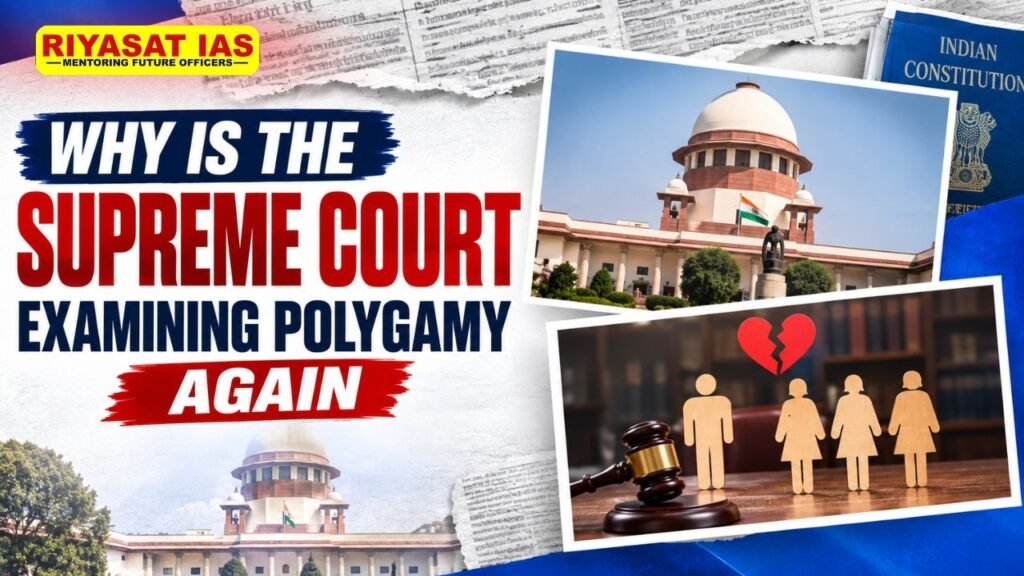
GS-II: Polity | Judiciary | Personal Laws | Gender Justice | Fundamental Rights
Context
- Supreme Court: The constitutional validity of polygamy among Muslim men is once again before the Supreme Court.
- Centre’s response: The Court has sought the Centre’s response and asked it to consider legislative steps to abolish polygamy for all citizens, irrespective of religion.
- Petitioners: Five activists have challenged the constitutional status of polygamy and sought to treat it as a criminal offence.
- Section 82, BNS: It provides punishment of up to seven years for marrying another person during the subsistence of an existing marriage, but applies to non-Muslims.
- Core issue: The debate concerns the balance between personal laws, gender equality and constitutional rights.
What Are the Petitioners Seeking?
- Constitutional validity: Challenge to Section 2 of the Muslim Personal Law (Shariat) Application Act, 1937, which permits polygamy.
- Fundamental rights: They argue that the provision violates Articles 14, 15 and 16, which provide equality to citizens irrespective of religion or gender.
- Codification: They seek steps towards the codification of Muslim Personal Law so that its provisions conform to constitutional principles of gender equality.
- Marriage registration: They seek compulsory registration of Muslim marriages and divorces with State authorities.
- Protection of first family: Registration would help prevent a second or subsequent marriage while an existing marriage continues.
- Matrimonial home: If a subsequent marriage occurs, the first wife and children should have the first and lasting right to the matrimonial home.
- Draft legislation: They seek directions to the Law Commission of India or the Union government to prepare a draft for codification of Muslim Personal Law concerning marriage, divorce and succession in line with constitutional principles.



Connection with the Triple Talaq Case
- Shayara Bano case: Two of the petitioners had earlier approached the Supreme Court seeking prohibition of instant triple talaq.
- 2017 judgment: The Supreme Court invalidated instant triple talaq in August 2017.
- Polygamy and nikah halala: The Court had then refrained from giving its verdict on these practices.
- 2019 legislation: Following the judgment, the Centre enacted the Muslim Women (Protection of Rights on Marriage) Act, 2019.
- Criminalisation: The Act made instant triple talaq a punishable offence.
What Has the Court Ruled Before?
- Sarla Mudgal case (1995): The Supreme Court held that a Hindu man with a subsisting marriage cannot convert to Islam merely to marry for a second time.
- Legal position: A second marriage after conversion to Islam without dissolving the first marriage was held void.
- Lily Thomas v. Union of India (2000): The Court reiterated the Sarla Mudgal position.
- Feigned conversion: A second marriage after conversion to Islam undertaken merely to evade the existing marriage was held illegal and punishable under Section 494 of the IPC.
Core Constitutional Debate
- Equality: Whether personal-law provisions permitting polygamy can withstand the requirements of constitutional equality.
- Gender justice: Whether polygamy creates unequal consequences for women within marriage.
- Personal law: The issue also raises questions regarding the relationship between religious personal laws and constitutional principles.
- Legislative role: The petitioners seek legislative intervention to bring personal-law provisions relating to marriage, divorce and succession in line with gender equality.
Conclusion
The renewed challenge to polygamy brings into focus the relationship between personal laws and constitutional guarantees of equality. The petitioners seek legal and institutional measures to ensure that marriage, divorce and succession under Muslim Personal Law are aligned with constitutional principles of gender equality, while earlier Supreme Court judgments provide an important judicial background to the issue.
UPSC Mains Practice Question
Q. “The debate over polygamy highlights the tension between personal laws and constitutional principles of gender equality.” Discuss in the light of the recent Supreme Court proceedings and earlier judicial interventions.




 Ravi Raaz
 Hassan Khan
 Shadab Ali