
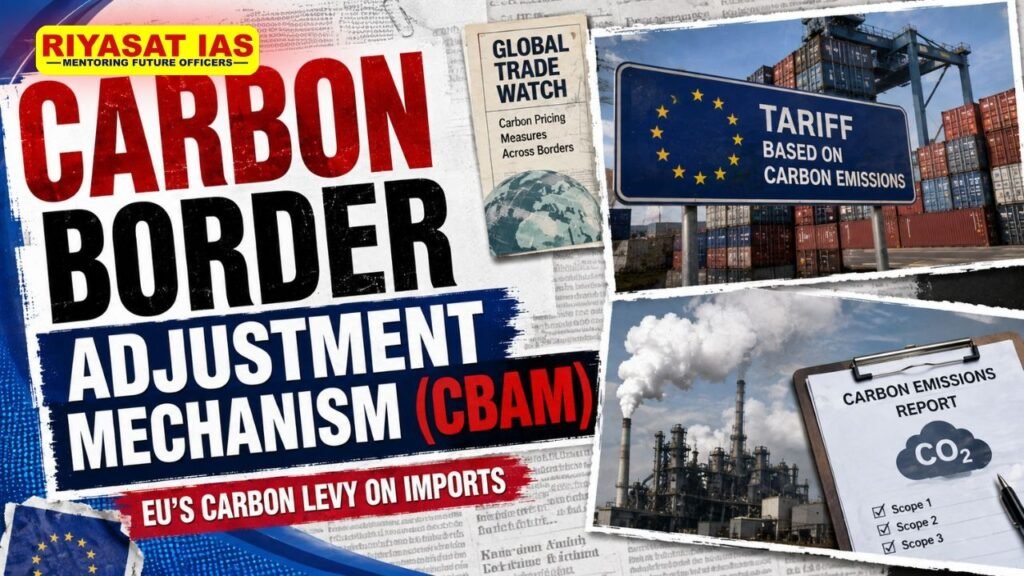
- Meaning: CBAM is a carbon-pricing mechanism on certain carbon-intensive imports entering a country/region.
- Main objective: To prevent carbon leakage — shifting production to countries with weaker climate regulations.
- EU-CBAM: The European Union has introduced CBAM as part of its climate policy.
- Definitive regime: The EU’s CBAM entered its definitive phase from 1 January 2026.
- Initial sectors: It covers cement, iron and steel, aluminium, fertilisers, electricity and hydrogen.
- Carbon cost: Importers are required to account for the embedded carbon emissions in covered products.
- Link with EU ETS: CBAM is linked to the EU’s Emissions Trading System (EU ETS) and seeks to ensure that imported goods face a carbon cost comparable to EU-produced goods.
- Developing countries: Developing economies have raised concerns that CBAM could increase the cost of their exports to the EU.
- India: Indian exporters, particularly in steel, aluminium and other carbon-intensive sectors, may face additional costs.
- BRICS concern: BRICS countries have criticised the EU’s carbon border measure as “punitive” and “unilateral”, arguing that climate measures should not become disguised trade barriers.
- Climate justice: The issue is linked to Common but Differentiated Responsibilities and Respective Capabilities (CBDR-RC).
- Carbon leakage:
Carbon leakage = production shifts from countries with strict climate policies to countries with weaker environmental regulations, potentially increasing global emissions.



Prelims Question — English
Q. With reference to Carbon Border Adjustment Mechanism (CBAM), consider the following statements:
- It seeks to address the problem of carbon leakage.
- The EU-CBAM imposes a carbon-related cost on certain carbon-intensive imports.
- CBAM is completely unrelated to the EU Emissions Trading System.
Which of the statements given above is/are correct?
A. 1 only
B. 1 and 2 only
C. 2 and 3 only
D. 1, 2 and 3
Answer: B. 1 and 2 only
Explanation: CBAM aims to prevent carbon leakage and puts a carbon-related cost on specified imports. It is closely linked to the EU Emissions Trading System (EU ETS), so statement 3 is incorrect.





 Ravi Raaz
 Hassan Khan
 Shadab Ali