
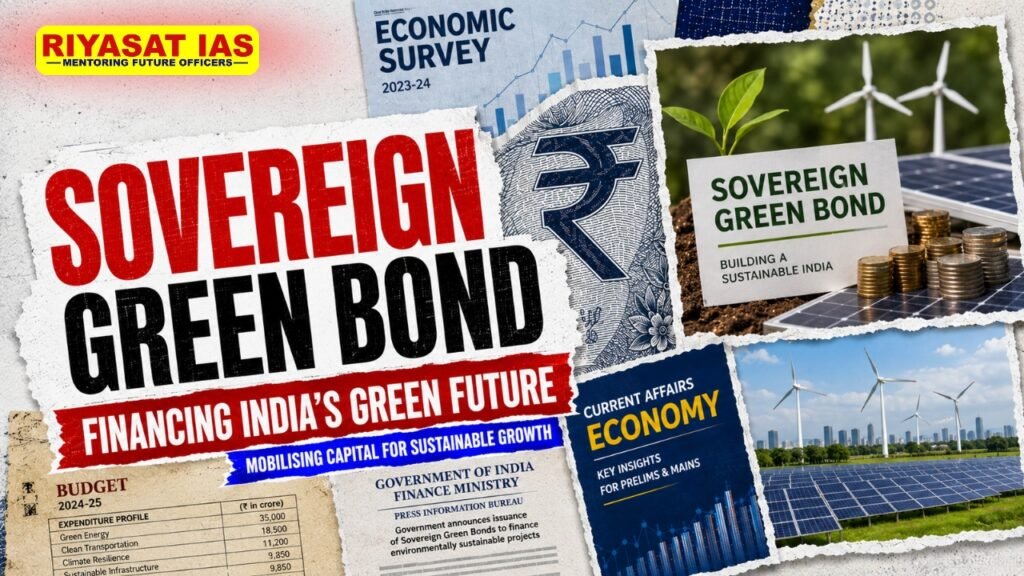
Sovereign Green Bonds, which are issued by the government, are intended to raise money for projects that improve the climate or the environment. The Indian government issues them as part of its regular borrowing program, but the proceeds are exclusively available to qualifying green projects.
India announced its plan to sell Sovereign Green Bonds in the Union Budget 2022–2023. The first issue was made in January 2023. These bonds are important because they connect public financing with India’s climate obligations and assist in raising money for the green transformation.
Meaning
In contrast to a traditional government bond, a green bond’s earnings must be allocated to environmental or climate change-related projects.
India’s Sovereign Green Bond Framework was released in 2022. It lays up rules for project selection, earnings use, evaluation, reporting, and supervision.
Project categories that qualify include:
· Clean mobility
· energy efficiency
· and renewable energy
· Green buildings
· sustainable water and waste management
· pollution prevention and control
· climate adaptation
· and sustainable management of living natural resources
The proceeds cannot be used for some projects, such as those based on fossil fuels, nuclear power, alcohol, weapons, tobacco, or large hydropower projects beyond a certain threshold.
Issuance and Features
Through the Reserve Bank of India, the Indian government issues Sovereign Green Bonds. They have sovereign support because they are a component of government securities.
India’s first Sovereign Green Bonds were issued in two maturities:
- 5-year green bonds
- 10-year green bonds



The potential for a greenium is a crucial aspect of green bonds. Because the bond revenues assist green projects, investors may be willing to accept a somewhat lower yield. If investor demand is high, this could lower borrowing costs for the government.
Greenium is not assured, though. The framework’s credibility, market conditions, liquidity, and investor appetite all play a role.
Significance for India
Sovereign Green Bonds are important because India needs large-scale finance for its climate and energy transition.
India has committed to major climate goals, including:
- achieving 500 GW non-fossil fuel capacity
- reducing emissions intensity of GDP
- increasing renewable energy share
- moving towards net zero by 2070
These objectives necessitate significant investments in energy efficiency, grid infrastructure, electric transportation, renewable energy, climate-resilient infrastructure, and adaptation initiatives.
Sovereign Green Bonds are beneficial in three ways.
1. They start by establishing a standard for the domestic green bond market in India.
2. Secondly, they draw in institutional investors who are interested in investments related to the environment, society, and governance.
3. Third, by associating borrowing with specific green expenditures, they improve transparency.
Concerns
· Ensuring that the funds are allocated to truly green initiatives is the primary difficulty. Inadequate project selection might result in “greenwashing,” which is the practice of labeling projects as green without really improving the climate.
· Reporting and monitoring are other issues. Investors require reliable information on the use of earnings and the environmental results attained.
· Additionally, there is the issue of market depth. Liquidity in sovereign green bonds has to increase for broader involvement in India’s still-developing green bond market.
· Lastly, India cannot finance its climate transition with green bonds alone. They are just one tool in a bigger climate finance plan that also has to incorporate state-level green financing, private investment, multilateral financing, budgetary support, and blended financing.
Conclusion
The Indian government issues Sovereign Green Bonds, a significant climate finance tool.
They promote India’s aspirations for sustainable infrastructure, climate adaption, and renewable energy while helping to collect money for green public initiatives.
Credible project selection, open reporting, quantifiable environmental impact, and increased investor involvement in India’s green financing sector are essential to their success.
Frequently Asked Questions (FAQs)
What are Sovereign Green Bonds?
Government bonds whose proceeds are used to finance eligible environmental and climate-related projects.
When did India issue its first Sovereign Green Bonds?
India issued its first Sovereign Green Bonds in January 2023, following the announcement in the Union Budget 2022–23.
What projects can Sovereign Green Bonds finance?
The proceeds can finance projects related to renewable energy, clean transportation, energy efficiency, green buildings, sustainable water and waste management, and climate adaptation.
What is the Greenium in Sovereign Green Bonds?
It refers to the possibility of investors accepting a slightly lower yield on green bonds because the funds are linked to environmental projects. However, a greenium is not guaranteed.
Why are Sovereign Green Bonds important for India?
They help mobilise funds for India’s energy transition, climate-resilient infrastructure and other environmental priorities, while also supporting the development of India’s green bond market.


 Ravi Raaz
 Hassan Khan
 Shadab Ali