
About
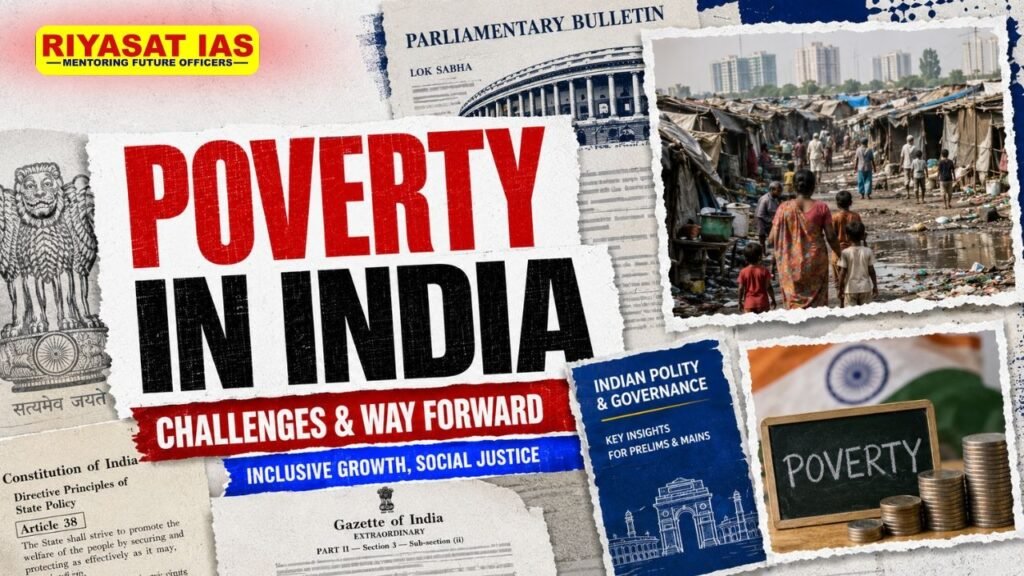
Poverty is not simply a shortage of income; it also reflects a person’s limited access to food, education, healthcare, housing, sanitation, employment and other basic opportunities. In India, poverty has therefore increasingly been studied through both monetary poverty and multidimensional poverty.
India has made considerable progress in reducing poverty over the last decade, but the problem has not disappeared. Regional disparities, informal employment, low household assets, malnutrition and unequal access to quality public services continue to keep many households vulnerable to falling back into poverty.
Definition of Poverty
World Bank
· The World Bank defines poverty in relation to the resources required to meet basic needs. Under its latest international poverty lines based on 2021 PPP, the extreme poverty line is $3.00 per person per day, while the poverty line relevant for lower-middle-income countries such as India is $4.20 per person per day.
Indian Government
· India’s official poverty measurement has historically been based on household consumption expenditure, with the poverty line representing the minimum level of consumption required to meet basic needs. The Tendulkar Committee methodology was used for the last official national poverty estimates, based on the 2011–12 consumption survey.
· The last official estimate put India’s poverty ratio at 21.9% in 2011–12. Since then, India has not released a new official national poverty ratio using the same methodology.
Current Status of Poverty in India
Recent World Bank estimates provide a much newer picture based on the 2023–24 Household Consumption Expenditure Survey (HCES).
· Decline in monetary poverty: According to the World Bank’s 2026 update, poverty measured using the $4.20 per person per day LMIC poverty line declined from 57.7% in 2011–12 to 16.1% in 2023–24.
· Extreme poverty: At the updated $3.00 per person per day international poverty line, India’s poverty rate declined from 27.1% in 2011–12 to 2.6% in 2023–24.
· People lifted out of poverty: The World Bank estimates that around 500 million people moved above the $4.20 poverty line between 2011–12 and 2023–24. However, around 233 million people remained below this line in 2023–24.
· Important caution: These estimates use the World Bank’s international poverty lines and methodology and therefore should not be directly equated with India’s official poverty ratio.
Multidimensional Poverty in India
Multidimensional poverty recognises that deprivation is not limited to income. NITI Aayog’s National Multidimensional Poverty Index (MPI) measures deprivation across health, education and standard of living, using 12 indicators.
· Decline in multidimensional poverty: NITI Aayog’s MPI shows that the proportion of multidimensionally poor people declined from 24.85% in 2015–16 to 14.96% in 2019–21.
· Latest estimate: NITI Aayog estimates that multidimensional poverty likely declined further to 11.28% in 2022–23. It estimates that around 24.8 crore people moved out of multidimensional poverty between 2013–14 and 2022–23.
· Major contributors: Improvement in housing, sanitation, drinking water, electricity, cooking fuel, financial inclusion and access to basic services has contributed to the reduction.
· Remaining concern: The multidimensional approach shows that even when household income improves, deprivation may continue in areas such as nutrition, education and healthcare.
State-wise Status of Multidimensional Poverty
There is considerable variation among States, which shows that India’s poverty problem is also a problem of regional inequality.
· Highest: According to NITI Aayog’s NFHS-5-based MPI, Bihar had the highest multidimensional poverty headcount ratio at 33.76%, followed by Jharkhand at 28.81% and Meghalaya at 27.79%.
· Lowest: Kerala recorded 0.55%, followed by Goa at 0.84% and Tamil Nadu at 2.20%.
· Large States: Uttar Pradesh also had a relatively high multidimensional poverty ratio of 22.93%, while Maharashtra recorded 7.81%.



· These differences indicate that human development, quality of public services, employment opportunities, urbanisation and governance capacity have a strong influence on poverty outcomes.
Distinct Characteristics of Poverty in India
· Rural and Informal Nature: A large section of the poor depends on agriculture, casual labour and informal employment, where income and employment are uncertain.
· Multidimensional Character: Poverty often appears together with malnutrition, poor housing, inadequate sanitation, limited education and weak healthcare access.
· Regional Concentration: Poverty is not evenly distributed. Some States and districts continue to have much higher levels of deprivation than the national average.
· Social Dimension: SCs, STs, certain minority communities, landless workers and other vulnerable groups can face a higher risk of persistent poverty.
· Gender Dimension: Women may experience poverty differently because of lower labour-force participation, unequal access to property and assets, unpaid care work and limited financial autonomy.
· Intergenerational Poverty: Poor nutrition, weak education and low household income can pass disadvantages from one generation to another.
· Vulnerability to Shocks: Even households above the poverty line can fall into poverty because of illness, unemployment, crop failure, disasters or sudden expenditure.
Factors Contributing to Poverty in India
· Unemployment and Underemployment: Lack of stable and productive employment remains one of the major causes of household poverty.
· Informal Employment: Informal workers often face low wages, irregular employment and limited social security.
· Low Agricultural Productivity: Small landholdings, dependence on monsoons, inadequate irrigation and price fluctuations affect rural incomes.
· Educational and Skill Gaps: Poor access to quality education and market-relevant skills limits people’s ability to obtain better-paying jobs.
· Health Expenditure: Illness can push vulnerable families into poverty because of medical expenses and loss of income.
· Social Inequalities: Caste, gender, tribal status and geographical location can influence access to land, education, employment and public services.
· Regional Imbalances: Uneven industrialisation and infrastructure development result in large differences in employment and income opportunities across States and districts.
· Low Asset Ownership: Households without land, productive assets or financial savings are more vulnerable to economic shocks.
Developmental Issues Arising from Poverty
· Human Capital Loss: Poverty can restrict access to quality education and healthcare, reducing the productive potential of the population.
· Malnutrition: Poor households are more vulnerable to inadequate nutrition, which affects physical growth, cognitive development and productivity.
· School Dropouts: Financial difficulties can push children into work or cause them to discontinue education.
· Poor Health Outcomes: Poverty can lead to delayed treatment, inadequate nutrition and greater exposure to health risks.
· Low Productivity: Poor health, limited skills and insecure employment reduce labour productivity and household income.
· Social Exclusion: Persistent poverty can reinforce discrimination and restrict participation in social, economic and political opportunities.
· Urban Problems: Rural poverty and limited livelihood opportunities can contribute to distress migration, informal settlements and pressure on urban infrastructure.
· Weak Demographic Dividend: If young people remain trapped in poverty, India may not be able to fully utilise its demographic advantage.
Major Government Programmes for Poverty Alleviation
MGNREGA
o MGNREGA provides livelihood security to rural households through guaranteed wage employment.
o It covers rural households whose adult members are willing to undertake unskilled manual work.
o The Act provides a legal guarantee of up to 100 days of wage employment per rural household in a financial year, while also creating rural assets.
National Food Security Act
o It aims to provide food and nutritional security to vulnerable sections of society.
o Eligible households receive subsidised foodgrains under the statutory food-security framework.
o It provides entitlement-based food support through the Targeted Public Distribution System, along with nutritional support for children and pregnant and lactating women.
PM Garib Kalyan Anna Yojana
o The scheme provides foodgrain support to protect vulnerable households from food insecurity.
o Foodgrains are provided to eligible beneficiaries under the National Food Security Act framework, strengthening food security for a large population.
Pradhan Mantri Awas Yojana
o PMAY seeks to improve access to pucca housing for poor and vulnerable households.
o It provides financial assistance for house construction or housing support, with separate components for rural and urban areas.
National Rural Livelihoods Mission
o DAY-NRLM seeks to reduce rural poverty by helping poor households develop sustainable livelihoods and access financial services.
o It organises rural women into Self-Help Groups, promotes savings and credit access and supports skills and livelihood activities.
PM Jan Dhan Yojana
o It aims to bring economically weaker sections into the formal financial system.
o It facilitates access to bank accounts, savings, remittances, credit, insurance and pension-related services, helping reduce financial exclusion.
PM Ujjwala Yojana
o It aims to improve access to clean cooking fuel among poor households.
o LPG connections are provided to eligible women from disadvantaged households, reducing dependence on traditional solid fuels and improving household health conditions.
Way Forward
· Focus on Productive Employment: Poverty reduction should increasingly depend on creating stable, productive and better-paid employment, rather than only expanding income-support programmes.
· Strengthen Human Capital: Greater investment in nutrition, early childhood development, education, healthcare and skills can prevent poverty from passing from one generation to the next.
· Target the Poorest Regions: States and districts with high poverty rates need location-specific strategies rather than a uniform national approach.
· Improve Social Protection: Schemes covering food, health, housing, pensions, employment and financial inclusion should be better integrated so that vulnerable families are protected from economic shocks.
· Make Welfare Outcome-Based: Government programmes should be evaluated through indicators such as income improvement, nutrition, learning outcomes, employment and reduction in deprivation, rather than expenditure or beneficiary numbers alone.
· Empower Women: Increasing women’s access to education, employment, property, credit and Self-Help Groups can have a strong impact on household poverty.
· Strengthen Rural Non-Farm Employment: Rural areas need more opportunities in MSMEs, food processing, services, manufacturing and digital work so that households are not dependent only on agriculture.
· Use Better Data: Regular consumption surveys and updated multidimensional data are necessary for evidence-based poverty measurement and policy design.
Conclusion
India has made substantial progress in reducing both monetary and multidimensional poverty. The World Bank’s latest estimates show a sharp decline in monetary poverty, while NITI Aayog’s MPI shows significant improvement in access to basic services and living conditions.
However, poverty cannot be considered solved simply because the number of people below a particular poverty line has fallen. The next stage requires attention to quality employment, nutrition, education, healthcare, social protection and regional inequalities. India’s goal should therefore be to move people not merely above the poverty line, but towards a secure and productive standard of living.
FAQs
1. What is poverty?
Ans: Poverty is a condition where people lack sufficient resources to meet their basic needs and live a dignified life.
2. What is India’s current poverty status?
Ans: World Bank estimates show that poverty at the $4.20/day line fell to 16.1% in 2023–24.
3. What is multidimensional poverty?
Ans: It measures poverty through health, education and standard of living, rather than income alone.
4. Which State has the highest multidimensional poverty?
Ans: Bihar has the highest rate, while Kerala has the lowest, according to NITI Aayog’s MPI.
5. What are the major causes of poverty in India?
Ans: Major causes include unemployment, low productivity, informal work, poor human capital, social inequality and regional disparities.


 Ravi Raaz
 Hassan Khan
 Shadab Ali