
About
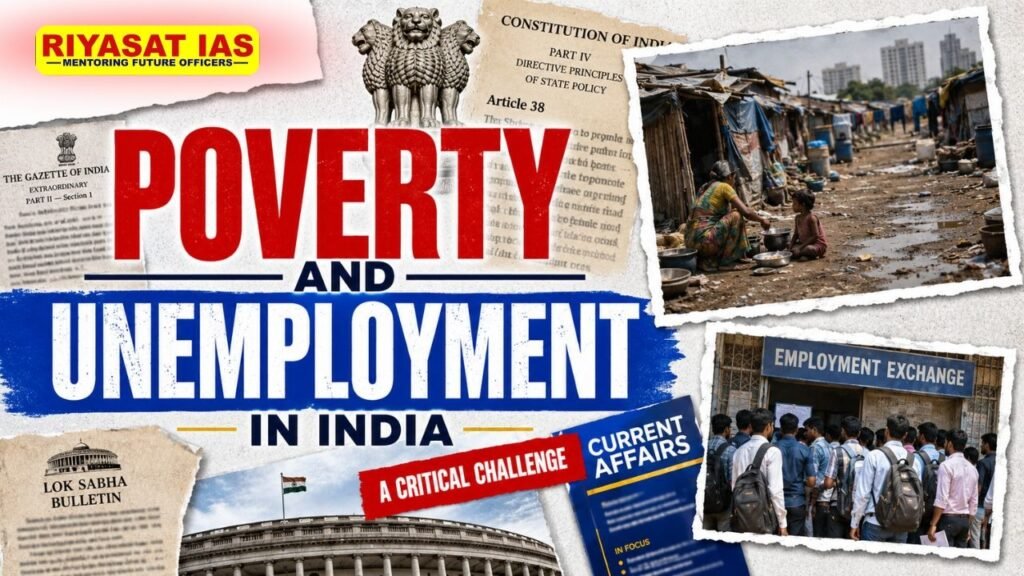
Poverty and unemployment are closely connected problems. Lack of adequate employment reduces household income and can push families below the poverty line, while poverty itself limits access to education, skills, nutrition and productive assets, making it harder to obtain better employment. This creates a cycle where low income leads to inadequate human capital, which reduces productivity and results in insecure employment, ultimately perpetuating poverty.
Relationship Between Poverty and Unemployment
· Income Loss: Unemployment directly reduces household income and can push vulnerable families into poverty.
· Low Human Capital: Poor households may not be able to afford quality education, skill training and healthcare, reducing their employability.
· Informal Employment: Poverty is not caused only by open unemployment. Low-paid, irregular and insecure employment can also keep working households in poverty.
· Intergenerational Cycle: Unemployment and low household income can force children to leave school early, increasing the possibility that poverty will continue into the next generation.
· Rural Vulnerability: Seasonal agricultural employment can produce periods of unemployment or underemployment, particularly among small and marginal farmers and agricultural labourers.
· Skill Mismatch: Even when jobs are available, people may remain unemployed because their skills do not match the requirements of emerging sectors.
Current Situation
India has experienced a decline in poverty alongside improvements in employment and household consumption, but the relationship between the two remains complex.
· The World Bank’s latest poverty estimates show that India’s poverty rate at the $4.20 per person per day lower-middle-income poverty line declined from 57.7% in 2011–12 to 16.1% in 2023–24.
· The Periodic Labour Force Survey (PLFS) 2023–24 reported India’s usual-status unemployment rate for persons aged 15 years and above at 3.2%, indicating an improvement in the overall unemployment rate.
· However, unemployment figures alone do not capture the problem of underemployment, low wages and informal work. A person may be employed but still remain economically vulnerable.
· Youth unemployment remains considerably higher than the overall unemployment rate, making the creation of productive jobs for India’s young population particularly important.
How Poverty Contributes to Unemployment
· Poor Education: Children from poor households may have limited access to quality schooling and are more likely to leave education early.
· Skill Deficit: Lack of resources for vocational training and higher education restricts access to skilled employment.
· Poor Health: Malnutrition and inadequate healthcare reduce physical and cognitive productivity.
· Limited Mobility: Poor households may not be able to afford relocation, transport or temporary accommodation required to access jobs elsewhere.
· Lack of Networks and Information: Economically disadvantaged workers may have limited access to information about formal jobs, apprenticeships and skill programmes.
· Low Access to Credit: Without affordable credit, poor households may find it difficult to start small businesses or invest in productive assets.



How Unemployment Contributes to Poverty
· Loss of Household Income: Prolonged unemployment reduces consumption and savings and increases dependence on family members or government support.
· Debt Dependence: Families may borrow to meet basic needs, increasing their financial vulnerability.
· Reduced Human Capital Investment: Income loss can lead households to cut expenditure on education, nutrition and healthcare.
· Distress Migration: Lack of local employment can force workers to migrate under uncertain conditions and often into informal employment.
· Social Vulnerability: Long-term unemployment can increase dependence, insecurity and exclusion, particularly among young people.
Poverty, Unemployment and Social Conflicts
Poverty and unemployment can create conditions in which economic grievances turn into social tensions, particularly when people perceive that opportunities and public resources are distributed unequally. However, poverty or unemployment alone does not automatically cause conflict; social, political, identity-based and governance factors also influence whether economic grievances become conflict.
Major Linkages
· Economic Deprivation: Persistent unemployment and poverty can create frustration among individuals and communities who feel excluded from economic opportunities.
· Competition for Resources: Scarcity of land, jobs, water, public employment and welfare benefits can intensify competition between groups.
· Youth Frustration: High unemployment among educated young people can generate dissatisfaction when educational qualifications do not translate into suitable employment.
· Regional Disparities: Unequal development between regions can create perceptions of neglect and contribute to regional or sub-regional tensions.
· Migration-Related Tensions: Large-scale migration in search of employment can sometimes create competition over jobs, housing and public services, producing tensions between migrants and local communities.
· Social Exclusion: Poverty among historically disadvantaged groups can combine with caste, tribal or ethnic discrimination and deepen social tensions.
· Crime and Extremism: Severe economic deprivation and lack of livelihood opportunities can increase vulnerability to criminal networks or extremist mobilisation, although poverty alone cannot be treated as the sole cause.
Developmental Consequences
· Lower Productivity: Persistent poverty and unemployment reduce the effective utilisation of India’s human resources.
· Weak Demographic Dividend: If young people remain unemployed or underemployed, India’s demographic advantage may not translate into higher economic growth.
· Social Inequality: Unequal access to employment and income can widen economic and social disparities.
· Human Development Loss: Poverty limits access to nutrition, healthcare and education, which further reduces future earning capacity.
· Political and Social Instability: Persistent economic exclusion can weaken social cohesion and increase dissatisfaction with institutions.
· Distress Migration: Lack of local opportunities can increase migration under insecure working and living conditions.
Government Efforts
MGNREGA
o To provide livelihood security to rural households by guaranteeing wage employment.
o It provides a legal guarantee of up to 100 days of unskilled manual employment to eligible rural households and creates community assets.
DAY-NRLM
o To reduce rural poverty by improving the livelihoods and financial inclusion of poor households.
o It organises rural women into Self-Help Groups and supports access to credit, skills, entrepreneurship and livelihood opportunities.
PMKVY
o To provide industry-relevant skill training and certification to improve employability.
o It supports skill development, certification and recognition of prior learning.
PMEGP
o To promote self-employment and micro-enterprises.
o It provides credit-linked subsidy support for eligible entrepreneurs establishing micro-enterprises in rural and urban areas.
PM SVANidhi
o To support street vendors who depend largely on informal employment.
o It provides working-capital loans and incentives for digital transactions, helping informal workers strengthen their livelihoods.
Skill India Mission
o To create a skilled workforce capable of meeting changing labour-market requirements.
o It promotes upskilling, reskilling, vocational training, apprenticeships and entrepreneurship.
Way Forward
· Create More Productive Jobs: India’s priority should shift from merely increasing employment numbers towards generating formal, productive and adequately paid employment.
· Strengthen Labour-Intensive Sectors: Greater employment potential exists in textiles, food processing, tourism, construction, footwear, logistics and other labour-intensive sectors.
· Improve Skill–Job Linkages: Skill programmes should be linked closely with local industries, apprenticeships and actual labour-market demand.
· Invest in Human Capital: Better school education, healthcare, nutrition and skill development can improve employability and break the poverty–unemployment cycle.
· Support MSMEs: Easier credit, infrastructure, technology and market access can help MSMEs become a major source of employment.
· Strengthen Social Security: Workers in informal employment need better access to health insurance, pensions, accident protection and income support.
· Promote Women’s Employment: Greater female labour-force participation can increase household income and reduce poverty while improving overall economic productivity.
· Develop Lagging Regions: Investment in infrastructure and industries in economically weaker districts can reduce regional disparities and distress migration.
· Improve Labour-Market Data: Better and more frequent data on employment, underemployment, wages and job quality is required for evidence-based policy.
Conclusion
Poverty and unemployment reinforce each other, but employment alone is not sufficient to eliminate poverty. India needs employment that is productive, adequately paid, secure and supported by social protection. Similarly, reducing poverty requires investment in education, health, nutrition, skills and assets so that people can participate meaningfully in the labour market.
FAQs
1. How are poverty and unemployment related?
Ans: Unemployment reduces household income, while poverty limits access to education, skills and healthcare, creating a cycle of deprivation.
2. Why does poverty contribute to unemployment?
Ans: Poor households often lack access to quality education, skill training, healthcare and productive assets, reducing employability.
3. How does unemployment deepen poverty?
Ans: Loss of income can reduce spending on food, education and healthcare and may push households into debt.
4. What is the major employment challenge in India?
Ans: Apart from unemployment, underemployment, informal work, low wages and skill mismatch remain major concerns.
5. How can India break the poverty–unemployment cycle?
Ans: India needs productive job creation, skill development, stronger MSMEs, human-capital investment and adequate social protection.


 Ravi Raaz
 Hassan Khan
 Shadab Ali