
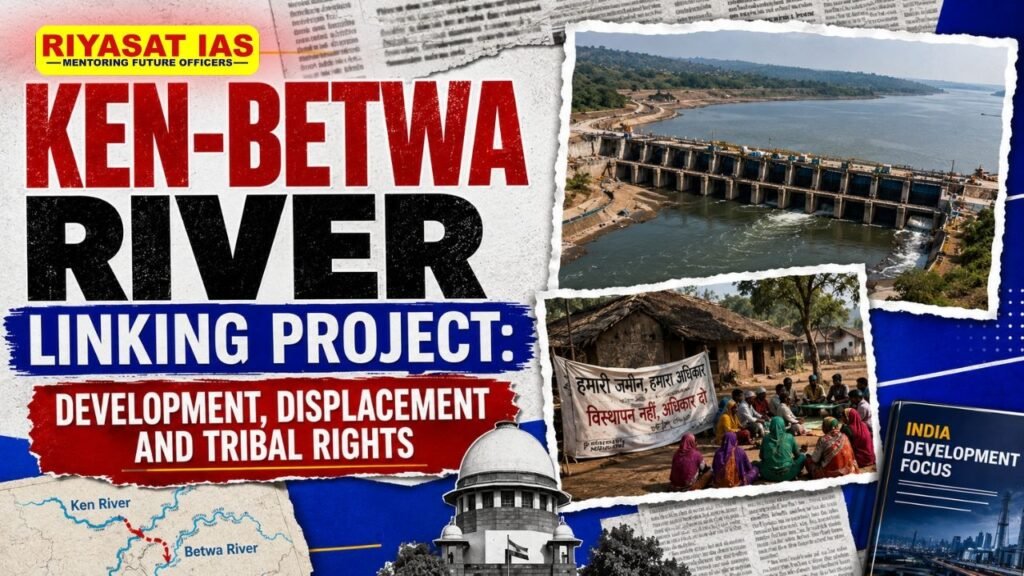
GS-III: Environment | GS-II: Tribal Issues | Inter-State River Water Management | Rehabilitation & Resettlement | Sustainable Development
Context
- Ken-Betwa River Linking Project: The project aims to transfer water from the Ken river to the Betwa river through a 231-km-long canal.
- Objective: Provide irrigation and drinking water to water-stressed areas of Bundelkhand.
- Displacement: The Daudhan dam will submerge 10 villages, while another 12 villages will be displaced to compensate for forest loss in the Panna Tiger Reserve.
- Affected region: In total, 22 villages across Panna and Chhatarpur districts will be affected.
- Core concern: Displacement threatens land, forests, livelihoods, cultural identity and community ties of Adivasi communities.
Ken and Betwa Rivers
- Ken: Originates in the Vindhyan plateau, flows mainly through Madhya Pradesh and joins the Yamuna in Banda, Uttar Pradesh.
- Betwa: Also originates in the Vindhyas and meets the Yamuna at Hamirpur, Uttar Pradesh.
- Bundelkhand: Covers 13 districts of Madhya Pradesh and Uttar Pradesh and is known for water stress and poverty.
- River-linking rationale: The project seeks to transfer water from the Ken basin to the relatively water-stressed Betwa basin.
Human Cost of Development
- Loss of homeland: Villagers consider the Ken river, forests and land their janam bhoomi (birthplace).
- Community displacement: Villagers want to relocate together rather than being scattered across different settlements.
- Livelihood loss: Forest produce such as mahua, charwa and tendu leaves supports household incomes.
- Cultural loss: Displacement threatens traditional languages, social relationships, religious practices and community identity.
- Adivasi concern: Many families reportedly lack formal patta land, making compensation and rehabilitation particularly difficult.
- Core demand: Villagers seek forest for forest, land for land, water for water and village for village.
Compensation and Rehabilitation Concerns
- Current compensation: Affected villagers who were 18 years or older in February 2024 are eligible for ₹12.5 lakh, along with ₹5 lakh per acre of acquired land.
- Land ownership: Many Adivasi families reportedly lack formal land titles.
- Alternative demands: Protesters have demanded:



o Three acres of land jointly in the names of male and female family heads.
o A village for the displaced village.
o Higher compensation.
o Joint survey of land and houses.
- Rehabilitation: Monetary compensation alone cannot replace community-based livelihoods and forest resources.
Ecological Concerns
- Forest loss: The detailed project report reportedly estimated that around 23 lakh trees would be felled.
- Panna Tiger Reserve: The project affects an ecologically sensitive tiger reserve.
- Forest-dependent communities: Large-scale forest loss directly affects communities dependent on forest produce.
- Ecosystem services: Forests provide livelihoods, biodiversity, water regulation and ecological security.
- Development dilemma: Infrastructure development may generate economic benefits but can impose concentrated ecological and social costs on local communities.
Chita Aandolan
- Nature of protest: Adivasi women have led the Chita Aandolan, or symbolic pyre protest.
- Beginning: The protests have been ongoing since 2022.
- Symbolism: The symbolic pyre represents the fear of losing their land, forests, homes and cultural identity.
- Recent protests: Major protests took place in April and July.
- Demands: Protesters have demanded better compensation, land-based rehabilitation and protection of community livelihoods.
- Law-and-order response: Police used force during some protests, with authorities describing it as “minimum limited force”.
Governance and Rights Concerns
- Participatory governance: Affected communities should be meaningfully consulted before displacement.
- Fair rehabilitation: Resettlement should restore livelihoods rather than merely provide monetary compensation.
- Community cohesion: Families and communities should be allowed to relocate together wherever feasible.
- Due process: Demolition and land acquisition should follow proper notice, compensation and rehabilitation procedures.
- Tribal rights: Forest-dependent communities require protection of their livelihood and cultural rights.
- Dialogue deficit: The absence of sustained dialogue between authorities and organised villagers has intensified distrust.
Development vs Sustainable Development
- Development need: Bundelkhand faces serious water scarcity and poverty, making irrigation and drinking-water infrastructure important.
- Social cost: Development cannot be evaluated only through irrigation potential or infrastructure created.
- Ecological cost: Forest diversion, biodiversity loss and habitat disruption must be incorporated into project assessment.
- Justice dimension: Those bearing the greatest costs of development should not be excluded from its benefits.
- Sustainable approach: Development should balance economic efficiency, ecological sustainability and social justice.
Way Forward
- Land-based rehabilitation: Provide land-for-land rehabilitation wherever feasible, particularly to livelihood-dependent communities.
- Community relocation: Ensure affected communities are relocated collectively rather than fragmented.
- Transparent surveys: Conduct joint and transparent surveys of land, houses, forests and livelihood resources.
- Fair compensation: Compensation should reflect both tangible assets and livelihood losses.
- Participatory dialogue: Establish continuous dialogue between the government and affected communities.
- Ecological safeguards: Strengthen monitoring of forest loss, biodiversity and wildlife impacts.
- Gender-sensitive rehabilitation: Recognise joint ownership and livelihood rights of women in rehabilitation packages.
- Rights-based development: Integrate tribal rights and environmental safeguards into infrastructure planning.
Conclusion
The Ken-Betwa project highlights the difficult balance between water security and the rights of communities dependent on land and forests. Development cannot be measured only by canals, dams and irrigation potential. For sustainable development, the people who bear the social and ecological costs must have a meaningful voice in decision-making and receive fair, livelihood-based and community-sensitive rehabilitation.
UPSC Mains Practice Question
Q. “Large infrastructure projects often create a tension between development objectives and the rights of local communities.” Discuss with reference to the Ken-Betwa River Linking Project.





 Ravi Raaz
 Hassan Khan
 Shadab Ali