
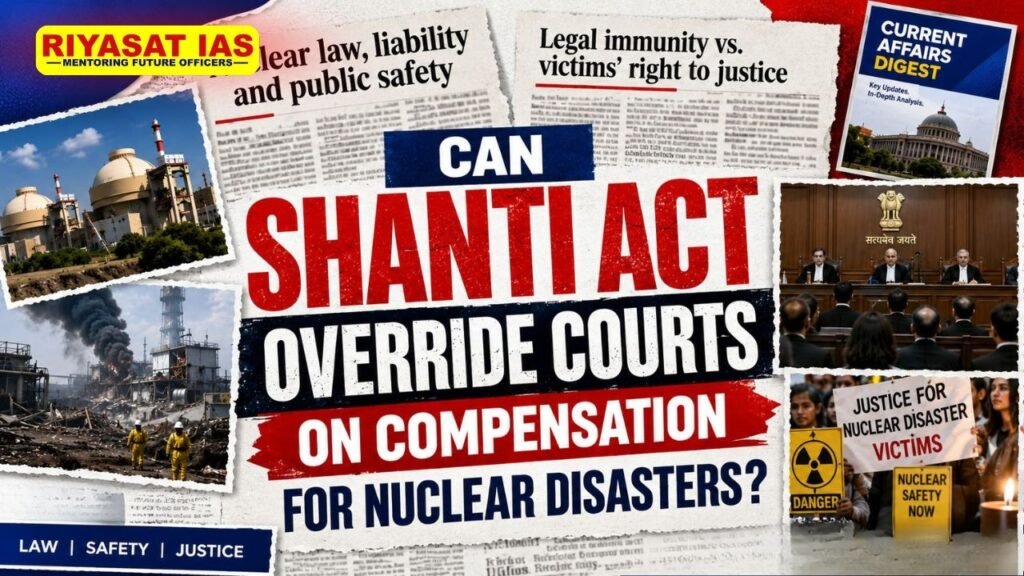
GS-II: Polity | GS-III: Nuclear Energy | Disaster Management | Constitutional Law
Context
- Supreme Court hearing: The Court asked whether the SHANTI Act, 2025 can prevent constitutional courts from granting fair and just compensation to victims of a nuclear accident beyond the statutory liability cap.
- Constitutional challenge: A petition led by E.A.S. Sarma, along with former bureaucrats, scientists and professors, challenged provisions of the Act as violating Articles 14, 19 and 21 of the Constitution.
- Core issue: Whether Parliament’s liability cap can override the constitutional power of courts to award adequate compensation.
What is the SHANTI Act?
- Full form: Sustainable Harnessing and Advancement of Nuclear Energy for Transforming India (SHANTI) Act, 2025.
- Replaces: The Civil Liability for Nuclear Damage Act, 2010 and provides a new framework for India’s nuclear power sector.
- Objective: Encourage greater investment and private participation in civil nuclear power.
Why is the Act Controversial?
- Operator liability cap: Liability of nuclear plant operators is capped, with the largest plants facing a ceiling of around ₹3,000 crore.
- Supplier liability: Petitioners argue that the Act substantially shields suppliers from liability.
- Constitutional concern: Critics contend that nuclear accidents can cause damage running into several lakh crore rupees, making statutory caps inadequate.
What Did the Supreme Court Say?
- Judicial power remains: CJI Surya Kant observed that even if Parliament imposes a liability cap, constitutional courts are not precluded from awarding fair and just compensation.
- Limited notice: The Court sought the Centre’s clarification on whether the Act restricts judicial power.
- Regulatory independence: The Court also questioned the appointment process of members of the Atomic Energy Regulatory Body (AERB) under Section 17(4), citing concerns about possible conflict of interest.



Petitioners’ Arguments
- Absolute liability: Hazardous industries should face strict and absolute liability, as laid down in M.C. Mehta v. Union of India.
- Safety concern: Liability caps could reduce incentives for operators and suppliers to maintain the highest safety standards.
- Conflict of interest: The Atomic Energy Commission should not influence appointments to the regulator because it also operates nuclear power stations.
Constitutional Principles Involved
- Article 21: Right to life includes the right to compensation for serious harm.
- Article 14: Equality before law.
- Absolute Liability: Enterprises engaged in hazardous activities bear heightened responsibility for damage caused.
Why is This Case Important?
- Nuclear expansion: The judgment will shape India’s approach as it expands private participation in nuclear energy.
- Victim rights: It tests whether statutory liability caps can limit constitutional remedies.
- Regulatory credibility: It also raises questions about the independence of India’s nuclear safety regulator.
Conclusion
The Supreme Court’s observations indicate that constitutional courts may retain the power to award compensation beyond statutory liability caps, even under the SHANTI Act. The final ruling will be significant in balancing investment in nuclear energy with constitutional guarantees of justice and victim compensation.
UPSC Mains Practice Question
Q. The SHANTI Act, 2025 seeks to promote nuclear energy investment, but it has raised concerns regarding liability and victim compensation. Discuss the constitutional issues involved.




 Ravi Raaz
 Hassan Khan
 Shadab Ali