
GS-III: Energy | Biofuels | Environment | Automobile Sector | Consumer Protection
Context
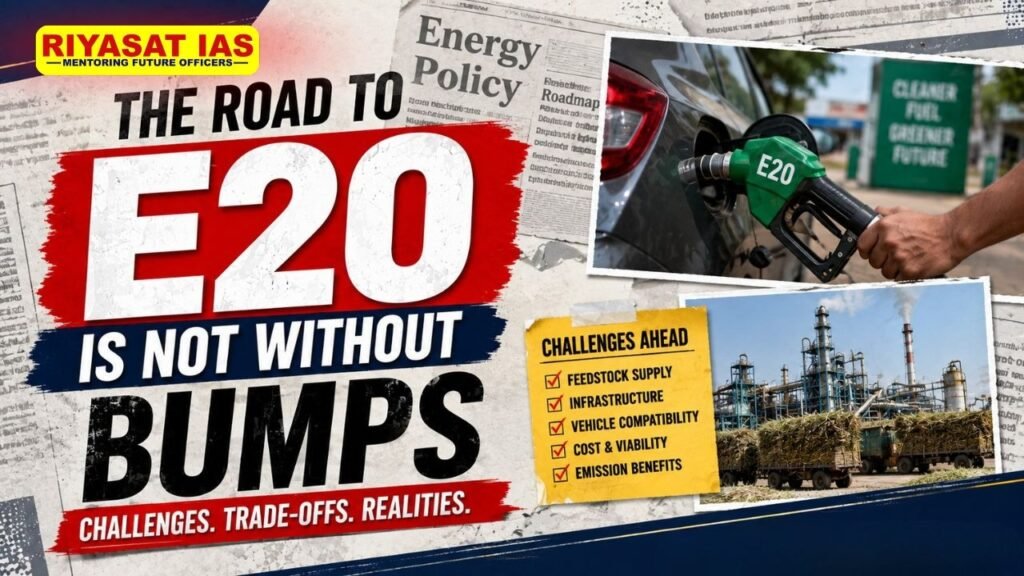
- E20 fuel regime: India is transitioning to petrol blended with 20% anhydrous ethanol.
- Government objective: Reduce crude oil import dependency, save foreign exchange and reduce carbon emissions.
- Emerging concerns: Mileage reduction, mechanical vulnerabilities in legacy vehicles, fuel contamination and elimination of unblended petrol (E0) as a consumer choice.
The Regulatory Baseline
- Government notification: From April 1, 2026, all States and Union Territories must sell petrol blended with up to 20% ethanol and a minimum RON of 95.
- Earlier regime: The 2021 notification permitted blending of up to 10% ethanol.
- BS-VI Phase 2 RDE: Automobile manufacturers were required to comply with these norms from April 2023.
- E20-compatible vehicles: Post-April 2023 vehicles were factory-engineered with ethanol-resistant FKM/Viton, upgraded fuel-pump seals and recalibrated PCMs.
- Legacy vehicles: Pre-April 2023 vehicles were largely calibrated for E5/E10 and used conventional NBR rubber and metallic fuel-system components.
- Vehicle pool: India has an estimated 310 million petrol-powered vehicles.
- Legacy fleet: Around 240 million vehicles are estimated to be legacy vehicles, most being two-wheelers.
Engineering Realities
- Solvent action: Ethanol acts as a strong solvent and detergent, dislodging rust, varnish and deposits in older fuel systems.
- Fuel-system blockage: Dislodged particles can clog fuel filters, fuel-pump strainers and fuel injectors.
- Hygroscopic nature: Ethanol absorbs moisture from the atmosphere, increasing the possibility of phase separation.
- Corrosion: Water-ethanol layers can accelerate corrosion and pitting in older steel fuel tanks.
- Rubber components: Conventional NBR hoses, O-rings and pump diaphragms may experience swelling, hardening and embrittlement.
- Mileage: Ethanol contains roughly 30–35% less energy per unit volume than petrol, potentially reducing mileage in engines not calibrated for higher ethanol blends.



Major Vulnerabilities
- Underground storage tanks: Water ingress into underground steel tanks can create fuel-quality problems.
- Phase separation: Excess moisture can cause ethanol-water separation, producing a low-octane and corrosive layer.
- Engine failure: Contaminated fuel can cause engine stalling and fuel-system failure.
- Chemical contamination: Agrochemical residues and chemicals used during distillation can introduce trace chlorides.
- Corrosion risk: Chlorides can contribute to corrosion of high-pressure injectors and cylinder components.
- Supply-chain vulnerability: Failure of dehydration systems or inadequate tanker sealing can increase water contamination.
Scientific Divergence
- IIT Kanpur findings: The Engine Research Laboratory reported that E20 causes no notable engine damage and that efficiency losses remain below 5%.
- Alternative concerns: Independent automotive experts and consumer communities have questioned whether laboratory findings adequately capture the experience of legacy vehicles.
- Peripheral components: Concerns have been raised regarding premature wear of fuel pumps, injectors and other fuel-system components.
- Industry data: Reuters reviewed internal industry communications involving tests of 250+ fuel samples across 21 States.
- Chloride levels: Samples reportedly showed readings above the specified 3 ppm ceiling in some locations.
- Water contamination: Samples reportedly showed high water content in some States.
- SIAM clarification: SIAM stated that the withdrawn document contained preliminary data from a limited number of OEMs and was intended for internal discussion.
- Further study: SIAM announced plans for a comprehensive and validated scientific study.
- Government position: The Ministry of Petroleum and Natural Gas stated that State-run fuel networks follow stringent testing procedures and characterised contamination reports as localised anomalies.
Need for Balancing
- Dual dispensing: Fuel outlets should consider providing lower-blend or unblended petrol such as E0/E10 for legacy vehicles.
- Consumer choice: This would provide an informed choice for owners of older two-wheelers and passenger vehicles.
- Pump labelling: Standardised and prominent labelling should indicate ethanol content at fuel stations.
- Quality transparency: Oil Marketing Companies should publish batch-level information on moisture and chloride levels.
- Retrofit kits: Affordable ethanol-resistant fuel lines, seals and other retrofit components should be developed for legacy vehicles.
- Service guidelines: Vehicle owners should receive clear guidance to minimise phase separation and corrosion risks.
- Independent research: Multi-year, real-world studies should assess the performance of pre-2023 vehicles across different climatic and geographical conditions.
- International learning: India can learn from Brazil’s experience in managing the transition towards biofuels.
The Way Forward
- Consumer-centric E20: The transition should balance energy-security objectives with consumer protection.
- Legacy vehicle protection: With a large legacy fleet, particularly two-wheelers, protection measures are essential.
- Dual-fuel access: Unblended petrol accessibility may be maintained as a consumer option.
- Field audits: Independent fuel-quality and vehicle-performance audits should supplement laboratory testing.
- Transparent standards: Clear pump labelling and regular fuel-quality disclosure should be ensured.
- Retrofit support: Subsidised retrofit support, especially for two-wheelers, can reduce transition costs.
- Public trust: Macroeconomic energy goals must be balanced with consumer safety, informed choice and technological realities.
Conclusion
India’s E20 transition can strengthen energy security, reduce crude-oil dependence and support biofuel development, but its success depends on managing the concerns of legacy vehicle owners and ensuring fuel-quality standards. A consumer-centric transition based on scientific evidence, transparent testing, informed choice and targeted retrofit support can balance national energy objectives with consumer protection.
UPSC Mains Practice Question
Q. India’s transition to E20 fuel offers significant energy-security benefits but also raises concerns regarding legacy vehicles, fuel quality and consumer protection. Discuss.




 Ravi Raaz
 Hassan Khan
 Shadab Ali