
About
India is undergoing a rapid demographic transition, with the elderly population (60 years and above) projected to more than double from100 million in 2011 to 230 million by 2036. This evolution indicates that by 2036, nearly one in seven Indians will be aged 60 years or older, representing a fundamental restructuring of the country’s population composition.
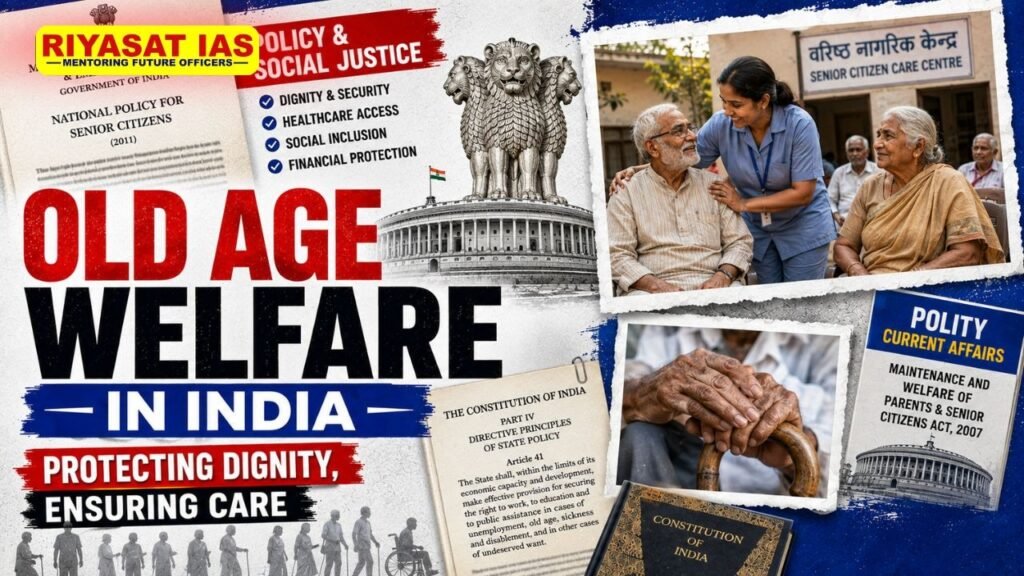
Keeping this transition in mind, India has adopted multiple policies, programmes and institutional mechanisms aimed at ensuring income security, healthcare, social protection, dignity, safety and active participation of senior citizens. With increasing life expectancy and changing family structures, old-age welfare has become an important component of social security and inclusive development.
Note: Under the Maintenance and Welfare of Parents and Senior Citizens Act, 2007, a senior citizen means a person who is 60 years of age or above.
· The International Plan of Action on Ageing was adopted by the General Assembly in 1982.
· In 1992, the United Nations General Assembly proclaimed 1999 as the International Year of Older Persons to highlight issues related to ageing and the well-being of older people.
· 1st October declared as the International Day for the Elderly.
· The U.N.General Assembly on December 16, 1991 adopted 18 principles for the older persons.
Constitutional Provisions and Legal Framework
· Article 41: It directs the State to make effective provision for securing the right to work, to education and to public assistance in cases of unemployment, old age, sickness and disablement, and in other cases of undeserved want subject to its economic capacity and development.
· Article 46: It directs the State to promote the educational and economic interests of Scheduled Castes, Scheduled Tribes and other weaker sections
· Article 21: The right to life has been interpreted to include the right to live with dignity, which has significance for the welfare and dignity of elderly persons.
· Article 47: It directs the State to raise the level of nutrition and the standard of living and to improve public health
Maintenance and Welfare of Parents and Senior Citizens Act, 2007
o Objective: The Act aims to ensure the maintenance and welfare of parents and senior citizens and provide them with a legal mechanism to secure basic needs.
o Target Group: It covers parents and senior citizens aged 60 years and above, subject to the provisions of the Act.
o Key Features: It provides for maintenance tribunals, maintenance orders, old-age homes, protection of life and property of senior citizens and measures for their welfare.
National Policy on Older Persons, 1999
o The National Policy on Older Persons (NPOP), 1999 provides a broad policy framework for improving the quality of life of older persons.



• Objective: It focuses on financial security, healthcare, shelter, education, welfare and protection of senior citizens.
• Approach: It encourages support from the family, community, government and voluntary organisations.
· The statutory provision for maintenance of parents under Hindu personal law is contained in Sec 20 of the Hindu Adoption and Maintenance Act, 1956.
· The Cr.P.C 1973, is a secular law and governs persons belonging to all religions and communities.
· The provision, however, was introduced for the first time in Sec. 125 of the Code of Criminal Procedure in 1973.
· Note: Daughters, including married daughters, also have a duty to maintain their parents.
Government Schemes and Initiatives
Atal Vayo Abhyuday Yojana (AVYAY)
o Objective: AVYAY aims to improve the quality of life of senior citizens by providing them with basic amenities, healthcare, protection and opportunities for active ageing.
o Target Group: It focuses on senior citizens, particularly vulnerable and economically disadvantaged elderly persons.
o Key Features: The scheme supports shelter, food, healthcare, active ageing, awareness and capacity-building programmes through various components and implementing organisations.
Indira Gandhi National Old Age Pension Scheme (IGNOAPS)
o Objective: IGNOAPS aims to provide social security and income support to elderly persons belonging to economically vulnerable households. It is implemented as a component of the National Social Assistance Programme (NSAP).
o Target Group: It covers eligible Below Poverty Line (BPL) senior citizens aged 60 years and above, subject to applicable government guidelines.
o Key Features: It provides a monthly social assistance pension, with higher central assistance for beneficiaries aged 80 years and above, while States may provide additional support from their own resources.
· National Social Assistance Programme (NSAP): NSAP provides social assistance to vulnerable households in situations such as old age, widowhood and disability. It covers eligible elderly persons, widows and persons with severe disabilities belonging to economically vulnerable households.
· Rashtriya Vayoshri Yojana: The scheme aims to improve the physical well-being and mobility of economically disadvantaged senior citizens suffering from age-related disabilities or impairments. It primarily benefits senior citizens belonging to economically weaker sections who have age-related disabilities or impairments.
· Senior Citizens’ Welfare Fund: The fund aims to support initiatives that improve the welfare and quality of life of senior citizens. The fund can support projects related to elderly care, shelter, healthcare and other welfare interventions implemented through eligible organisations.
· Elderline – National Helpline for Senior Citizens: Elderline provides a single-window support mechanism for senior citizens seeking assistance and information. It is available to senior citizens across India.
Major Challenges of Old Age Welfare
· Income Insecurity: A large number of elderly persons lack adequate pension, savings or stable post-retirement income.
· Healthcare Burden: Ageing increases the prevalence of chronic diseases, disabilities, dementia and long-term healthcare requirements.
· Family Structure Changes: Urbanisation, migration and the transition from joint to nuclear families can reduce traditional family-based support systems.
· Social Isolation: Elderly persons may experience loneliness, neglect and reduced social participation, particularly when living alone.
· Elder Abuse: Senior citizens may face physical, emotional and financial abuse, including neglect by family members.
· Inadequate Geriatric Care: India continues to require greater availability of geriatric specialists, long-term care facilities and community-based healthcare.
· Rural–Urban Divide: Elderly persons in rural and remote areas may have limited access to healthcare, pensions, transportation and social services.
Way Forward
· Universal and Adequate Social Security: Pension coverage and social assistance should be strengthened to ensure minimum income security in old age.
· Strengthen Geriatric Healthcare: Primary healthcare should integrate geriatric care, preventive health services, mental-health support and long-term care.
· Promote Active Ageing: Senior citizens should be encouraged to participate in community activities, volunteering, skill-sharing and suitable employment.
· Strengthen Family and Community Support: Policies should support caregivers, community-based care and age-friendly local institutions.
· Prevent Elder Abuse: Stronger awareness, grievance mechanisms and effective implementation of legal safeguards are required to protect elderly persons from abuse, neglect and exploitation.
· Develop Age-Friendly Infrastructure: Public spaces, transport, healthcare facilities and housing should incorporate universal and age-friendly design.
· Convergence-Based Approach: Health, social security, housing, financial inclusion and welfare departments should work together to provide integrated elderly care.
Conclusion
Old-age welfare should move beyond income support and institutional care towards a comprehensive approach based on income security, healthcare, dignity, social participation and active ageing. As India’s elderly population grows, strengthening family, community and State support systems will be essential for ensuring that ageing remains a dignified and secure phase of life.
FAQs
1. Who is considered a senior citizen in India?
Answer: A person aged 60 years or above is considered a senior citizen under the Maintenance and Welfare of Parents and Senior Citizens Act, 2007.
2. Which Constitutional Article deals specifically with old-age welfare?
Answer: Article 41 directs the State to provide public assistance in cases of old age, sickness and disablement.
3. What is the main objective of the Maintenance and Welfare of Parents and Senior Citizens Act, 2007?
Answer: It aims to ensure the maintenance, welfare, protection and dignity of parents and senior citizens.
4. Which scheme provides pension support to elderly persons?
Answer: Indira Gandhi National Old Age Pension Scheme (IGNOAPS) provides social assistance to eligible elderly persons under NSAP.
5. What is the purpose of Elderline?
Answer: Elderline (14567) provides information, support and assistance to senior citizens through a single-window helpline.


 Ravi Raaz
 Hassan Khan
 Shadab Ali