
About
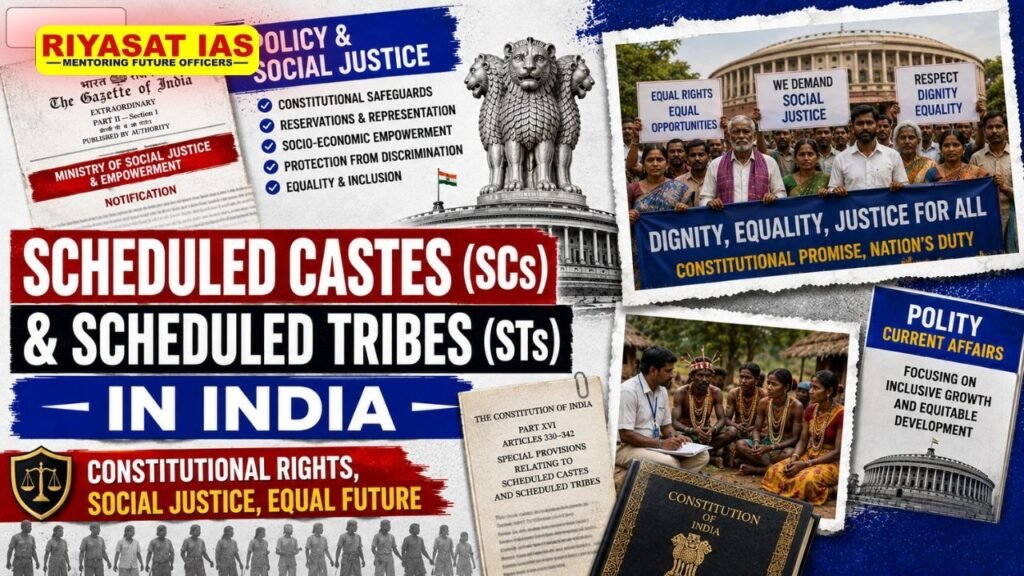
Scheduled Castes (SCs) and Tribes (STs) are constitutionally recognised communities that have historically faced social exclusion, discrimination, economic deprivation and limited access to education and development opportunities. The Constitution provides them with specific safeguards, representation and affirmative-action measures to promote equality, dignity and inclusive development.
Recognition
· Under Article 366(24) define the Schedule Caste and Article 366(25) define Schedule Tribes.
· Under Article 341, the President specifies the castes, races or tribes that are deemed to be SC for a particular State or Union Territory, after consultation with the Governor in the case of a State. Parliament can subsequently include or exclude groups from the notified list.
· Under Article 342, the President specifies the tribes or tribal communities that are deemed to be Scheduled Tribes for a particular State or Union Territory. Parliament has the power to subsequently modify the notified list.
Constitutional and Legal Safeguards
· Fundamental Rights: Article 14, 15, 16 and 17.
· Article 46: It directs the State to promote the educational and economic interests of weaker sections, particularly SCs and STs, and protect them from social injustice and exploitation.
· Article 330: It provides for reservation of seats for SCs and STs in the Lok Sabha.
· Article 332: It provides for reservation of seats for SCs and STs in State Legislative Assemblies.
· Article 335: It recognises the claims of SCs and STs to services and posts under the Union and States, consistent with maintaining administrative efficiency.
· Article 338: It establishes the National Commission for Scheduled Castes (NCSC) as a constitutional body to safeguard the interests of SCs.
· Article 338A: It establishes the National Commission for Scheduled Tribes (NCST) as a constitutional body to safeguard the interests of STs.
· Article 244: It provides for the administration of Scheduled Areas and Tribal Areas through the Fifth and Sixth Schedules.
· Fifth Schedule: It provides a special administrative framework for Scheduled Areas and Scheduled Tribes in States other than those covered by the Sixth Schedule.
· Sixth Schedule: It provides for Autonomous District and Regional Councils in specified tribal areas of Assam, Meghalaya, Tripura and Mizoram.
Legal Protection
· Protection of Civil Rights Act, 1955: It provides legal protection against the practice of untouchability and associated disabilities.
· Scheduled Castes and the Tribes (Prevention of Atrocities) Amendment Act, 2015: It seeks to prevent atrocities against SCs and STs and provides for special courts, relief and rehabilitation of victims and stronger legal safeguards against caste- and tribe-based violence and discrimination.
· Forest Rights Act, 2006: The Scheduled Tribes and Other Traditional Forest Dwellers (Recognition of Forest Rights) Act, 2006 recognises certain individual and community forest rights of eligible forest-dwelling STs and other traditional forest dwellers.
· Prohibition of Employment as Manual Scavengers and Their Rehabilitation Act, 2013: The Act seeks to eradicate manual scavenging, prohibit the employment of manual scavengers and ensure their rehabilitation through appropriate support and alternative livelihood opportunities.
Government Schemes and Initiatives for SCs
Pradhan Mantri Anusuchit Jaati Abhyuday Yojana (PM-AJAY)
o The scheme aims to improve the socio-economic conditions of Scheduled Castes by promoting livelihoods, education and infrastructure development in SC-dominated areas.
o The scheme primarily targets Scheduled Caste communities and SC-dominated villages.
o PM-AJAY has three major components, namely Adarsh Gram, Grants-in-Aid and Hostels, which support village development, income-generating activities, infrastructure and educational facilities for SC students.



Post-Matric Scholarship for SC Students
o The scheme aims to improve access to post-secondary and higher education among SC students by reducing financial barriers.
o It benefits eligible Scheduled Caste students pursuing post-matriculation or post-secondary education.
o Financial assistance is provided for eligible educational expenses, including compulsory fees and academic support, subject to prescribed eligibility conditions.
National Fellowship for Scheduled Caste Students
o The scheme aims to promote advanced research and higher education among SC students.
o It benefits eligible SC students pursuing M.Phil., Ph.D. and equivalent research programmes.
o Selected scholars receive fellowship support to pursue higher research in recognised institutions.
National Overseas Scholarship
o The scheme aims to improve access to high-quality higher education abroad for students belonging to disadvantaged communities.
o It provides financial assistance to eligible SC students and certain other notified disadvantaged categories for higher studies abroad.
o Support is provided for eligible Master’s-level and Ph.D. programmes, subject to prescribed conditions.
National Scheduled Castes Finance and Development Corporation (NSFDC)
o NSFDC aims to promote the economic empowerment and self-employment of SC beneficiaries.
o It primarily supports eligible persons belonging to Scheduled Castes.
o It facilitates concessional finance, loans, skill development and income-generating activities through eligible channels and implementing agencies.
Read this- Caste Census in India
Government Schemes and Initiatives for STs
Eklavya Model Residential Schools (EMRS)
o EMRS aims to provide quality residential education to Scheduled Tribe students, particularly in tribal-dominated areas.
o The scheme primarily benefits ST students, especially those living in remote and tribal areas.
o EMRS provides residential schooling with facilities for academic education, sports, skill development, cultural preservation and overall personality development.
Pradhan Mantri Janjati Adivasi Nyaya Maha Abhiyan (PM-JANMAN)
o PM-JANMAN aims to improve the socio-economic conditions and quality of life of Particularly Vulnerable Tribal Groups (PVTGs) by addressing critical infrastructure and service gaps.
o It covers 75 PVTG communities across 18 States and one Union Territory.
o The mission focuses on saturation of basic services such as housing, drinking water, sanitation, education, healthcare, nutrition, electricity, roads, telecommunications and sustainable livelihoods through convergence among Union Ministries and State governments.
Dharti Aaba Janjatiya Gram Utkarsh Abhiyan
o The programme aims to accelerate the socio-economic development of tribal villages by addressing gaps in basic services and livelihood opportunities.
o It focuses primarily on tribal communities and tribal-dominated villages.
o The programme adopts a convergence approach by bringing together multiple government schemes and focusing on areas such as education, health, infrastructure, livelihoods and basic services.
Pradhan Mantri Janjatiya Vikas Mission
o PMJVM aims to strengthen the livelihoods and economic empowerment of tribal communities.
o It primarily benefits tribal communities, tribal entrepreneurs, producer groups and organisations involved in tribal products.
o The mission supports tribal entrepreneurship, value addition, marketing, processing and better market linkages for tribal products, thereby improving income opportunities.
Scholarships for ST Students
o Tribal scholarship programmes aim to improve educational access, retention and progression among ST students.
o They cover eligible Scheduled Tribe students at pre-matric, post-matric and higher-education levels.
o Support includes Pre-Matric and Post-Matric Scholarships, National Fellowship and Scholarship for Higher Education of ST Students, and National Overseas Scholarship for eligible beneficiaries.
Article 275(1) Grants
o Article 275(1) grants aim to promote the welfare of Scheduled Tribes and improve administration in Scheduled Areas.
o The grants are provided to States having Scheduled Areas and ST populations.
o Financial assistance is provided by the Union to States for tribal development, infrastructure and improvement of administration in Scheduled Areas.
Pradhan Mantri Adi Adarsh Gram Yojana (PMAAGY)
o The scheme aims to transform tribal-dominated villages into model villages with better socio-economic infrastructure.
o It focuses on villages with a significant tribal population.
o It seeks to address gaps in roads, drinking water, sanitation, education, health, electricity, housing and livelihoods through convergence with existing government schemes.
Issues Faced by SCs and STs in India
Caste- and Tribe-based Violence: NCRB’s Crime in India 2024 recorded 55,685 crimes against SCs a decline of 3.6% from 57,789 in 2023 and 9961 for Scheduled Tribes in 2024, (12959 cases in 2023).
o Uttar Pradesh recorded the highest number with 14,642 cases, followed by Madhya Pradesh (7,765), Bihar (7,549) and Rajasthan (7,008). For STs, 9,966 cases were recorded in 2024, down 23.1% from 2023; Madhya Pradesh reported the highest number (3,165), followed by Rajasthan (2,282) and Maharashtra (830).
Weakness in Justice Delivery: Despite the existence of the SC/ST (Prevention of Atrocities) Act, 1989, delays in investigation and prosecution remain a concern. NCRB data for 2024 shows that 3,525 cases under the SC/ST (Prevention of Atrocities) Act were pending investigation at the end of the year, with more than one-third of them pending for 1–3 years.
Socio-Economic and Educational Gaps: SC and ST communities continue to face disparities in quality education, employment, income, healthcare and access to basic infrastructure. For tribal communities, geographical isolation and inadequate connectivity further complicate access to public services.
Land and Livelihood Vulnerability: ST communities remain particularly vulnerable to land alienation, displacement and loss of traditional livelihoods. These concerns are especially significant for PVTGs and communities living in remote forest and tribal areas, where access to basic services remains uneven.
Way Forward
· Strengthen Implementation of the SC/ST (Prevention of Atrocities) Act: The focus should be on improving investigation, Special Courts, prosecution, victim compensation and witness protection, rather than merely increasing the number of cases registered. Faster investigation is particularly important because the law prescribes a time-bound investigation framework.
· Make Welfare Schemes Outcome-Oriented: Schemes such as PM-AJAY, scholarships, EMRS, Article 275(1) grants, PM-JANMAN and Dharti Aaba Janjatiya Gram Utkarsh Abhiyan should be assessed through measurable outcomes such as school completion, employment, income improvement, infrastructure coverage and reduction in deprivation, rather than expenditure alone.
· Strengthen Last-Mile Tribal Development: Programmes such as PM-JANMAN should continue with a saturation approach covering housing, drinking water, healthcare, education, roads, electricity, telecommunications and livelihoods for PVTG communities. PM-JANMAN covers 75 PVTG communities across 18 States and one Union Territory.
· Improve Monitoring and Community Participation: Implementation should involve Gram Sabhas, Panchayats, tribal communities and local organisations, along with stronger social audits and independent evaluation. Better coordination between Union and State governments can also reduce duplication and improve delivery of SC/ST welfare programmes.
Conclusion
The constitutional framework for SCs and STs combines protective discrimination, political representation, legal safeguards and developmental interventions. However, effective empowerment requires stronger implementation, better targeting, improved educational and economic opportunities, protection of rights and meaningful participation of communities in decision-making.
FAQs
1. Which constitutional provisions provide safeguards for SCs and STs?
Ans: Important provisions include Articles 15(4), 16(4), 17, 46, 330, 332, 335, 338 and 338A, along with the Fifth and Sixth Schedules for tribal areas.
2. What are the major challenges faced by SCs and STs in India?
Ans: Major challenges include caste- and tribe-based violence, social discrimination, educational and economic inequalities, land alienation, displacement and gaps in access to basic services.
3. Which States reported the highest number of crimes against SCs and STs in NCRB’s latest report?
Ans: According to NCRB’s Crime in India 2024, Uttar Pradesh recorded the highest number of crimes against SCs, while Madhya Pradesh recorded the highest number of crimes against STs.
4. What are the major government initiatives for the development of SCs and STs?
Ans: Major initiatives include PM-AJAY, scholarships and NSFDC for SCs, and EMRS, PM-JANMAN, DA-JGUA, PMJVM and Article 275(1) grants for STs.
5. What should be the approach towards the welfare of SCs and STs?
Ans: The focus should shift from merely providing welfare benefits to ensuring effective implementation, outcome-based monitoring, economic empowerment, quality education, protection of rights and meaningful community participation.


 Ravi Raaz
 Hassan Khan
 Shadab Ali