
About
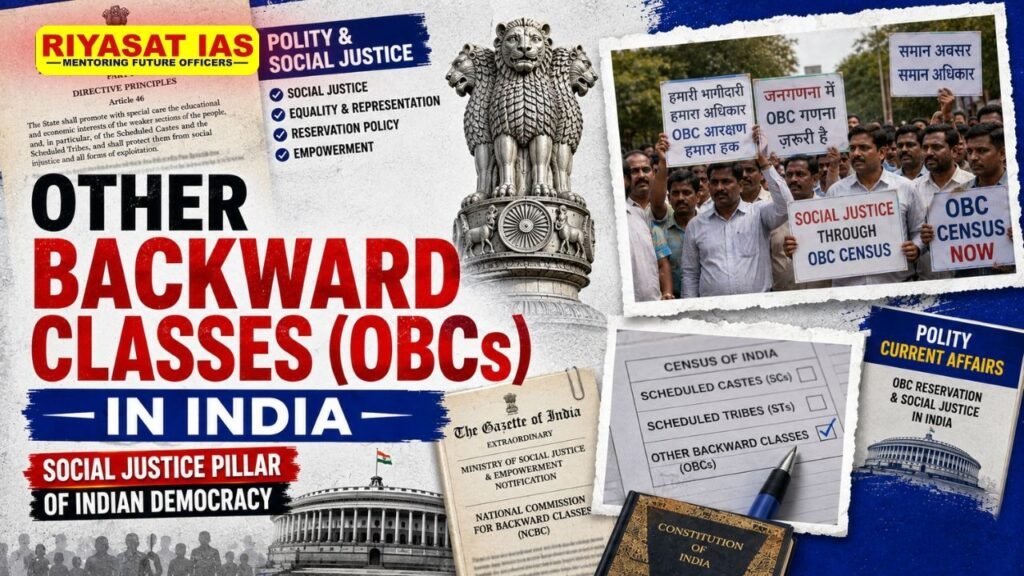
Other Backward Classes (OBCs) are socially and educationally backward communities that do not fall within the Scheduled Castes or Scheduled Tribes categories. The constitutional framework enables the State to adopt special measures for their advancement in education, employment and social development.
Recognition
Constitutional Recognition of OBCs
· The Constitution does not provide a single exhaustive definition of OBCs. However, Article 340 empowers the President to appoint a Commission to investigate the conditions of socially and educationally backward classes and recommend measures for their advancement.
· The 102nd Constitutional Amendment Act, 2018 gave constitutional status to the National Commission for Backward Classes (NCBC) through Article 338B and inserted Article 342A relating to the specification of socially and educationally backward classes.
· The 105th Constitutional Amendment Act, 2021 clarified the power of States and Union Territories to prepare and maintain their own lists of socially and educationally backward classes for their own purposes.
Constitutional and Legal Safeguards
· Article 15(4): It enables the State to make special provisions for the advancement of socially and educationally backward classes, including OBCs.
· Article 15(5): It enables special provisions for the educational advancement of socially and educationally backward classes through admission to educational institutions, including private institutions, subject to constitutional exceptions.
· Article 16(4): It enables reservation in public employment for backward classes that are inadequately represented in the services of the State.
· Article 340: It provides for the appointment of a Commission to investigate the conditions of socially and educationally backward classes and recommend measures for their advancement.
· Article 338B: It provides for the National Commission for Backward Classes (NCBC) as a constitutional body.
· Article 342A: It deals with the Central List of socially and educationally backward classes and the constitutional framework for their identification.
· Article 46: It directs the State to promote the educational and economic interests of weaker sections and protect them from social injustice and exploitation.
Historical Background
Kaka Kalelkar Commission
· The First Backward Classes Commission, headed by Kaka Kalelkar, was appointed in 1953 under Article 340 to investigate the conditions of socially and educationally backward classes.
· The Commission submitted its report in 1955, but its recommendations were not implemented at the national level.
Mandal Commission
· The Second Backward Classes Commission, commonly known as the Mandal Commission, was appointed in 1979 under Article 340 under the chairmanship of B.P. Mandal.
· It identified social and educational backwardness using multiple indicators and recommended 27% reservation for OBCs in Central Government employment.
· The recommendations were implemented in 1990, leading to significant political and social debate.
Indra Sawhney Judgment, 1992
· In Indra Sawhney v. Union of India (1992), the Supreme Court upheld 27% reservation for OBCs in government jobs, while introducing important principles such as the creamy layer exclusion.
· The Court also generally upheld the 50% ceiling on reservations, subject to exceptional circumstances.



Creamy Layer
· The creamy layer principle excludes the relatively advanced sections among OBCs from reservation benefits so that benefits reach the genuinely disadvantaged sections.
· It seeks to prevent the concentration of reservation benefits among relatively better-off OBC families.
· It promotes equitable distribution of affirmative-action benefits within the OBC category.
· The creamy-layer criterion is primarily relevant to OBC reservation, unlike SC/ST reservation where the same framework does not apply in the same manner.
Government Schemes and Initiatives for OBCs
PM-YASASVI
· PM-YASASVI stands for Pradhan Mantri Young Achievers Scholarship Award Scheme for Vibrant India for OBCs and Others and is a major educational support programme for OBC, EBC and DNT students.
· The scheme aims to improve educational access, retention and opportunities for students belonging to disadvantaged communities.
· It primarily covers eligible students belonging to OBC, EBC and DNT communities, subject to prescribed conditions.
· The scheme provides scholarships and educational support, including assistance for school education and higher educational opportunities under its different components.
Post-Matric Scholarship for OBC, EBC and DNT Students
· The scheme aims to reduce financial barriers and improve access to post-matriculation education among disadvantaged students.
· It covers eligible students belonging to OBC, EBC and DNT communities.
· Financial assistance is provided for eligible educational expenses, fees and academic support, subject to prescribed eligibility criteria.
Pre-Matric Scholarship for OBC, EBC and DNT Students
· The scheme aims to prevent school dropout and improve educational participation among children belonging to disadvantaged communities.
· It covers eligible OBC, EBC and DNT students at the pre-matric level, subject to scheme conditions.
· The scheme provides financial assistance for schooling to reduce economic barriers to education.
National Fellowship for OBC Students
· The scheme aims to promote higher education and advanced research among OBC students.
· It provides fellowship support to eligible OBC students pursuing M.Phil., Ph.D. and equivalent research programmes.
· Selected scholars receive fellowship assistance to pursue research in recognised institutions.
Top Class Education for OBC, EBC and DNT Students
· The scheme aims to enable meritorious students from disadvantaged communities to access quality higher education in institutions of excellence.
· It covers eligible OBC, EBC and DNT students admitted to notified institutions.
· Financial assistance is provided for prescribed educational and related expenses, reducing financial barriers to premier higher education.
National Overseas Scholarship
· The scheme aims to facilitate access to advanced higher education abroad for students belonging to disadvantaged communities.
· Eligible students from OBC and other notified disadvantaged categories can receive assistance subject to prescribed conditions.
· It provides financial support for eligible Master’s and Ph.D. programmes abroad.
National Backward Classes Finance and Development Corporation (NBCFDC)
· NBCFDC aims to promote the economic development and self-employment of backward classes.
· It primarily supports eligible individuals belonging to Backward Classes.
· NBCFDC provides concessional loans, micro-finance, skill development and entrepreneurship support through eligible channels.
PM-DAKSH
· PM-DAKSH aims to improve the skill levels, employability and livelihood opportunities of disadvantaged sections.
· It covers OBCs, Scheduled Castes, Economically Weaker Sections, De-notified Tribes and Safai Mitras, among other eligible groups.
· The programme provides short-term training, upskilling, reskilling and entrepreneurship-oriented training to facilitate employment and self-employment.
Credit-Based Economic Empowerment
· Government interventions for OBCs also focus on improving access to institutional credit, entrepreneurship and skill development, particularly through organisations such as NBCFDC.
· These measures seek to reduce dependence on informal credit and strengthen livelihood security and economic independence.
National Commission for Backward Classes (NCBC)
· The NCBC was initially established as a statutory body under the NCBC Act, 1993, and was given constitutional status through the 102nd Constitutional Amendment Act, 2018.
· The Commission safeguards the interests of socially and educationally backward classes and advises on their constitutional and developmental safeguards.
· Under Article 338B, the Commission can investigate and monitor safeguards, inquire into complaints, participate in and advise on socio-economic development, and submit reports to the President.
· The 105th Constitutional Amendment Act, 2021 clarified that States and Union Territories can maintain their own lists of socially and educationally backward classes for their respective purposes.
Major Challenges Faced by OBCs
· Educational Backwardness: Many OBC communities continue to face disparities in access to quality education and higher education.
· Economic Deprivation: A significant section remains dependent on low-income occupations and informal employment.
· Internal Inequality: The OBC category contains substantial socio-economic diversity, with some communities benefiting more than others from affirmative-action measures.
· Creamy Layer Concerns: Better-off sections may capture a disproportionate share of benefits if exclusion mechanisms are not effectively implemented.
· Data Deficiency: The absence of regularly updated and comprehensive caste-wise socio-economic data creates difficulties in accurately assessing backwardness and designing targeted policies.
· Regional Variation: The social and economic status of OBC communities varies significantly across States, making uniform policy approaches difficult.
· Caste-Based Discrimination: Some communities continue to experience social discrimination, exclusion and limited opportunities.
Way Forward
· Evidence-Based Identification: Identification of backwardness should rely on reliable socio-economic and educational data rather than political considerations alone.
· Improve Educational Opportunities: Greater focus should be placed on school education, scholarships, higher education, skill development and digital access.
· Strengthen Economic Empowerment: OBC communities should receive better access to credit, entrepreneurship, markets and skill-based employment.
· Ensure Equitable Distribution: Policy should address internal inequalities within the OBC category so that benefits reach the most disadvantaged communities.
· Strengthen NCBC: The Commission should have adequate institutional capacity, data access and monitoring mechanisms to effectively perform its constitutional role.
· Improve Data Availability: Updated socio-economic data can support evidence-based welfare and affirmative-action policies.
Conclusion
The constitutional framework for OBCs seeks to achieve substantive equality by addressing historical social and educational disadvantages. However, affirmative action must be complemented by quality education, skill development, economic opportunities and social empowerment. The ultimate objective should be to ensure that reservation and welfare policies become instruments of social mobility and equal opportunity rather than permanent dependence on State support.


 Ravi Raaz
 Hassan Khan
 Shadab Ali