
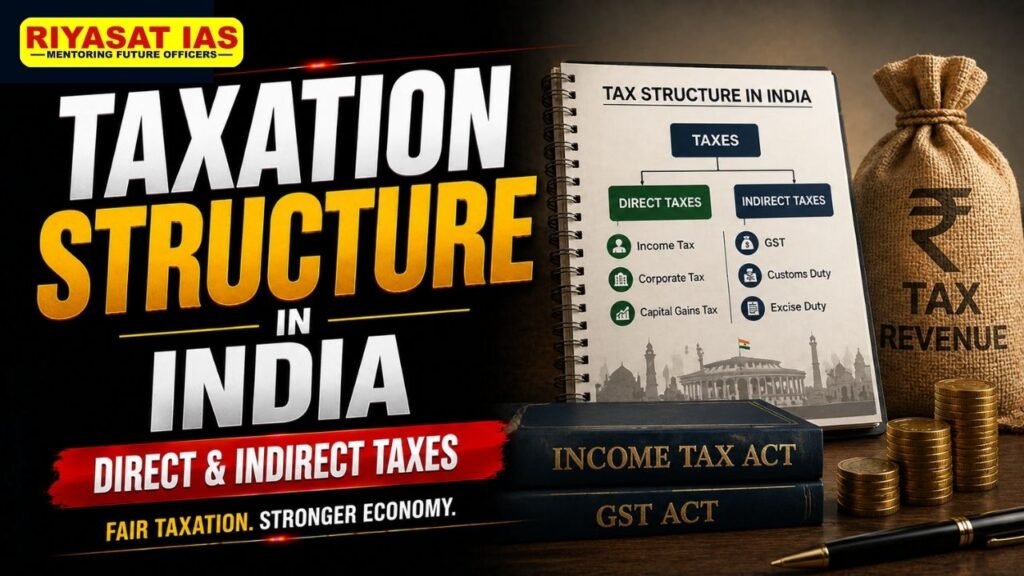
India has a federal taxation system in which the Union Government, State Governments and local bodies levy taxes according to powers provided by the Constitution and relevant laws. Taxes finance public expenditure, redistribute resources and influence investment, consumption and economic activity.
The introduction of GST in 2017 significantly changed India’s indirect-tax structure by bringing several central and state indirect taxes into a common framework. GST operates primarily as a destination-based tax on the supply of goods and services.
Types of Taxes in India
• Direct Taxes: Taxes imposed directly on the income, profits or specified economic gains of individuals and businesses. Major examples include personal income tax and corporate income tax.
• Indirect Taxes: Taxes imposed on transactions involving goods and services. Major examples include GST, customs duties and central excise duties on specified products.
Classification of Taxes
• Progressive Tax: The effective tax burden increases with income or taxable capacity. India’s personal income-tax structure uses slabs with progressively higher marginal rates.
• Proportional Tax: The same tax rate applies to the relevant tax base irrespective of its size.
• Regressive Tax: Lower-income groups bear a relatively larger burden as a proportion of income. Some consumption taxes may have regressive effects.
• Specific Tax: A fixed amount is imposed according to quantity, weight or another physical unit rather than value.
• Ad Valorem Tax: Tax is calculated as a percentage of the value of a product or transaction; GST rates are generally applied to taxable supply value.
Constitutional Provisions for Taxation in India
• Article 265: No tax can be levied or collected except by authority of law.
• Article 246: Along with the Seventh Schedule, distributes legislative powers between Parliament and State Legislatures.
• Article 246A: Provides special legislative powers to Parliament and State Legislatures in relation to GST.
• Article 269A: Deals with GST on inter-State supplies.
• Article 270: Provides the framework for distribution of specified Union taxes between the Centre and States.
• Article 280: Provides for the Finance Commission and its role in fiscal devolution.
• Article 279A: Provides for the GST Council.
How GST Changed India’s Tax Structure
Before GST, India’s indirect-tax system contained multiple central and state taxes. GST brought many of these taxes into an integrated framework.



• Dual GST Model: CGST + SGST generally apply to intra-State supplies, while IGST applies to inter-State supplies.
• Destination-Based Tax: GST links tax revenue primarily to the place of consumption rather than production.
• Input Tax Credit: Subject to prescribed conditions, eligible taxes paid on inputs can be credited, reducing cascading taxation.
Objectives of Taxation in India
• Revenue Generation: Provides resources for infrastructure, defence, healthcare, education, welfare and other public expenditure.
• Income Redistribution: Progressive taxation combined with public expenditure can help reduce excessive economic inequality.
• Economic Stability: Tax policy influences aggregate demand, savings, investment and consumption.
• Behavioural Regulation: Taxation can discourage consumption of products with negative social or environmental effects.
• Investment and Employment: Tax incentives and predictable rules can influence investment, entrepreneurship and employment.
• Fiscal Federalism: Tax sharing between the Union and States helps finance development programmes and strengthens fiscal federalism.
Major Challenges in India’s Taxation System
• Narrow Direct-Tax Base: A relatively limited section of the population bears personal income-tax liability, making tax-base expansion important.
• Large Informal Economy: Informality makes income and transactions harder to document and can restrict compliance.
• Tax Evasion: Concealment of income and transactions reduces revenue and burdens compliant taxpayers.
• GST Complexity: Multiple rates, classification disputes and compliance requirements can increase costs.
• Compliance Burden: Procedural requirements and complex provisions can increase administrative costs.
• Tax Litigation: Prolonged disputes can delay revenue collection and create uncertainty.
• Centre-State Fiscal Issues: Effective Union-State cooperation remains essential for GST rate decisions and administration.
Recent Reform: Income-tax Act, 2025
The Income-tax Act, 2025 replaced the Income-tax Act, 1961 with effect from 1 April 2026. The Income-tax Rules, 2026 also came into force from the same date.
The reform provides a modern framework for income-tax administration, with relevant forms and tax-payment mechanisms for Tax Year 2026–27 shifted to the new Act.
Key Income-Tax Relief Announced in Budget 2025–26
• Higher Rebate Threshold: No income tax was made payable on normal income up to ₹12 lakh under the new regime because of the applicable rebate.
• Relief for Salaried Taxpayers: With the ₹75,000 standard deduction, a salaried taxpayer could have income up to ₹12.75 lakh without income-tax liability on normal income, subject to applicable conditions.
• Policy Objective: The changes were intended to increase disposable income and support consumption, savings and investment.
Way Forward
• Simplify the Tax System: Reduce unnecessary classifications, procedures and compliance requirements.
• Broaden the Tax Base: Use formalisation and digitalisation to bring more economic activity into the tax system.
• Strengthen GST: Pursue simpler structures and efficient dispute resolution.
• Use Technology: Apply data analytics and digital systems to improve compliance and detect evasion.
• Reduce Tax Litigation: Ensure faster dispute resolution and greater clarity in tax laws.
• Ensure Policy Stability: Predictable tax rules can improve investment decisions and business confidence.
Conclusion
India’s taxation structure has evolved towards a more digital, integrated and rules-based framework. GST transformed indirect taxation, while the Income-tax Act, 2025 represents an important change in direct-tax administration.
The next stage of reform should focus on simplification, wider compliance, lower litigation, stable tax policies and stronger Centre-State coordination.
FAQs on Taxation Structure in India
What are the two main types of taxes in India?
Taxes are broadly classified into direct taxes and indirect taxes.
What are the major direct taxes in India?
Personal income tax and corporate income tax are major direct taxes.
What are the major indirect taxes in India?
GST, customs duties and excise duties applicable to specified products are major indirect taxes.
Is GST a direct or indirect tax?
GST is an indirect tax imposed on the supply of goods and services.
Is GST origin-based or destination-based?
GST is principally a destination-based consumption tax.
Which Article provides for the GST Council?
The GST Council is provided under Article 279A.
Is the Income-tax Act, 1961 still applicable?
It was replaced by the Income-tax Act, 2025 with effect from 1 April 2026.


 Ravi Raaz
 Hassan Khan
 Shadab Ali