
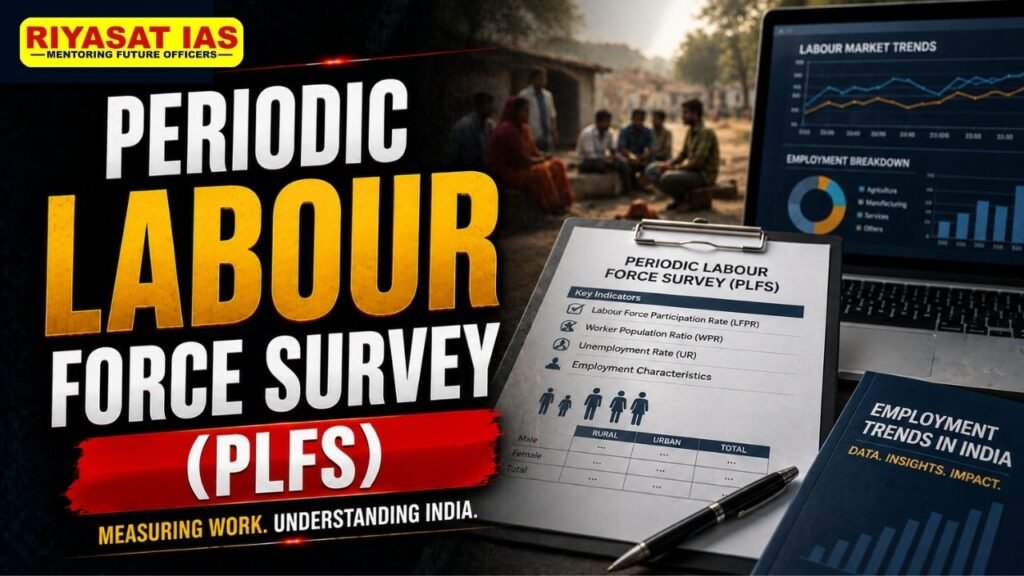
The National Statistical Office (NSO) launched the Periodic Labour Force Survey (PLFS) in 2017, making it India’s key source of regular data on employment, unemployment and labour-force participation. Its first annual report covered July 2017–June 2018.
What is PLFS?
PLFS provides important labour-market indicators such as:
Labour Force Participation Rate (LFPR): Percentage of the population that is working or seeking/available for work.
Worker Population Ratio (WPR): Percentage of employed persons in the population.
Unemployment Rate (UR): Percentage of unemployed persons in the labour force.
How Does PLFS Measure Employment?
Usual Status
Measures a person’s activity during the previous 365 days, providing a longer-term picture of employment.
Current Weekly Status (CWS)
Measures employment status during the seven days preceding the survey, providing a shorter-term picture of labour-market conditions.
Key Distinction: Do not treat Usual Status and Current Weekly Status (CWS) estimates as identical because they use different reference periods.
Major Changes in PLFS
The PLFS framework has been strengthened to make employment data more frequent, representative and useful for policy-making.
Monthly Estimates: Monthly LFPR, WPR and UR estimates are generated at the all-India level using CWS.
Quarterly Estimates: Quarterly employment and unemployment estimates cover both rural and urban areas.
Calendar-Year Reporting: Annual results are reported according to the January–December calendar year.
Larger Sample: The sample has increased to around 2.72 lakh households, improving the precision of estimates.
Better District Representation: The survey gives greater importance to districts during sample selection to ensure better regional representation.



PLFS 2025: Key Findings
Stable Labour-Force Participation: LFPR for persons aged 15 years and above stood at 59.3%, but a significant gender gap persisted, with male LFPR at 79.1% and female LFPR at 40.0%.
Higher Worker Population Ratio: WPR reached 57.4%, corresponding to approximately 61.6 crore employed persons—41.6 crore males and 20.0 crore females.
High Youth NEET Rate: Around 25% of youth aged 15–29 years were not in employment, education or training, indicating significant underutilisation of India’s demographic potential.
Youth Unemployment Improved: Youth unemployment declined to 9.9%, but remained considerably higher in urban areas (13.6%) than in rural areas (8.3%).
Gradual Sectoral Shift: Agriculture accounted for 43.0% of employment, while manufacturing and services accounted for 12.1% and 13.1%, respectively.
Signs of Formalisation: The share of self-employment declined to 56.2%, while regular wage/salaried employment increased to 23.6%.
Rising Female Earnings: Female earnings increased by 8.8% in self-employment and 7.2% in regular salaried employment.
Care Work Limits Female Participation: 44.4% of women outside the labour force cited childcare and homemaking responsibilities as the primary reason.
Major Skill Gap: Only 4.2% of the workforce aged 15–59 years had received formal vocational or technical training.
What Do the PLFS 2025 Findings Indicate?
Gender Gap → Female labour-force participation remains substantially below male participation.
Youth Underutilisation → A high NEET rate limits the potential of India’s demographic dividend.
Skill Mismatch → Limited formal vocational training creates a gap between education and employability.
At the same time, the rise in WPR, growth of manufacturing and services employment, and increase in regular salaried work indicate gradual improvement in the labour market.
Way Forward
Increase Women’s Workforce Participation: Expand affordable childcare and elderly-care facilities and encourage flexible work arrangements.
Link Education with Industry: Integrate paid apprenticeships and practical training into higher education to improve employability.
Strengthen Vocational Training: Align skill programmes with growing sectors such as manufacturing and services and provide self-employed workers with digital and financial skills.
Promote Formal Employment: Encourage MSMEs to shift workers towards regular salaried employment with social-security coverage.
Diversify Rural Employment: Promote agro-processing and other rural non-farm activities to create more productive and stable employment.
Reduce Regional Gaps: Invest in local infrastructure, industrial clusters, skill hubs and labour mobility to connect workers with emerging opportunities.
Conclusion
The PLFS has become a critical tool for understanding India’s changing labour market. PLFS 2025 indicates a relatively resilient labour market, but low female participation, high youth NEET levels and inadequate vocational training remain important concerns.
The policy focus should therefore shift from simply creating more jobs to creating better jobs—jobs that are productive, skilled, formal and accessible to women and young people.
FAQs
What is the full form of PLFS?
Periodic Labour Force Survey.
Who conducts PLFS?
It is conducted by the National Statistical Office (NSO).
What are the main PLFS indicators?
LFPR, WPR and Unemployment Rate.
What is CWS?
Current Weekly Status measures employment status during the seven days preceding the survey.
What is the key concern highlighted by PLFS 2025?
The major concerns are low female labour-force participation, high youth NEET levels and inadequate formal vocational training.


 Ravi Raaz
 Hassan Khan
 Shadab Ali