
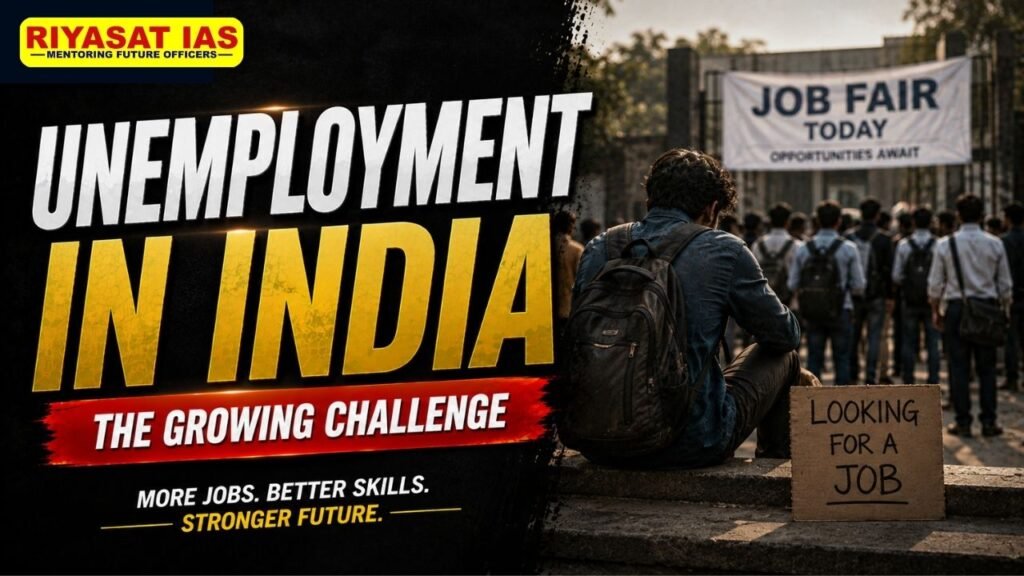
Unemployment is one of the most important challenges facing India’s economy because employment determines not only household income but also economic security, social mobility and the ability to realise India’s demographic dividend.
India’s labour market has undergone significant changes in recent years. Official PLFS data show an improvement in unemployment indicators, but challenges remain in youth employment, skill mismatch, informal work, regional disparities and the availability of productive and decent jobs.
What is Unemployment?
Unemployment refers to a situation in which people who are willing and available to work and are seeking employment do not have a job.
The Unemployment Rate (UR) is calculated as:
Unemployment Rate = (Number of Unemployed Persons ÷ Labour Force) × 100
The labour force consists of people who are either employed or unemployed but available for and seeking work.
Important: Unemployment should not be confused with people who are outside the labour force. A person who is neither working nor seeking/available for work is generally not counted as unemployed.
Latest Unemployment Data in India
India’s official employment and unemployment statistics are primarily provided by the Periodic Labour Force Survey (PLFS) conducted by the National Statistical Office (NSO), Ministry of Statistics and Programme Implementation (MoSPI). From January 2025, the PLFS methodology was revamped to provide more frequent monthly and quarterly labour-market estimates.
| Indicator | Latest official information |
| Annual unemployment rate | 3.1% in 2025 for persons aged 15 years and above under usual status. |
| Female unemployment | 3.0% in 2025 under the same usual-status measure; male unemployment was 3.2%. |
| Latest monthly estimate | 5.5% in May 2026 for persons aged 15 years and above under Current Weekly Status (CWS). |
| Rural vs urban unemployment | 5.1% in rural areas and 6.4% in urban areas in May 2026. |
| Female LFPR | Female labour force participation remained below the overall LFPR, highlighting the importance of greater women’s participation. |
Note: Annual PLFS figures based on usual status and monthly figures based on Current Weekly Status measure labour-market conditions over different reference periods. They should not be directly compared as identical indicators.
What are the Main Causes of Unemployment in India?
Rapid Growth of the Labour Force
India has a large working-age population entering the labour market every year. The economy therefore needs to generate employment at a pace that can absorb new entrants and existing unemployed workers.
Slow Growth of Labour-Intensive Manufacturing
Manufacturing can help shift workers from low-productivity agriculture to higher-productivity employment. However, sectors capable of absorbing large numbers of low- and semi-skilled workers have not expanded sufficiently.
Skill Mismatch
There is often a gap between the skills possessed by workers and the skills demanded by employers. Rapid technological change has made this problem more significant.
Agricultural Dependence
Agriculture remains an important source of employment but can involve seasonal work, underemployment and disguised unemployment.
Dominance of Informal Employment
A large share of India’s workforce remains in informal employment, often with irregular incomes, limited social security and inadequate employment protection.
Technological Change
Automation, artificial intelligence and digital technologies are changing occupational structures. Workers whose skills become obsolete may face difficulty transitioning into emerging occupations.



Low Female Workforce Participation
Women’s participation is influenced by unpaid care work, safety, mobility, childcare responsibilities and social norms.
Types of Unemployment in India
1. Disguised Unemployment
More workers are engaged in an activity than are actually required. It is particularly associated with agriculture and family-based economic activities.
2. Structural Unemployment
Occurs when workers’ skills do not match the requirements of available jobs. It can result from technological change, industrial restructuring and changing demand.
3. Seasonal Unemployment
Occurs when employment opportunities are available only during particular periods of the year, especially in agriculture, tourism and weather-dependent activities.
4. Cyclical Unemployment
Results from fluctuations in economic activity. During a slowdown, falling demand can lead firms to reduce production and employment.
5. Frictional Unemployment
Temporary unemployment that occurs when workers move between jobs or enter the labour market for the first time.
6. Educated Unemployment
Occurs when people with formal educational qualifications cannot find suitable employment, often due to skill mismatch or limited formal-sector jobs.
7. Underemployment
A person has a job but works fewer hours than desired or performs work significantly below their skills and productive capacity.
How is Unemployment Measured in India?
Usual Status
Considers activity during the preceding 365 days and identifies principal and subsidiary activity status.
Current Weekly Status
Considers activity during the seven days preceding the survey and is useful for more frequent labour-market estimates.
Current Daily Status
Examines employment activity on each day of the reference week, capturing day-to-day variations in employment.
PLFS after 2025
The redesigned PLFS provides monthly and quarterly estimates in addition to annual estimates, improving the timeliness of labour-market information.
What are the Effects of Unemployment?
Economic Effects
Lower Economic Output: Unemployed human resources represent unused productive capacity.
Lower Household Income: Lack of employment reduces purchasing power and consumption.
Loss of Tax Revenue: Lower incomes and consumption can reduce government revenues.
Higher Fiscal Pressure: Greater economic vulnerability can increase the need for social-support measures.
Human Capital Loss: Prolonged unemployment can cause workers to lose skills and experience.
Social Effects
Greater Economic Insecurity: Unemployment can reduce household financial stability.
Reduced Social Mobility: Lack of employment opportunities can limit upward economic mobility.
Migration Pressure: Workers may migrate in search of employment.
Psychological Stress: Prolonged unemployment can affect confidence and well-being.
Social Tensions: Persistent unemployment, particularly among youth, can contribute to dissatisfaction and social unrest.
Government Initiatives to Promote Employment
MGNREGA
Provides rural households with a legal guarantee of wage employment while creating rural assets.
PMEGP
Supports the establishment of micro-enterprises through a credit-linked subsidy mechanism and promotes self-employment.
PMKVY
Focuses on skill development, certification and improving employability.
DDU-GKY
Focuses on skill training and placement for rural youth, particularly from poor households.
Pradhan Mantri Viksit Bharat Rozgar Yojana
Approved in 2025 with an outlay of ₹99,446 crore and an aim to incentivise more than 3.5 crore jobs over two years, with special focus on manufacturing.
What Should India Do to Reduce Unemployment?
Promote Labour-Intensive Manufacturing
Expand textiles, footwear, food processing, tourism and other labour-intensive industries.
Strengthen MSMEs
Improve access to credit, technology, infrastructure and markets.
Align Skills with Industry
Connect skill development with employment demand through vocational education, apprenticeships and industry partnerships.
Increase Women’s Employment
Expand childcare, safe transport, flexible work arrangements and workplace infrastructure.
Expand Rural Non-Farm Employment
Promote agro-processing, rural manufacturing, tourism, logistics, renewable energy and digital services.
Prepare Workers for Technological Change
Combine AI and automation with reskilling and upskilling.
Improve the Business Environment
Strengthen infrastructure, access to finance, regulatory predictability and dispute resolution.
Unemployment and India’s Demographic Dividend
India’s large working-age population provides a significant opportunity, but demographic advantage becomes meaningful only when people have access to productive employment.
Young Population → Skills → Employment → Higher Productivity → Higher Income → Savings and Investment → Economic Growth
If the employment link remains weak, the demographic dividend may not deliver its full economic potential. India’s employment strategy must therefore focus not merely on reducing the unemployment rate, but also on increasing productive, decent and better-paid work.
Conclusion
Unemployment in India is not simply a shortage of jobs. It is also a problem of skills, productivity, structural transformation, regional disparities, gender participation and employment quality.
Recent official PLFS data indicate that unemployment rates have improved, but the challenge of creating productive and sustainable employment at scale remains important.
India therefore needs an integrated employment strategy built around labour-intensive manufacturing, stronger MSMEs, industry-linked skills, higher female workforce participation, rural diversification and technological reskilling.
The ultimate objective should be to transform India’s large workforce into a productive economic asset, enabling the country to convert its demographic potential into sustained and inclusive growth.
FAQs on Unemployment in India
What is unemployment?
Unemployment is a situation where people who are willing, available and seeking work are unable to find employment.
How is unemployment calculated?
Unemployment Rate = (Unemployed Persons ÷ Labour Force) × 100.
Which organisation measures unemployment in India?
The National Statistical Office (NSO) under MoSPI conducts the Periodic Labour Force Survey (PLFS).
What are the major types of unemployment in India?
Disguised, structural, seasonal, cyclical, frictional and educated unemployment, along with widespread underemployment.
What is disguised unemployment?
It occurs when more workers are engaged in an activity than are actually required, so removing some workers has little or no effect on total output.
What is structural unemployment?
It occurs when there is a mismatch between workers’ skills and the skills demanded by available jobs.
What is seasonal unemployment?
It occurs when employment is available only during certain periods of the year, particularly in agriculture and tourism.
What is the biggest challenge in India’s employment situation?
Beyond unemployment itself, India faces the challenge of creating productive, formal and adequately paid employment, particularly for young people and women.
How can India reduce unemployment?
India can reduce unemployment through labour-intensive manufacturing, MSMEs, skill development, entrepreneurship, women’s employment, rural non-farm activities and technology-oriented reskilling.


 Ravi Raaz
 Hassan Khan
 Shadab Ali