
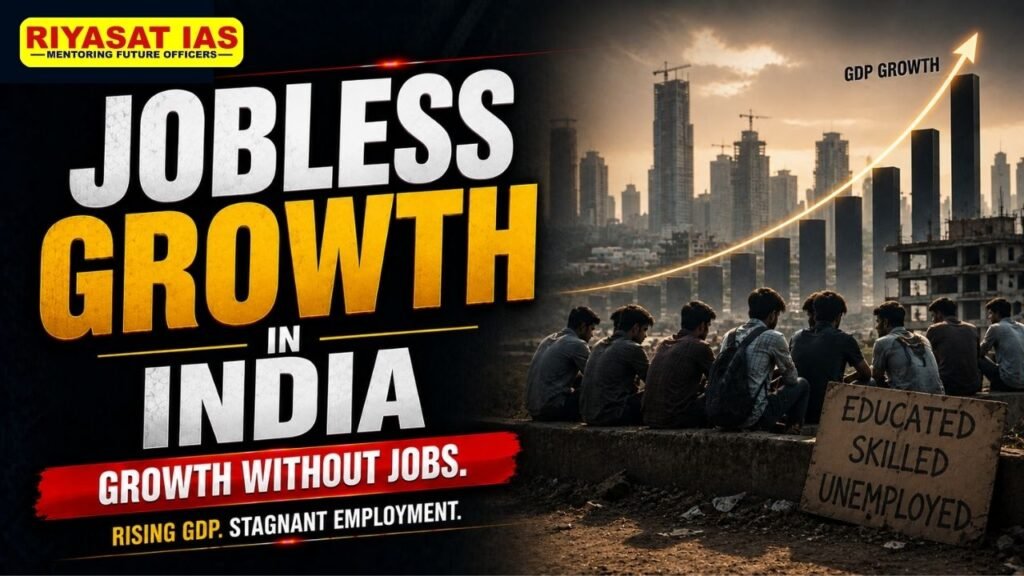
Economic growth is generally expected to create more employment. However, an economy can grow rapidly without generating jobs at the same pace. This situation is commonly described as jobless growth.
For India, the issue is particularly important because a large working-age population is entering the labour market while the economy is undergoing rapid technological and structural change. The challenge is therefore not simply to achieve higher GDP growth, but to ensure that growth translates into productive, decent and widely accessible employment.
What is Jobless Growth?
Jobless growth refers to a situation where economic output increases but employment fails to increase proportionately.
It does not necessarily mean that an economy creates zero jobs. Rather, the problem arises when the pace of employment generation is significantly lower than the pace of economic growth or the number of people seeking work.
For example, if GDP grows rapidly but employment rises only marginally, the economy is becoming more productive without generating enough additional work opportunities.
Jobless Growth, Unemployment and Underemployment
| Concept | Meaning |
| Unemployment | A person willing and able to work does not have a job. |
| Underemployment | A person is employed but works fewer hours or in a job below their productive potential. |
| Jobless Growth | GDP increases, but employment does not rise proportionately. |
This distinction is important because jobless growth can exist even when the unemployment rate is relatively low, particularly when people remain engaged in low-productivity or informal work.
Employment Elasticity
A useful measure for understanding jobless growth is employment elasticity of growth.
Employment Elasticity = % Change in Employment ÷ % Change in GDP
It indicates how strongly employment responds to economic growth.
- High employment elasticity: Economic growth generates relatively more jobs.
- Low employment elasticity: Output increases without a comparable increase in employment.
- Falling elasticity: Growth is becoming increasingly less employment-intensive.
Therefore, employment elasticity helps explain why high GDP growth does not automatically mean high employment growth.
Why is Jobless Growth a Concern in India?
India’s labour market has improved in several respects in recent years, so the term “jobless growth” should not be treated as a blanket description of the entire economy. India’s official labour-market data are now primarily generated through the Periodic Labour Force Survey (PLFS) conducted by the National Statistical Office.
The deeper concern is the quality, productivity and adequacy of employment, particularly for young people. The ILO’s India Employment Report 2024 highlights continuing challenges involving youth unemployment, skills and the transition from education to work.
Major Causes of Jobless Growth
Capital-Intensive Growth
Modern production increasingly relies on machines, automation and advanced technology. Firms can therefore increase output without expanding their workforce proportionately.
This improves productivity, but it can reduce employment generation in sectors where machines can substitute routine labour.
Weak Growth of Labour-Intensive Manufacturing
Manufacturing has traditionally been an important pathway through which developing economies move workers from low-productivity agriculture to higher-productivity activities.
India, however, has not yet created manufacturing employment on the scale required to absorb its large workforce. Greater expansion of textiles, footwear, food processing, furniture and other labour-intensive industries could improve this transition.
Skill Mismatch
There is often a gap between what education systems provide and what employers require.
The ILO’s India Employment Report identifies skills and employability as important challenges for young people, particularly as the economy demands new and more specialised capabilities.
Thus, simply increasing educational attainment is not enough. Workers also need practical skills, vocational training, apprenticeships and industry exposure.
Services-Led Growth
India’s rapid expansion of services has been a major source of economic growth. However, high-productivity services such as IT, finance and specialised business services generally require greater skills.
At the other end, many low-skilled services remain informal and relatively insecure.



This creates a challenge: services can generate substantial output without necessarily absorbing India’s entire low- and semi-skilled workforce.
Slow Structural Transformation
A typical development pathway is:
Agriculture → Manufacturing → Modern Services
India’s transition has been different. A large workforce remains dependent on agriculture, while the economy has moved strongly towards services without manufacturing generating enough mass employment.
This incomplete structural transformation contributes to low-productivity employment and underemployment.
Technology, AI and Automation
Artificial intelligence, robotics and automation are changing the nature of work.
Technology can replace certain routine tasks, but it can also create new occupations, raise productivity and generate demand for new skills.
Therefore, the real challenge is not to stop technological progress but to ensure:
Automation + Reskilling + New Opportunities = Inclusive Technological Progress
Low Female Labour Force Participation
Women face additional barriers such as unpaid care work, safety concerns, inadequate childcare, mobility restrictions and limited access to suitable jobs.
Increasing women’s participation in paid economic activity can significantly expand India’s productive workforce.
Effects of Jobless Growth
Weak Demographic Dividend
India’s young population provides a major economic opportunity. But a young population becomes a demographic dividend only when people have productive employment.
If employment opportunities remain inadequate, the same demographic structure can create economic and social pressures.
Rising Inequality
When growth benefits capital owners and highly skilled workers more than low-skilled workers, income disparities can widen.
Underutilisation of Human Capital
Educated young people unable to find suitable employment represent a loss of human capital and productive potential.
The ILO has highlighted the particularly difficult employment situation faced by educated youth in India.
Persistence of Low-Productivity Work
When formal and productive jobs are unavailable, workers may remain in agriculture, casual employment or informal activities simply to earn a livelihood.
Thus, the problem is not only joblessness, but also the shortage of decent and productive jobs.
Social and Economic Stress
Persistent difficulty in finding suitable employment can affect household incomes, social mobility and young people’s expectations about their economic future.
Is Technology Creating or Destroying Jobs?
The relationship between technology and employment is more complex than simply saying “automation destroys jobs.”
Technology can:
Displace → Transform → Create
It may eliminate some routine occupations while increasing demand for workers in areas such as AI, data, cybersecurity, digital services, advanced manufacturing and technology-enabled businesses.
The policy challenge is therefore to ensure that workers can move from declining occupations to emerging occupations.
This makes reskilling and lifelong learning increasingly important.
What Has India Done to Promote Employment?
India has introduced several programmes aimed at improving employability, entrepreneurship and livelihood opportunities.
- Skill India and PMKVY: Focus on skill development and improving employability.
- National Education Policy 2020: Emphasises vocational exposure, multidisciplinary learning and skills relevant to changing economic requirements.
- MGNREGA: Provides rural households with a statutory employment opportunity while supporting rural asset creation.
- MUDRA: Supports micro and small enterprises through institutional credit.
- Startup India: Promotes entrepreneurship, innovation and new business creation.
- Apprenticeship Programmes: Help bridge the gap between formal education and practical workplace skills.
These initiatives are important, but employment outcomes ultimately depend on the capacity of the economy to generate productive demand for labour.
How Can India Create Job-Rich Growth?
Promote Labour-Intensive Manufacturing
India should strengthen sectors capable of absorbing large numbers of workers, including textiles, garments, footwear, food processing, tourism and light manufacturing.
Strengthen MSMEs
MSMEs can become major employment generators if they receive better access to:
Credit + Technology + Infrastructure + Markets + Skilled Workers
Link Skills with Industry
Skill programmes should be closely connected with actual labour-market demand through apprenticeships, internships, vocational education and industry partnerships.
Increase Women’s Employment
Policies should address practical barriers through:
- Affordable childcare
- Safe transport
- Flexible work arrangements
- Better workplace facilities
- Access to skills and finance
Expand Rural Non-Farm Employment
Agro-processing, rural manufacturing, tourism, logistics, renewable energy and digital services can create alternatives to low-productivity agricultural employment.
Prepare Workers for AI and Automation
Workers need continuous reskilling and upskilling so that technological change becomes a source of productivity and new employment rather than simply displacement.
Improve the Business Environment
Better infrastructure, predictable regulations, faster dispute resolution and easier access to finance can encourage private investment and employment creation.
Jobless Growth and India’s Demographic Dividend
The relationship can be understood through a simple chain:
Young Population → Skills → Productive Jobs → Higher Income → Higher Savings → Investment → Faster Growth
If the “productive jobs” link is weak, the demographic dividend cannot be fully realised.
This is why employment policy should not be treated merely as a welfare issue. Job creation is an essential component of India’s long-term growth strategy.
Way Forward
India needs to move from growth that is merely output-intensive to growth that is employment-intensive, productive and inclusive.
The focus should be on five broad priorities:
- Manufacturing: Expand labour-intensive industries and integrate Indian firms into global value chains.
- Skills: Make education and vocational training more closely aligned with industry requirements.
- MSMEs: Improve access to finance, technology and markets.
- Women: Remove barriers to female workforce participation.
- Technology: Combine automation with large-scale reskilling and lifelong learning.
The objective should be not simply to create more jobs, but to create better jobs with higher productivity, adequate earnings and social protection.
Conclusion
Jobless growth captures an important challenge of development: GDP growth by itself does not guarantee employment growth or improved livelihoods.
India has made considerable progress in its labour-market indicators, but concerns around youth employment, skills mismatch, informal work and the quality of available jobs remain important. The ILO’s recent assessments underline the continuing need to improve the transition of young people from education to productive and decent work.
India therefore needs a growth strategy that combines manufacturing, services, skills, entrepreneurship, technological adaptation and higher female participation.
The ultimate goal should be simple:
Not merely faster economic growth, but growth that creates productive work, raises incomes and converts India’s demographic potential into a genuine demographic dividend.
FAQs on Jobless Growth
What is jobless growth?
Jobless growth is a situation where GDP increases but employment does not increase at a comparable rate.
What is employment elasticity?
Employment elasticity measures the percentage change in employment resulting from a 1% change in GDP.
Is India experiencing jobless growth?
The term should be used carefully. India’s recent labour-market indicators have improved, but challenges remain in youth employment, skills, informality, productivity and the availability of quality jobs.
What are the main causes of jobless growth?
The major factors include capital-intensive production, limited labour-intensive manufacturing, skill mismatch, services-led growth, technological change, incomplete structural transformation and barriers to women’s employment.
Does automation cause jobless growth?
Automation can reduce some jobs while creating new ones. Its overall effect depends on the pace of technological adoption, investment, new industry creation and worker reskilling.
How can India reduce jobless growth?
India can promote labour-intensive manufacturing, MSMEs, industry-linked skills, entrepreneurship, women’s employment, rural non-farm activities and technology-oriented reskilling.
How is jobless growth related to India’s demographic dividend?
A large working-age population becomes a demographic dividend only when it has access to productive employment. Without sufficient jobs, the demographic advantage may not translate into higher growth and living standards.
What is the difference between jobless growth and unemployment?
Unemployment refers to people who do not have jobs despite being willing and available to work. Jobless growth describes the relationship between overall economic growth and employment generation.
What is the most important solution to jobless growth in India?
There is no single solution. India needs a combination of employment-intensive manufacturing, better skills, stronger MSMEs, greater female participation and continuous reskilling for technological change.


 Ravi Raaz
 Hassan Khan
 Shadab Ali