
Introduction
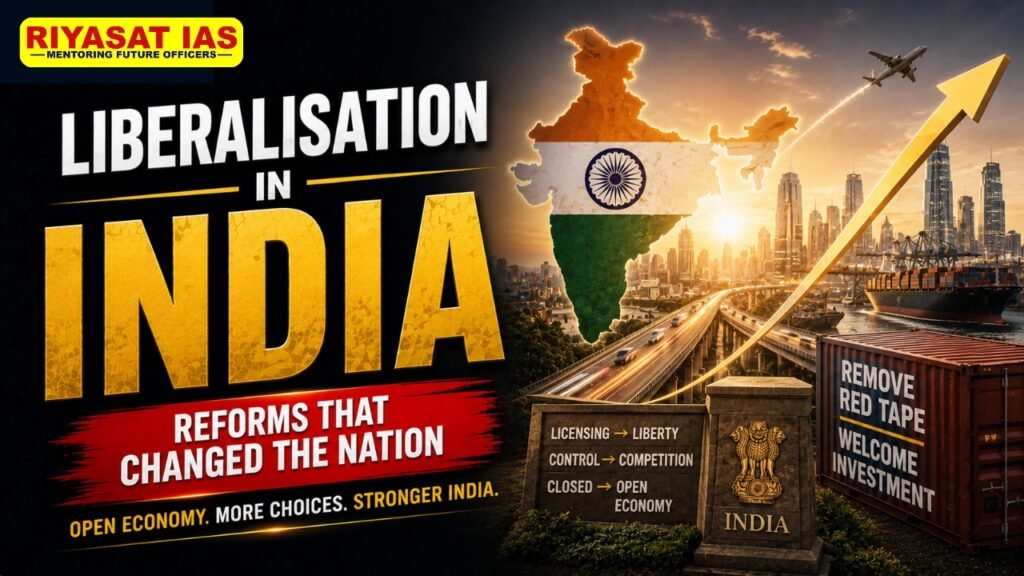
Liberalisation means reducing unnecessary government restrictions on economic activities and giving greater freedom to private businesses and foreign investors. It aims to make the economy more competitive, efficient and market-oriented.
In India, liberalisation became a major part of the 1991 LPG reforms—Liberalisation, Privatisation and Globalisation. These reforms marked a shift from a highly regulated economic system towards greater competition, private participation and global integration.
Why Did India Liberalise in 1991?
India introduced major economic reforms in 1991 amid a severe economic crisis, including external-sector pressures and a shortage of foreign exchange.
The reforms were initiated under Prime Minister P.V. Narasimha Rao, with Dr. Manmohan Singh as Finance Minister. Their broad objective was to stabilise the economy and improve investment, productivity, competition and long-term growth.
What Changed After 1991?
- Industrial Deregulation: Industrial licensing was substantially reduced, weakening the License Raj and giving businesses greater freedom to establish and expand.
- Trade Reforms: Import restrictions and tariffs were gradually reduced, increasing competition from international markets.
- Foreign Investment: More sectors were opened to foreign investment, bringing capital, technology and managerial expertise.
- Financial Reforms: Banking and financial-market reforms aimed to improve efficiency, competition and transparency.
- Greater Private Participation: Private enterprises gained greater opportunities to invest and operate across the economy.
Effects on the Indian Economy
Higher Growth and Productivity
Greater competition encouraged firms to reduce costs, improve productivity and adopt better technologies. Increased investment and more efficient allocation of resources also supported economic expansion.
Growth of the Private Sector
Private enterprises became increasingly important in investment, production and employment. Competition from domestic and foreign firms encouraged improvements in technology, management and efficiency.
Expansion of Services
The post-reform period witnessed rapid growth in IT, telecommunications, finance, business services and other modern services. India’s integration with global markets further supported the expansion of export-oriented services.
Greater Global Integration
Liberalisation increased India’s participation in international trade and investment. Indian businesses gained greater access to global markets, foreign capital, technology and international production networks.



More Choices for Consumers
Greater competition increased the variety, quality and availability of goods and services, while competitive pressures encouraged firms to improve products and pricing.
Technology and Innovation
Greater exposure to international companies and markets encouraged domestic firms to adopt modern technologies and production methods, improving competitiveness in several sectors.
What Were the Challenges?
- Employment Challenge: Higher economic growth did not always generate enough stable and productive employment, leading to concerns about job-poor growth.
- Income Inequality: The benefits of growth were uneven, with skilled workers, capital owners and globally connected sectors often gaining more rapidly.
- Agricultural Pressure: Greater exposure to global markets increased the vulnerability of some farmers to international price fluctuations and competition.
- MSME Challenges: Small businesses often face difficulties competing with larger domestic and multinational firms because of differences in technology, finance and economies of scale.
- Regional Inequality: Investment and modern economic activities tend to concentrate in regions with better infrastructure, skills and connectivity.
- Global Vulnerability: Greater integration also exposes India to global financial crises, commodity-price shocks and changes in international demand.
- Environmental Concerns: Rapid industrialisation and urbanisation can increase pollution and resource pressure without effective environmental safeguards.
Liberalisation and Inclusive Growth
Liberalisation and inclusive growth are related, but they are not the same.
| Liberalisation | Inclusive Growth |
| Reduces economic controls | Expands access to opportunities |
| Encourages competition | Promotes broad-based participation |
| Promotes private investment | Focuses on employment and human development |
| Integrates the economy globally | Seeks wider distribution of development benefits |
| Improves economic efficiency | Combines efficiency with equity |
Liberalisation can create opportunities for growth, but complementary policies are necessary to ensure that these opportunities reach disadvantaged groups and regions.
This requires investment in education, healthcare, skills, infrastructure, social protection and regional development.
What Should the Next Reforms Focus On?
- Better Regulation: Replace excessive controls with simple, transparent and predictable regulations.
- Quality Employment: Promote labour-intensive manufacturing, MSMEs and modern services to generate productive jobs.
- Competitive Manufacturing: Improve infrastructure, logistics, skills and technology to strengthen India’s position in global value chains.
- Technology Transfer: Ensure that foreign investment contributes not only capital but also technology, skills and domestic supply-chain integration.
- Balanced Regional Development: Expand infrastructure and investment beyond established economic centres.
- Innovation: Move from low-cost production towards research, technology and productivity-driven growth.
- Sustainable Growth: Ensure that economic expansion is compatible with environmental protection and efficient resource use.
Conclusion
The 1991 liberalisation reforms transformed India’s economic landscape by reducing excessive controls, encouraging private enterprise, attracting foreign investment and strengthening India’s integration with the global economy.
However, the experience also shows that liberalisation alone cannot guarantee inclusive development. Differences in skills, infrastructure, employment opportunities and access to finance can determine who benefits most from economic reforms.
India’s next phase should therefore focus on combining market efficiency with inclusion, institutional capacity and sustainability. The objective should be not merely a larger economy, but an economy that generates productive employment, wider opportunities and better living standards.
FAQs on Liberalisation
What is liberalisation?
Liberalisation is the process of reducing government restrictions and controls over economic activities to encourage private enterprise, competition and market-based decision-making.
When did liberalisation begin in India?
India introduced major liberalisation reforms in 1991 as part of the broader LPG reforms—Liberalisation, Privatisation and Globalisation.
Who introduced the 1991 economic reforms?
The reforms were introduced under Prime Minister P.V. Narasimha Rao, with Dr. Manmohan Singh serving as Finance Minister.
What were the main features of liberalisation in India?
The major features included industrial deregulation, reduction of trade barriers, greater foreign investment, financial-sector reforms and increased private-sector participation.
What are the major benefits of liberalisation?
Liberalisation contributed to greater competition, investment, technological advancement, private-sector expansion, consumer choice and global economic integration.
What are the negative effects of liberalisation?
Major concerns include income inequality, employment challenges, pressure on agriculture and MSMEs, regional disparities, external vulnerability and environmental stress.
How is liberalisation different from privatisation?
Liberalisation reduces government restrictions and increases economic freedom, while privatisation involves increasing private ownership or participation in activities previously dominated by the public sector.
How did liberalisation affect India’s service sector?
Liberalisation and global integration supported rapid expansion of sectors such as IT, telecommunications, finance and business services, strengthening India’s role in global services.
Is liberalisation sufficient for inclusive growth?
No. Liberalisation can improve efficiency and create economic opportunities, but inclusive growth also requires quality employment, human-capital development, social protection and balanced regional development.
What is the main lesson from India’s liberalisation experience?
The key lesson is that markets and the state have complementary roles: markets can promote investment, competition and innovation, while the state must provide human capital, infrastructure, regulation and social protection.


 Ravi Raaz
 Hassan Khan
 Shadab Ali