
Introduction
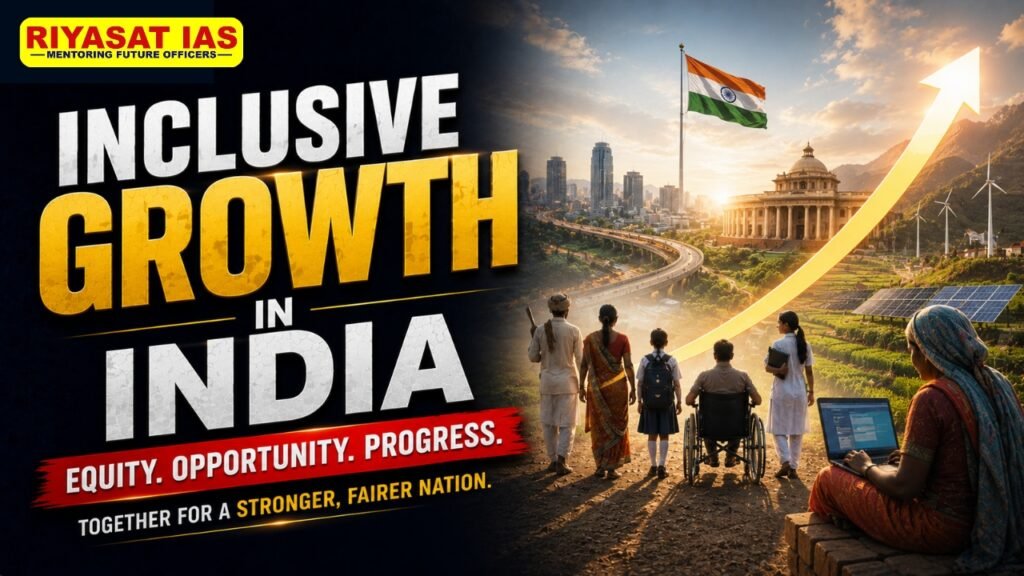
Inclusive growth means economic growth that creates opportunities for a wide section of society and ensures that the benefits of development reach different income groups, regions and social groups. It goes beyond GDP growth by focusing on employment, poverty reduction, human capital, financial inclusion, gender equality and access to basic services.
For India, inclusive growth is essential to ensure that rapid economic expansion translates into better livelihoods, wider opportunities and improved living standards, supporting the vision of Viksit Bharat @2047.
What is Inclusive Growth?
Inclusive growth has two interconnected dimensions:
- Participation in Growth: People should have access to education, healthcare, skills, employment, finance, infrastructure and markets so that they can participate in economic activity.
- Fair Distribution of Opportunities: The gains of economic growth should translate into improved incomes, living standards and access to essential services across different sections of society.
Thus, inclusive growth is not simply about redistributing income after growth; it aims to make the growth process itself more broad-based and opportunity-driven.
Why is Inclusive Growth Important for India?
- Poverty Reduction: Expanding employment and access to basic services helps vulnerable households improve their living standards.
- Employment Generation: Productive employment allows people to participate directly in economic growth and reduces dependence on welfare support.
- Human Capital Development: Better education, healthcare, nutrition and skills raise productivity and strengthen long-term growth.
- Financial Inclusion: Access to banking, credit, insurance and pensions enables households and small enterprises to participate in the formal economy.
- Women’s Economic Participation: Greater participation of women in employment and entrepreneurship expands India’s productive capacity.
- Balanced Development: Reducing disparities between regions, rural and urban areas, and social groups makes economic growth more sustainable.
India’s Progress in Inclusive Growth
India has made significant progress in reducing poverty and expanding access to economic and social opportunities.
- Reduction in Multidimensional Poverty: NITI Aayog estimates that multidimensional poverty declined from 24.8% in 2015–16 to 11.28% in 2022–23, with around 24.8 crore people moving out of multidimensional poverty between 2013–14 and 2022–23.
- Improving Employment Indicators: Unemployment among the 15–59 age group declined from 6.2% in 2018–19 to 3.4% in 2022–23, while the Labour Force Participation Rate increased from 53.6% to 61.6%.
- Expansion of Financial Inclusion: By July 2026, PMJDY had 58.63 crore accounts, with women holding 55.74% of the accounts and 77.8% located in rural and semi-urban areas.
- Expansion of Social Protection: Social protection coverage increased substantially, strengthening protection against economic and social vulnerabilities.
- Improved Basic Services: Jal Jeevan Mission has significantly expanded rural household access to tap water, while digital infrastructure has improved access to financial and public services.



Overall, India has made considerable progress in expanding access, but the quality and distribution of opportunities remain uneven.
Major Challenges to Inclusive Growth in India
Rather than creating separate sections for every individual problem, the challenges can be grouped into four broad areas:
1. Employment and Income Challenges
- Informal Employment: A large workforce remains engaged in informal activities with limited social security and income stability.
- Quality of Jobs: India needs more productive, adequately paid and socially secure employment rather than focusing only on the number of jobs created.
- Rural Income Vulnerability: Small landholdings, climate risks and limited non-farm opportunities constrain rural income growth.
2. Human Capital and Social Gaps
- Education and Skill Gaps: Unequal learning outcomes and skill mismatches limit employability and productivity.
- Healthcare and Nutrition: Differences in access to quality healthcare and nutrition affect human-capital formation.
- Gender Inequality: Constraints related to safety, mobility, unpaid care work, skills and access to finance limit women’s economic participation.
3. Regional and Digital Inequality
- Regional Disparities: Differences in infrastructure, investment and institutional capacity create uneven development across States and districts.
- Rural–Urban Divide: Rural areas often have weaker access to quality services, markets and non-farm employment.
- Digital Divide: Unequal access to devices, connectivity and digital literacy can prevent vulnerable groups from benefiting from India’s digital transformation.
4. Governance and Delivery Gaps
- Last-Mile Delivery: Weak administrative capacity can reduce the effectiveness of welfare and development programmes.
- Fragmented Interventions: Poverty, employment, health, education and financial exclusion are interconnected, requiring better coordination across programmes.
Government Initiatives for Inclusive Growth
India’s inclusive-growth strategy combines income support, employment, financial inclusion, human development and basic infrastructure.
Financial Inclusion and Livelihoods
- Pradhan Mantri Jan Dhan Yojana: Expands access to banking, savings, insurance, pensions and Direct Benefit Transfers.
- MUDRA: Provides institutional credit to micro and small enterprises.
- MGNREGA: Provides rural employment while creating productive rural assets.
- DAY-NRLM: Promotes rural livelihoods through Self-Help Groups, particularly among women.
- PM Vishwakarma: Supports traditional artisans through skills, tools, credit and market linkages.
Human Development
- National Education Policy 2020: Focuses on foundational learning, skills, quality and equitable access to education.
- PM POSHAN: Supports children’s nutrition along with school participation.
- Ayushman Bharat: Strengthens healthcare access and financial protection for vulnerable households.
Basic Services and Connectivity
- Jal Jeevan Mission: Expands household tap-water access in rural India.
- PM Awas Yojana: Promotes access to affordable housing.
- PMGSY: Improves rural connectivity and access to markets and essential services.
- Digital Public Infrastructure: Platforms such as Aadhaar and UPI have expanded access to financial and public services.
Way Forward for Inclusive Growth
- Prioritise Quality Employment: Promote labour-intensive manufacturing, MSMEs, modern services and entrepreneurship to generate productive jobs.
- Strengthen Human Capital: Improve learning outcomes, healthcare, nutrition and industry-relevant skills.
- Increase Women’s Economic Participation: Address childcare, safety, mobility, workplace and financial barriers.
- Diversify Rural Economies: Promote agro-processing, rural manufacturing, tourism, logistics and digital services.
- Deepen Financial Inclusion: Move beyond opening bank accounts towards affordable credit, insurance, pensions and productive financial services.
- Reduce Regional Disparities: Use district- and block-level data to target areas with persistent development deficits.
- Improve Last-Mile Governance: Strengthen monitoring, social audits, grievance redressal and institutional capacity.
- Promote Sustainable Inclusion: Combine poverty reduction with climate-resilient infrastructure, green jobs and sustainable agriculture.
Inclusive Growth and Viksit Bharat @2047
India’s development journey cannot be measured only by the size of its GDP. A genuinely developed economy must provide productive employment, quality education, accessible healthcare, financial security and equal opportunities.
Therefore, inclusive growth should become an integral part of the Viksit Bharat strategy. High economic growth must be combined with human development, social protection and balanced regional development so that India’s demographic and economic potential is converted into broad-based prosperity.
Conclusion
India has made significant progress in poverty reduction, financial inclusion, employment participation and access to basic services. However, challenges relating to job quality, gender inequality, human capital, regional disparities and informality continue to limit the inclusiveness of growth.
The next phase should therefore focus on moving from access to quality, from welfare to empowerment and from growth to opportunity creation. Such an approach can make India’s economic transformation more inclusive, sustainable and resilient, while advancing the goal of Viksit Bharat @2047.
FAQs on Inclusive Growth
What is inclusive growth?
Inclusive growth is economic growth that creates broad-based opportunities and ensures that different sections of society benefit from economic development.
What are the main pillars of inclusive growth?
The major pillars include employment, poverty reduction, human capital, financial inclusion, gender equality, social protection and access to basic services.
What are the major challenges to inclusive growth in India?
The major challenges include informal employment, poor job quality, gender inequality, regional disparities, human-capital gaps, rural vulnerability and the digital divide.
Which government schemes promote inclusive growth?
Important initiatives include PMJDY, MGNREGA, MUDRA, DAY-NRLM, PM Vishwakarma, Ayushman Bharat, PM POSHAN, Jal Jeevan Mission, PM Awas Yojana and PMGSY.
Why is inclusive growth important for Viksit Bharat?
Because a developed India requires not only higher GDP, but also productive employment, improved human development, equal opportunities and better living standards across regions and social groups.


 Ravi Raaz
 Hassan Khan
 Shadab Ali