
GS-II: Government Policies & Interventions | Food Security | Health & Nutrition | Vulnerable Sections
Context
- Changing food-security landscape: Estimates based on the latest household consumption survey suggest that households unable to afford the ICMR-NIN recommended diet declined from about 52% in 2011-12 to 25% in 2023-24.
- Persistent challenge: Despite substantial progress, around one-fourth of households still cannot afford an adequate healthy diet.
- Food security vs nutrition security: Poverty, hunger and inability to afford a healthy diet overlap, but they are not identical.
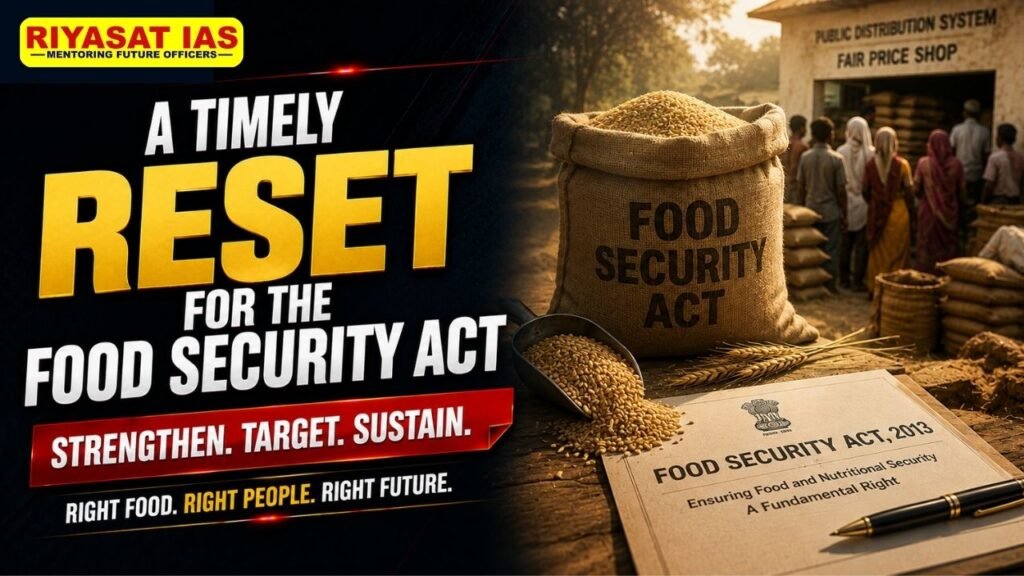
- Draft NFSA Amendment Bill, 2026: Proposes linking Antyodaya Anna Yojana (AAY) entitlements to household size, raising the entitlement to 7 kg per person per month, capped at 35 kg.
- Policy dilemma: Reform must correct inequities without reducing existing foodgrain access while creating a pathway from food security towards nutrition security.
Existing Entitlement Structure
- Priority Households (PHH): Receive 5 kg of foodgrains per person per month.
- AAY households: Receive a flat 35 kg per household per month, irrespective of household size.
- Unequal per-capita benefit: Larger AAY households receive progressively less grain per person.
o A seven-member household receives about 5 kg per person.
o An eight-member household receives only about 4.4 kg per person.
- Draft proposal: Entitlement of 7 kg per person, capped at 35 kg.
- Potential impact: Households with fewer than five members could experience a reduction in their existing entitlement, while households with five or more members would remain broadly unchanged.
Concerns Regarding AAY Reform
- No-loss principle: Existing AAY households should not lose their current 35 kg entitlement merely because of a change in the formula.
- Vulnerability beyond household size: A small household may consist of an elderly person, widow, person with disability or other dependent member.
- Tamil Nadu example: The State reports that 84.5% of its AAY households have fewer than five members, indicating the potentially significant impact of the proposed formula.
- Need for evidence-based reform: Household size alone should not become the sole indicator of vulnerability.
- Larger households: Support beyond the 35 kg ceiling may need separate consideration for households with greater dependency or nutritional requirements.
Coverage Challenge under NFSA
- Beneficiary ceiling: The NFSA permits coverage of up to 75% of the rural and 50% of the urban population.
- Census 2011 limitation: The current ceiling of about 81.35 crore beneficiaries is still based on Census 2011.
- Changing population: With India’s estimated population at around 146.4 crore in 2025, the existing ceiling covers only around 55.6% of the population.
- Way forward: The beneficiary ceiling should be recalculated when Census 2027 data become available.
- Interim reform: Updated population estimates and transparent deprivation criteria could help identify exclusion, accompanied by accessible inclusion and appeal mechanisms.



From Foodgrain Security to Nutrition Security
- Malnutrition persists: NFHS-6 indicates that while stunting declined, wasting and underweight showed only limited improvement.
- Child dietary inadequacy: Only around 15% of children aged 6–23 months receive a minimally adequate diet.
- Double burden of malnutrition: India simultaneously faces undernutrition and rising non-communicable diseases (NCDs).
- Diabetes burden: The ICMR-INDIAB study estimated around 101 million Indians with diabetes and 136 million with prediabetes in 2021.
- Core concern: Food security cannot be measured merely by the quantity of cereals supplied; dietary quality and diversity are equally important.
Need for Dietary Diversification
- Cereal-heavy diets: A predominantly cereal-based food basket can contribute to dietary imbalance when combined with insufficient intake of protein-rich foods and other nutrients.
- ICMR-INDIAB evidence: A 2025 study found carbohydrates supplied around 62.3% of daily energy, while protein contributed about 12%.
- Balanced diet: The solution is not to reduce essential cereal entitlements but to finance dietary diversification alongside them.
- ICMR-NIN guidelines: The 2024 dietary guidelines recommend limiting cereals and millets to a maximum of about 45% of total energy, with greater contributions from pulses, beans, milk, nuts, vegetables and fruits.
- Important distinction: Foodgrain entitlement should not itself be equated with diabetes risk; the concern is the broader dietary composition.
Reorienting the PDS
- Beyond cereals: The PDS should progressively facilitate access to pulses, local rice, wheat, millets and, where feasible, healthy edible oils.
- Local procurement: Local production and consumption patterns should guide supply chains.
- MSP support: Effective procurement of pulses, millets and oilseeds can encourage farmers to diversify production.
- Complementary programmes: Food security should be linked with:
o PDS for household food access.
o Anganwadi services for young children and pregnant/lactating women.
o PM POSHAN for schoolchildren.
- Nutrition basket: Where locally acceptable and feasible, programmes could include eggs, milk or suitable alternatives.
Leveraging Digital and Last-Mile Delivery
- Strong delivery network: By end-2025, around 5.50 lakh of 5.51 lakh fair price shops were using electronic point-of-sale devices.
- One Nation One Ration Card: Nearly all NFSA beneficiaries have access to portability under ONORC.
- Digital inclusion: Technology should improve portability and monitoring without creating exclusion.
- Offline alternatives: Reliable offline mechanisms and assisted or doorstep access are essential for people with limited mobility.
- Authentication safeguards: Authentication failure must never result in denial of entitled foodgrains.
- Fair Price Shops: FPSs could also become platforms for nutrition information and referral, without turning dealers into health professionals.
Linking Food Security with Health
- Nutrition awareness: Multilingual receipts, displays, voice messages and mobile communication can promote:
o Dietary diversity.
o Appropriate cereal portions.
o Greater consumption of pulses.
o Healthier oils.
o Lower salt and added-sugar intake.
- Primary healthcare linkage: Fair price shops can facilitate voluntary referrals to government services for diabetes, hypertension and other NCDs.
- Ayushman Arogya Mandirs: With more than 1.86 lakh centres by June 2026, India’s primary healthcare network can complement food-security initiatives.
- Clear boundaries: FPS dealers should inform and refer, not diagnose or counsel.
- Rights-based approach: Participation should remain voluntary, confidential and completely unrelated to ration eligibility or authentication.
Way Forward
- No-loss safeguard: Explicitly preserve the existing 35 kg monthly AAY entitlement for every eligible household.
- Periodic review: Examine whether the 35 kg ceiling remains adequate for larger and highly dependent households.
- Recalculate coverage: Update NFSA coverage using Census 2027 data and transparent deprivation criteria.
- Separate nutrition financing: Dietary diversification should be separately budgeted, rather than financed by reducing cereal entitlements.
- Promote crop diversification: Strengthen procurement and market support for pulses, millets and oilseeds.
- State pilots: Test diversified food baskets and complementary interventions before nationwide expansion.
- Strengthen last-mile delivery: Combine digital systems with offline, assisted and grievance-redress mechanisms.
- Adopt a holistic approach: Move from measuring food security merely in terms of tonnes of grain distributed towards measuring whether vulnerable households can eat enough, eat healthily and access entitlements with dignity.
Conclusion
India’s next phase of food-security reform must move from calorie security towards nutrition security without weakening the existing protection against hunger. The proposed AAY reform should therefore follow a no-loss principle, while broader policy must address dietary diversity, changing population coverage and the growing burden of NCDs. The objective should not be merely to distribute more or different foodgrains, but to build an integrated system in which food access, nutrition, health and dignity reinforce one another.
UPSC Mains Practice Question
Q. “India’s food-security challenge is gradually shifting from ensuring access to foodgrains towards ensuring access to an affordable and nutritious diet.” Discuss in the context of the proposed reforms in the National Food Security Act and suggest a way forward.



 Ravi Raaz
 Hassan Khan
 Shadab Ali