
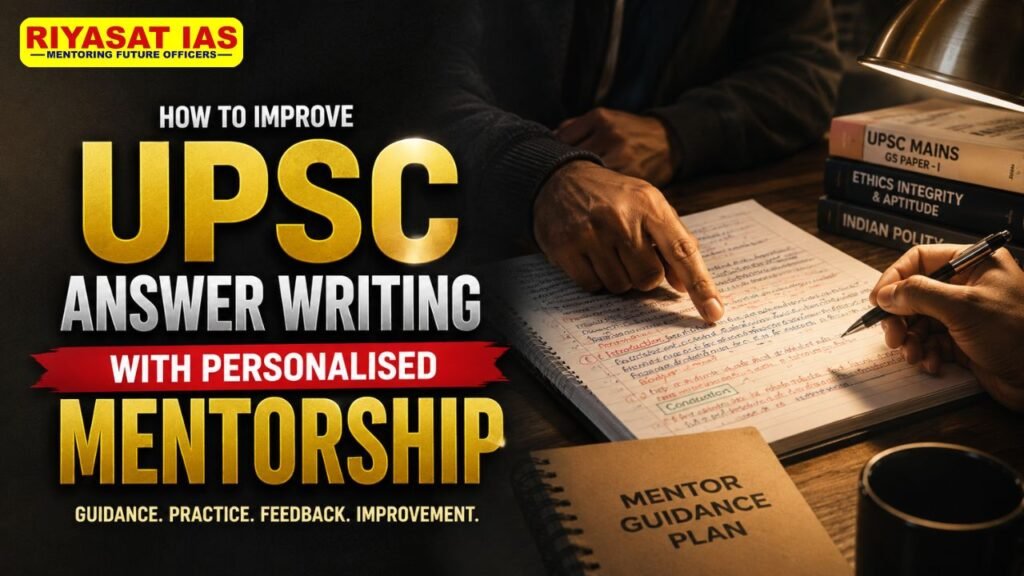
The phrase ‘improve your answer writing’ appears in almost every UPSC preparation programme’s marketing — but the mechanisms by which improvement actually occurs, the specific feedback loop that produces measurable score gains, and the time it takes for different types of improvement to solidify are rarely described with precision. This guide fills that gap: it explains exactly how personalised mentorship drives answer writing improvement, what the improvement trajectory looks like across months, and why self-study alone cannot replicate it.
The Two Things Personalised Mentorship Provides That Nothing Else Does
Answer writing improvement comes from two specific inputs that are structurally impossible to generate through self-study, model answer reading, or test series participation:
Input 1: Someone Reading Your Actual Answer as an Examiner Would
When you read your own answer, you read what you intended to write — your knowledge of your own preparation fills in gaps, interprets ambiguous sentences favourably, and credits implied evidence that is not explicitly present. A personalised mentor reads only what is on the page — exactly as a UPSC examiner would. This reading reveals the gap between what you believe your answer contains and what it actually communicates.
This gap is consistently surprising and consistently larger than self-evaluation suggests. Aspirants who have been writing practice answers for months and believe their demand fulfilment is strong regularly discover, from a mentor’s reading of their specific answer, that their introduction did not engage the question’s specific directive, that their third body paragraph contained no named evidence, or that their conclusion added nothing that the introduction did not already state. None of these findings are visible from inside the writing.
Input 2: Pattern Tracking Across Multiple Answers Over Time
A mentor who reads one answer gives you feedback on one answer. A mentor who reads your answers across six months gives you something more valuable: a pattern analysis. The specific introduction habit you default to. The evidence type you consistently omit. The conclusion pattern that appears in 70% of your answers. The question type where demand misidentification is most frequent.
These patterns are the preparation targets that produce the most concentrated score improvement — because addressing a pattern that affects every answer you write produces more cumulative improvement than addressing any single answer’s individual problems.
The Improvement Cycle: How Mentorship Drives Measurable Change
| Week | What Happens | What Changes |
| Week 1–2 (Baseline) | Mentor reads 3–5 of the aspirant’s existing practice answers without any prior feedback; identifies the 3 most consistent patterns from this baseline sample | Aspirant receives the first honest external assessment of their answer quality — often the first time specific, named weaknesses are identified rather than felt vaguely |
| Week 3–6 (Correction Targeting) | Mentor identifies the single highest-impact correction (the pattern that costs the most marks per occurrence) and makes it the exclusive focus; every session asks: ‘Did this answer apply the correction?’ | The targeted pattern begins to shift — inconsistently at first, then more reliably. Most aspirants show measurable improvement in the targeted dimension within 3–4 weeks of focused correction |
| Week 7–12 (Habit Formation) | The first correction becomes more automatic; mentor introduces the second most important correction; dual-focus feedback begins | The first correction is largely habitual; the second correction is in active development; the answer quality gains from the first correction are compounding in every new answer |
| Week 13–20 (Integration) | Multiple corrections running simultaneously as habits; mentor feedback shifts from ‘did you apply the correction?’ to ‘did you apply it to the most analytically difficult question in the set?’ | Answer quality is measurably above the baseline; the improvement is visible in mock test GS scores, in evaluator feedback, and in the aspirant’s own experience of writing — faster, more decisive, less self-doubt |
| Week 21+ (Refinement) | Mentor feedback focuses on the highest-difficulty dimensions — the analytical depth and current affairs integration quality that separates 120-range scores from 135+ scores | Answer writing quality is at or near examination standard for most question types; remaining work is on precision and current affairs integration depth |
| Want your answer writing improvement tracked through this exact cycle? → Explore Answer Writing Mentorship at Riyasat IAS |



What the Feedback Looks Like — Specifically
To make ‘personalised mentorship feedback’ concrete rather than abstract, here is what specific answer writing feedback from Riyasat IAS Mentorship looks like on a single GS Paper 2 answer on Article 356:
- On the introduction: ‘Your first two sentences contextualise the Article 356 debate in general terms — they could have opened any answer on Centre-State relations. The question asked specifically to critically examine the misuse of Article 356. Your introduction should have named the specific constitutional mechanism being critically examined (Article 356 + President’s Rule) and signalled that the answer will evaluate both the constitutional safeguards and their limitations. Try: [specific alternative first sentence provided].’
- On Body Paragraph 3: ‘This paragraph asserts that the judiciary has provided safeguards against misuse without citing the specific judgment that established the strongest safeguard. The S.R. Bommai case (1994) — which made Presidential Rule subject to a floor test in the Lok Sabha before it can come into effect — is the non-negotiable citation here. Without it, the assertion is credited as general awareness, not specific knowledge.’
- On the conclusion: ‘Your conclusion summarises the balance between Centre and States, which is what the introduction stated. A synthesising conclusion for a critical examination would reach a qualified judgment: that Article 356’s misuse has been substantially reduced by Bommai, but the Governor’s discretion in recommending Presidential Rule remains structurally under-checked, creating a residual vulnerability that only a further constitutional amendment can address. This is a conclusion; yours is a restatement.’
This is what personalised feedback looks like — specific to your sentences, specific in the corrections it provides, and immediately actionable in the next answer you write.
Frequently Asked Questions
How many practice answers per week should I submit for mentorship evaluation?
Two per week is the optimal frequency for most aspirants — enough to maintain a consistent feedback loop (weekly submission → weekly evaluation → correction applied in next week’s submission) without producing more answers than the mentor can evaluate at quality level. Three per week is manageable in intensive phases; one per week is insufficient to build and correct habits at the pace examination preparation requires.
How long does it take to see measurable improvement in GS answer quality with personalised mentorship?
Measurable structural improvement — answers consistently meeting demand, body paragraphs including named evidence, conclusions synthesising rather than restating — typically appears within 6–8 weeks of consistent evaluation with focused correction. This assumes two answers submitted per week with the identified correction as the week’s specific practice target. The improvement accelerates after Week 8 as multiple corrections begin compounding.
Can personalised mentorship improve answer writing quality in both Hindi and English medium?
Yes — and the specific nature of the feedback differs by medium. For English medium answers, feedback focuses on analytical expression, evidence specificity, and demand fulfilment. For Hindi medium answers, feedback adds a third dimension: register precision — whether the vocabulary, sentence structure, and administrative terminology match UPSC’s own Hindi question paper register rather than colloquial Hindi or translated English-medium language.“Riyasat IAS Mentorship addresses both dimensions through feedback across both mediums.”
Conclusion
Personalised mentorship improves UPSC answer writing through two mechanisms that nothing else provides: someone reading your actual answers as an examiner reads them, and pattern tracking across multiple answers that identifies the chronic weaknesses that single-answer feedback cannot surface. The improvement cycle above — baseline reading, correction targeting, habit formation, integration, refinement — is the trajectory that consistent personalised evaluation produces across 20+ weeks of preparation. The aspirant who begins this cycle in Month 3 of preparation and sustains it through Mains arrives at the examination with a fundamentally different analytical expression skill than one who relies on self-evaluation and model answer comparison alone.
| Riyasat IAS Mentorship — Personal Guidance for UPSC CSE Direct mentorship from Riyasat Ali Sir │ Hindi & English Medium │ 100% Online — Apply Now |


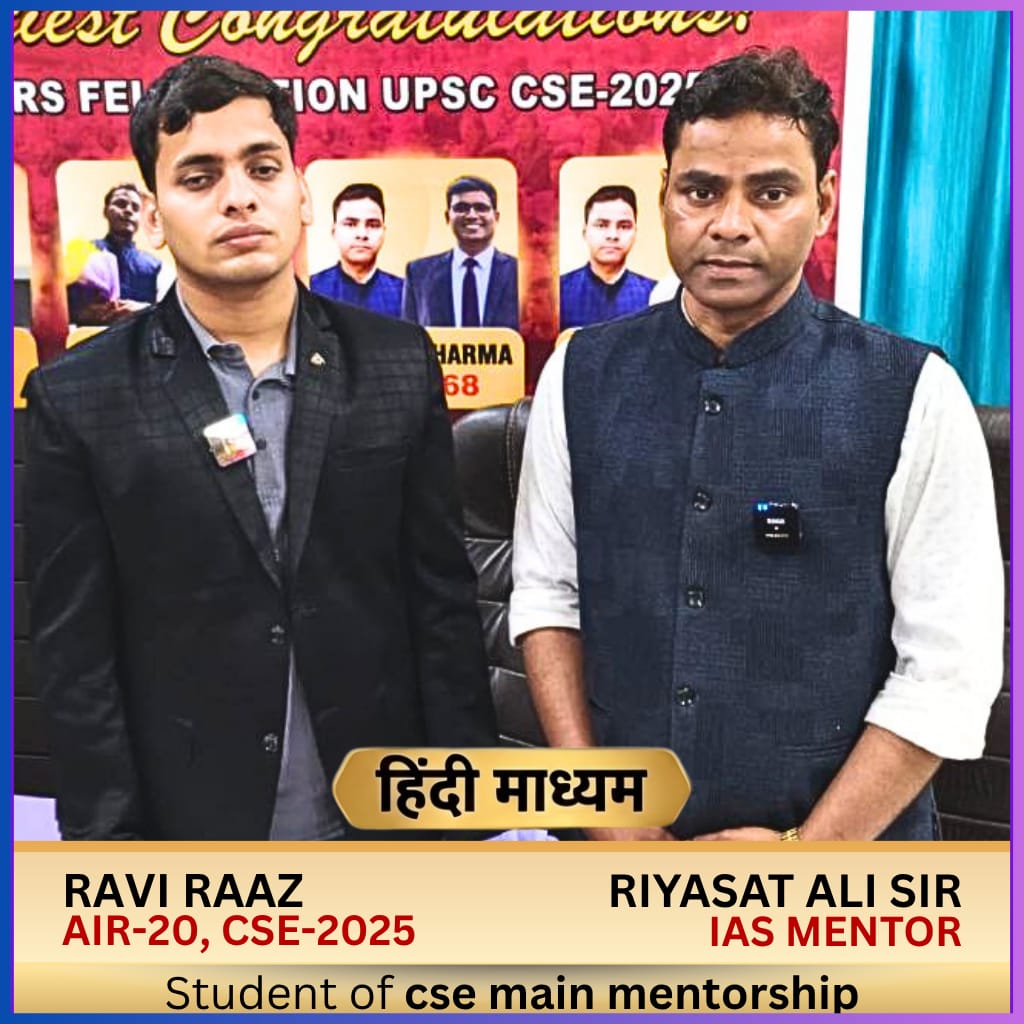 Ravi Raaz
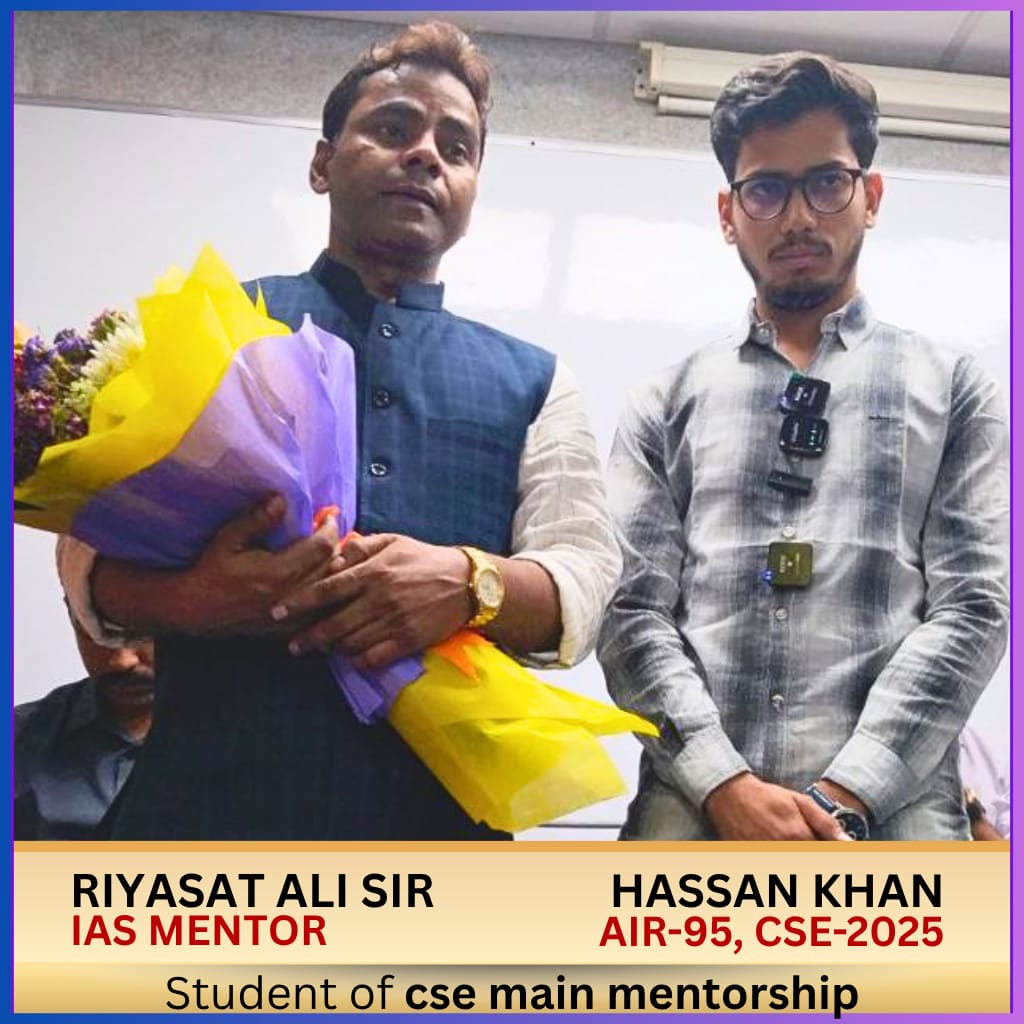 Hassan Khan
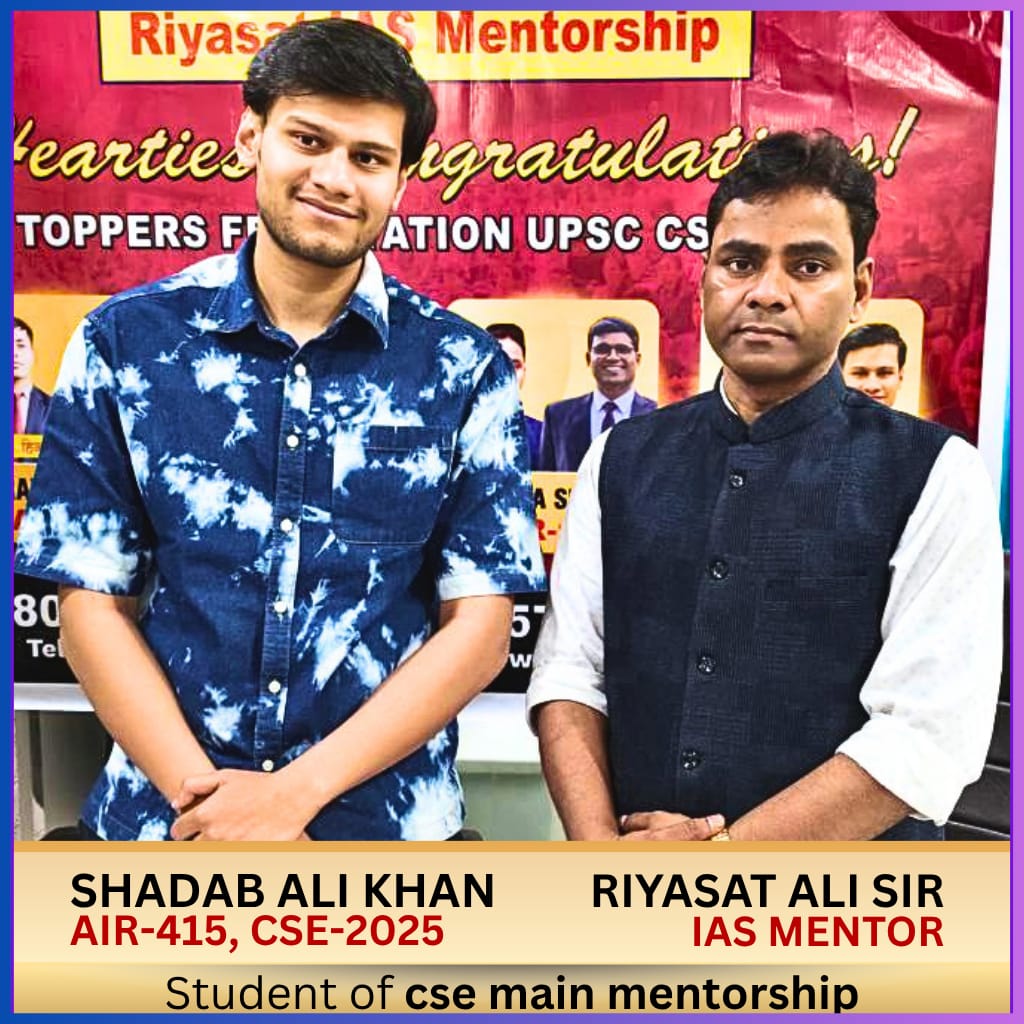 Shadab Ali