
GS-I: Geography | GS-III: Environment & Climate Change
Context
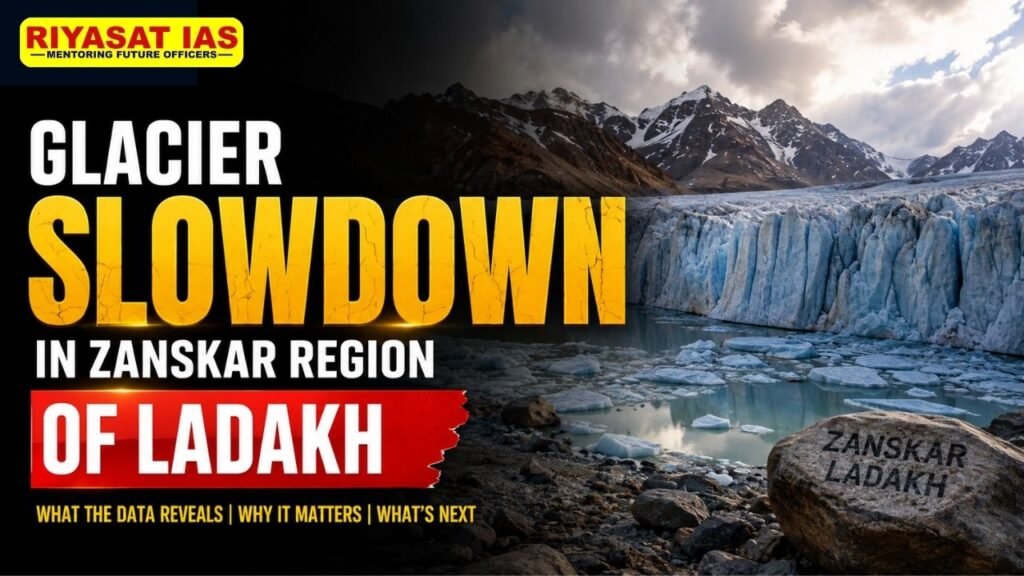
- New study: Glaciers in the Zanskar region of Ladakh are moving more slowly than they did 30 years ago.
- Importance: Zanskar contains some of the largest and most extensive glaciers in the Himalaya.
- Freshwater reservoirs: Glaciers release meltwater during warmer months, sustaining rivers, ecosystems, agriculture and local communities in arid Ladakh.
- Snowfall source: Most glaciers receive snowfall from mid-latitude westerly disturbances during winter.
- High-altitude setting: Their unique climatic setting makes their response to climate change different from glaciers in the eastern and central Himalaya.
Study Findings
- Study period: Researchers examined glacier flow from 1992 to 2023 across 12 glaciers in the Zanskar Himalaya.
- Satellite data: Researchers used satellite data to measure surface velocities and understand the transfer of ice from accumulation zones to lower elevations.
- Slowing glaciers: Glacier flow slowed by an average of 2.4 m/year per decade.
- Increasing thinning: Surface thinning increased from around 0.22 m/year during 2000–05 to 0.57 m/year during 2015–20.
- Basic mechanism: Greater ice loss → thinner glacier → lower driving stress → slower glacier flow.
- Reduced ice transport: Slower flow means less ice reaches lower parts of glaciers, potentially making continued shrinkage more likely.
Factors Affecting Glacier Flow
- Glacier geometry: The physical shape and structure of glaciers influence their movement.
- Debris cover: The amount and distribution of debris can affect glacier behaviour.
- Glacier terminus: Conditions at the snout/terminus can influence the rate of glacier flow.
- Local variations: Not all glaciers respond to warming in the same way.



Limitations of the Study
- Limited sample: The study covers 12 glaciers, whereas the Zanskar basin has around 1,755 glaciers.
- Satellite limitation: Surface velocity observations cannot directly reveal subglacial hydrology or basal sliding.
- Limited field data: Long-term measurements of ice thickness, mass balance and bed conditions remain limited.
- Cautious interpretation: Findings should therefore not automatically be extended to every glacier in Ladakh.
Impact on Indus Basin
- Summer flows: Glacier melt contributes significantly to Indus river flows during dry summer months.
- Peak water: Increased melting can temporarily increase runoff, known as “peak water”.
- Long-term decline: After substantial loss of stored ice, glacier meltwater contributions are expected to decline.
- Water security: Continued glacier thinning can affect water security, agriculture, hydropower and downstream ecosystems.
- Multiple factors: Indus flows also depend upon snowfall, rainfall, groundwater and water management.
Global Significance
- Wider trend: Similar glacier slowdowns have been reported in the European Alps, Alaska, Canadian Arctic, Andes and parts of the Tibetan Plateau.
- Common mechanism: In many regions, glacier thinning reduces driving stress, causing slower ice movement.
- Exceptions: Some glaciers may temporarily accelerate because of meltwater reaching the glacier bed, glacier surges or interactions with proglacial lakes/marine environments.
Way Forward
- Long-term monitoring: Strengthen long-term observations of glacier responses to climate change.
- Ground measurements: Increase measurements of ice thickness, mass balance, ice temperature and meltwater discharge.
- Satellite validation: Combine satellite observations with ground-based measurements to improve glacier models.
- High-altitude weather data: Expand continuous weather observations at high elevations.
Conclusion
Glacier slowdown in Zanskar demonstrates the link between climate-induced mass loss, glacier thinning and reduced ice transport. While glacier behaviour varies locally, continued thinning indicates declining long-term glacier water storage, making sustained monitoring crucial for the future water security of the Indus Basin.
UPSC Mains Practice Question
Q. Glacier slowdown is an important indicator of climate change and has implications for long-term water security. Discuss with reference to the Zanskar Himalaya and the Indus Basin.



 Ravi Raaz
 Hassan Khan
 Shadab Ali