
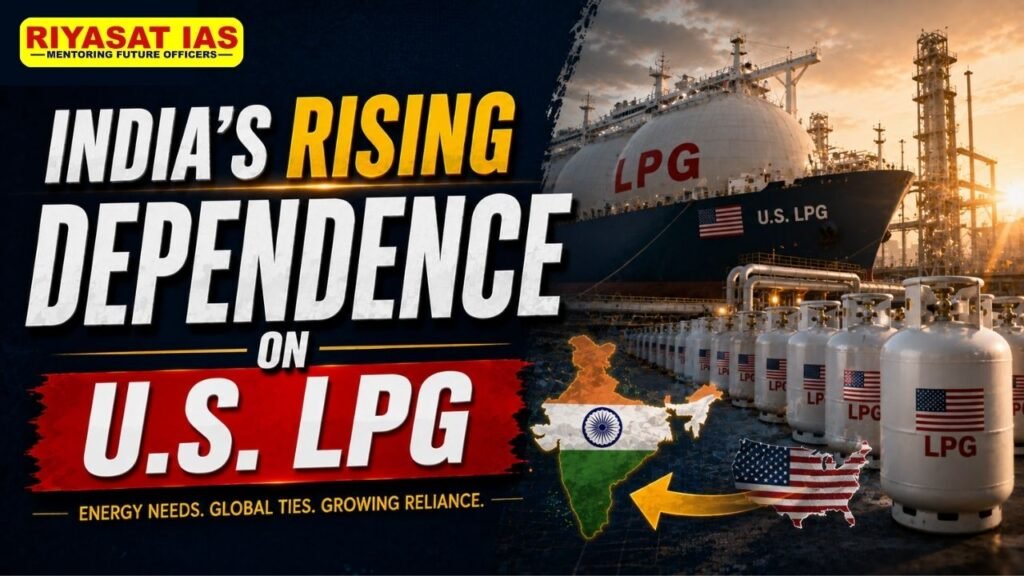
GS-III: Economy | Energy Security | Infrastructure
Context
- Rising U.S. dependence: Union Minister of Petroleum and Natural Gas Hardeep Singh Puri stated that 67% of India’s LPG came from the U.S., marking a major shift from the earlier decision to source about 10% of cooking gas from the U.S.
- Crisis management: India, the world’s second-largest importer of LPG, began increasing purchases from the U.S. amid disruptions linked to the Strait of Hormuz.
- Long-term deal: State-run oil refiners signed a long-term agreement for 2.2 million tonnes in 2026, although the exact contracted $/tonne or landed cargo price has not been publicly disclosed.
- Strategic significance: Greater reliance on the U.S. signals diversification of supply sources, but also raises concerns about replacing one form of dependence with another.
- Hormuz disruption: India’s LPG security cannot be anchored to a single geography, particularly given vulnerabilities associated with the Strait of Hormuz.
- Import shift: As per Vortexa, India’s LPG imports from West Asia fell by almost 85% between February 2026 and June 2026, while imports from other countries, including the U.S., increased.
- U.S. imports: India’s LPG imports from the U.S. reached 0.77 million metric tonnes in June.
Risk of Overdependence
- Market concentration: Overdependence on any single market is risky, particularly when energy supplies may become linked with bilateral trade and geopolitical considerations.
- Strategic leverage: Greater dependence on the U.S. could potentially allow energy supplies to become a bargaining tool in bilateral trade negotiations.
- Financial sanctions: The U.S. has historically used financial sanctions, export controls and technology restrictions as instruments of foreign policy.
- Third-country transactions: Even when commercial relations exist, the U.S. can influence third-country transactions through its sanctions framework.
- Sanctioning Russia and Iran Act: The Lindsey O. Graham Sanctioning Russia and Iran Act of 2026, proposing tariffs of up to 100% on the top five buyers of Russian oil and natural gas, represents a potential non-tariff trade barrier.
Proximity Pricing
- Traditional Gulf dependence: India has traditionally relied heavily on the Gulf region for LPG supplies.
- Import dependence: India imports about 60% of the LPG it consumes, with nearly 90% of imports passing through the Strait of Hormuz.
- Shipping distance: U.S. shipments generally take 25–35 days, compared with 5–10 days from the Gulf.
- Proximity advantage: India could therefore lose the advantage of proximity pricing by relying more heavily on distant U.S. supplies.
- U.S. LPG pricing: U.S. LPG, based largely on Mont Belvieu propane, claims a competitive advantage over West Asian supplies.
- West Asian pricing: West Asian LPG, linked to Saudi Aramco CP, is generally cheaper at the disembarking point because of the much shorter shipping distance.
- Geopolitical exception: However, geopolitical risks have temporarily increased the cost of West Asian supplies, making U.S. cargoes more competitive.



For more UPSC Related Current Affairs- Click here
Macroeconomic Risks
- U.S. monetary policy: If U.S. inflation remains elevated, the Federal Reserve may keep interest rates higher for longer.
- Stronger dollar: Tighter U.S. monetary policy can strengthen the dollar, increasing the rupee cost of imported LPG.
- Under-recoveries: If domestic LPG prices remain controlled while global prices rise and the rupee depreciates, oil companies’ under-recoveries can increase.
- Fiscal pressure: Higher under-recoveries can create additional fiscal and external-sector pressures.
- OMC under-recoveries: The government recently informed Parliament that accumulated under-recoveries of public sector Oil Marketing Companies (OMCs) exceeded ₹59,000 crore as of July 31, 2026.
India’s LPG Demand and Production
- Large consumer base: As per Petroleum Planning and Analysis Cell (PPAC) data, as of July 1, 2026, PSU OMCs — Indian Oil, Bharat Petroleum and Hindustan Petroleum — together had 33.14 crore active domestic LPG customers.
- Customer growth: The number of domestic LPG customers recorded a CAGR of 7.6% during 2015–2026.
- Consumption estimate: The original LPG consumption estimate for 2026–27 is 34,692 TMT.
- Production gap: Domestic LPG production has remained nearly stagnant and has not kept pace with rising consumption.
- Q1 FY27: LPG production was 4.3 MMT, while consumption stood at 6.5 MMT during the first quarter of FY27.
- Maximising domestic output: Refineries were directed to maximise LPG production by diverting propane, butane and other streams into the LPG pool.
- Production growth: In Q1 FY27, LPG production increased by 35.73% year-on-year to 4.26 MMT.
- Crisis response: At the peak of the crisis, OMCs increased cumulative daily LPG production from 34,000 MT to 55,000 MT, helping absorb some of the impact of lower imports.
Australia as an Alternative Source
- Strategic advantage: Australia offers strategic advantages because it is located in the Indo-Pacific, outside the Strait of Hormuz.
- Shorter route: Australia also offers a shorter route than the U.S.
- Limitation: Its LPG export volumes, however, are much smaller.
- Diversification: Australia can therefore form part of a diversified supply network but cannot immediately replace major suppliers.
Way Forward
- Avoid supplier dependence: Energy security should not mean replacing one supplier with another; it should ensure that no single player holds all the cards.
- Strengthen domestic production: India must increase domestic LPG production to reduce structural import dependence.
- Diversify suppliers: Multiple supply sources should be developed across the Gulf, U.S., Australia and other reliable markets.
- Build strategic reserves: India should strengthen strategic LPG reserves to absorb temporary geopolitical and supply disruptions.
- Strengthen supply chains: India should develop resilient and diversified LPG logistics and supply chains.
- Balance cost and security: Energy procurement should balance price competitiveness, supply reliability and geopolitical risk.
- Reduce single-route vulnerability: Greater attention should be given to alternative shipping routes and sources outside the Strait of Hormuz.
Conclusion
India’s shift towards U.S. LPG has helped mitigate the immediate risks arising from disruptions in the Strait of Hormuz, but excessive dependence on any single supplier creates new vulnerabilities. The objective of energy security should therefore not be to replace Gulf dependence with U.S. dependence, but to build a resilient system based on domestic production, diversified suppliers, multiple supply chains and strategic reserves.
UPSC Mains Practice Question
Q. “India’s LPG security cannot be achieved merely by replacing dependence on one supplier with dependence on another.” Discuss the challenges associated with India’s LPG import dependence and suggest measures to strengthen energy security.




 Ravi Raaz
 Hassan Khan
 Shadab Ali