
GS-II: International Relations | West Asia | India and the Gulf
Context
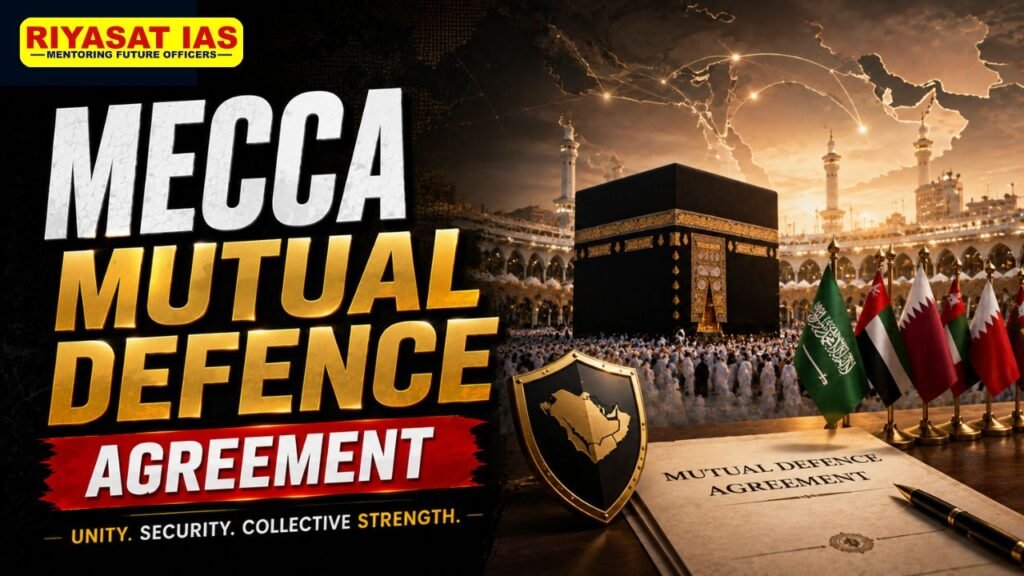
- Mecca Agreement: Saudi Arabia, Türkiye and Pakistan signed a mutual defence agreement in Mecca on August 7, under which an attack on one member would be considered an attack on all three.
- Geopolitical significance: The agreement could mark an important turning point in West Asian geopolitics and reflects changing strategic calculations among major Muslim countries.
- Strategic hedging: The pact does not end dependence on the United States, but indicates a growing effort by regional powers to supplement external security guarantees with their own arrangements.
- Changing security architecture: Traditionally, West Asian security has depended heavily on external powers; the agreement raises the possibility of a more autonomous regional security architecture.
The Pact Through India’s Eyes
- Avoid automatic hostility: India should not automatically interpret the agreement as an anti-Indian development.
- Saudi-India relations: India has developed exceptionally close relations with Saudi Arabia over the past two decades, including significant economic and strategic engagement.
- Saudi strategic interests: Riyadh has considerable economic and strategic interests in maintaining good relations with India and has little incentive to allow the pact to become an instrument in India-Pakistan disputes.
- Türkiye factor: Türkiye presents a more complicated challenge because Ankara has repeatedly supported Pakistan’s position on Kashmir and has supplied defence equipment to Pakistan.
- Need for reassurance: India should seek explicit reassurance from Saudi Arabia that the pact has no application to an India-Pakistan confrontation.
- Broader perspective: New Delhi should nevertheless avoid viewing the emerging alignment exclusively through the India-Pakistan prism.
Implications for Iran
- Possible anti-Iran interpretation: Given Saudi-Iranian rivalry and recent tensions, the pact could be viewed as an emerging anti-Iranian coalition.
- Competing interests: However, Türkiye and Pakistan share borders with Iran and have important interests in maintaining border stability.
- Avoiding confrontation: Both countries therefore have strong incentives to avoid an unnecessary confrontation with Tehran.
- Strategic ambiguity: The agreement’s implications for Iran are consequently complex rather than straightforward.



Implications for Israel
- Strategic concern: Israel may view the development with greater concern because one of its traditional strategic advantages has been the political and military fragmentation of the Muslim world.
- No explicit anti-Israel alliance: The Mecca agreement does not formally establish an anti-Israeli alliance.
- Changed calculations: Nevertheless, the institutionalised combination of Saudi financial power, Turkish conventional military strength and Pakistani nuclear capability could alter regional strategic calculations.
Implications for the United States
- Strategic paradox: The pact presents Washington with a paradox.
- Burden-sharing: The U.S. has long encouraged regional partners to assume greater responsibility for their own defence.
- Reduced leverage: However, greater regional responsibility can also generate greater strategic autonomy, potentially reducing American influence.
- No anti-American realignment: It would nevertheless be premature to describe the agreement as an anti-American realignment.
- Continued U.S. linkages: Saudi Arabia remains dependent on American military technology and security guarantees, Türkiye remains a NATO member, and Pakistan continues to maintain an important relationship with Washington.
Implications for India
- Strategic stakes: India has enormous economic, energy and strategic interests in West Asia and therefore cannot remain a passive observer.
- Diplomatic balancing: New Delhi should maintain strong relations with Saudi Arabia, Türkiye, Iran, Israel and other regional stakeholders.
- Saudi engagement: India should deepen its strategic partnership with Saudi Arabia while seeking clarity regarding the scope of the mutual defence commitment.
- Avoid overreaction: India should not respond with undue alarm or interpret every regional alignment exclusively through its Pakistan-centric lens.
- Strategic autonomy: India should strengthen its own strategic partnerships and pursue a policy of multi-alignment and strategic autonomy.
- Regional stability: India’s diplomacy should support an inclusive regional order based on dialogue, sovereignty, stability and economic interdependence.
Way Forward
- Strategic engagement: India should proactively engage emerging regional security arrangements rather than remain a spectator.
- Deepen Gulf partnerships: Economic, defence, energy and maritime cooperation with Saudi Arabia and other Gulf countries should be strengthened.
- Maintain Iran engagement: India should preserve its independent engagement with Iran while avoiding involvement in regional rivalries.
- Balance Pakistan factor: India should distinguish between the pact’s broader regional objectives and its possible implications for India-Pakistan relations.
- Strengthen maritime security: India’s role in ensuring the security of sea lanes, energy routes and the Indian Ocean–West Asian corridor should be enhanced.
- Promote regional autonomy: India should support a West Asian security environment that encourages regional ownership without creating exclusive military blocs.
Conclusion
The Mecca Mutual Defence Agreement should not be viewed simply as the emergence of a “Muslim NATO” or an anti-American, anti-Indian or anti-Iranian bloc. Its deeper significance lies in the emergence of strategic hedging and regional ownership of security. By combining Saudi financial power, Turkish conventional military strength and Pakistani military capabilities, the pact could influence the evolving security architecture of West Asia. For India, the appropriate response is neither alarm nor indifference, but proactive diplomacy, strategic autonomy and deeper engagement with all major regional stakeholders.
UPSC Mains Practice Question
Q. “The Mecca Mutual Defence Agreement reflects a shift from external security dependence towards regional strategic autonomy in West Asia.” Discuss its geopolitical implications and examine what it means for India.





 Ravi Raaz
 Hassan Khan
 Shadab Ali