
GS-I: Indian Culture | GS-III: Indian Economy | Handloom Sector | Rural Employment | Women Empowerment
Context
- National Handloom Day: Observed on August 7, commemorating the launch of the Swadeshi Movement in 1905.
- Nationalist legacy: From the boycott of British textiles to Mahatma Gandhi’s adoption of the spinning wheel, weaving became a symbol of economic resistance and self-reliance.
- Beyond cultural value: Indian handloom has historically been a major contributor to manufacturing, trade and India’s global economic influence.
- Contemporary significance: The sector remains an important source of rural non-farm employment, women’s livelihoods and cultural preservation.
A Legacy Beyond Craft
- Historical manufacturing power: Before the Industrial Revolution transformed European manufacturing, Indian textiles were among the world’s most important manufactured goods.
- Global trade: Indian textiles travelled across continents and contributed significantly to international trade.
- Economic foundation: Handloom was an important foundation of India’s historical manufacturing strength and global influence.
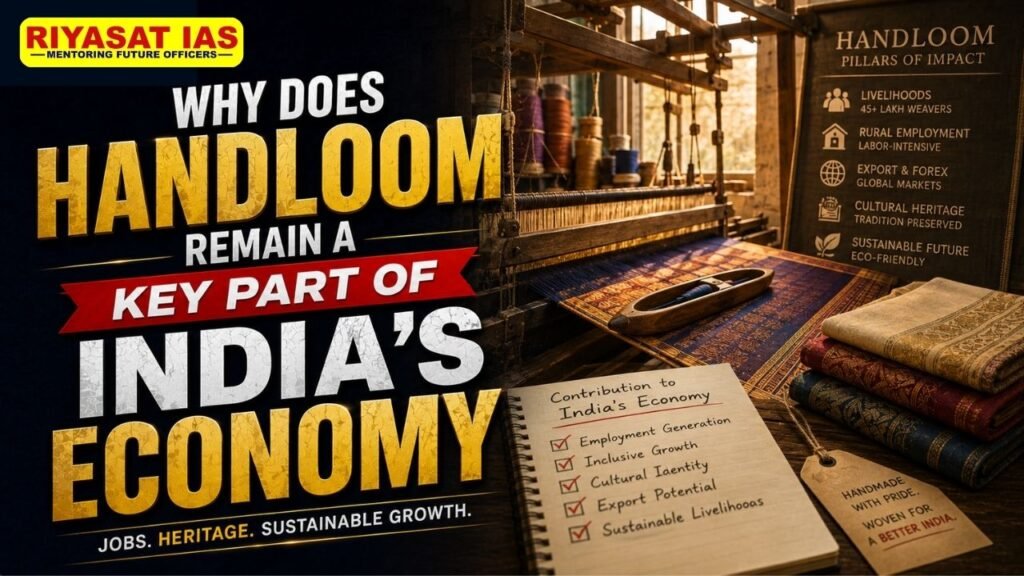
- Employment: The sector provides livelihoods to more than 35 lakh weavers and allied workers.
- Households: It covers more than 31 lakh households.
- Women’s participation: Women constitute nearly 70% of the workforce.
- Rural employment: Handloom remains one of rural India’s significant sources of non-farm employment.
- Production: The sector produces nearly 15% of India’s cloth despite relying largely on manual technology.
- Capital efficiency: Few manufacturing activities generate comparable employment with such modest capital investment.
Threat of Disappearing Weaves
- Declining returns: Lower economic returns are encouraging younger generations to leave the weaving profession.
- Fragmented markets: Limited market access and fragmented value chains reduce the profitability of traditional weaving.
- Skill transmission: Traditional skills are increasingly failing to pass from one generation to the next.
- Cultural loss: Disappearing weaves represent the loss of centuries of traditional knowledge, design vocabulary and cultural identity.
- Civilisational heritage: Protecting handloom is therefore not merely an economic concern but also a cultural and civilisational responsibility.
Government Support
- National Handloom Development Programme: Focuses on skill development, design innovation, technology adoption, branding and market access.
- E-commerce integration: Greater access to digital marketplaces is helping artisan clusters reach consumers beyond traditional markets.
- Export opportunities: Expanding international markets can provide new avenues for income and growth.
- Targeted intervention: Successful clusters demonstrate that traditional crafts can thrive when design, institutional support and market access converge.
- Examples of revival: The revival of Tangaliya weaving in Gujarat, transformation of Badturang village in Odisha’s Sambalpur district, and growing popularity of Siddipet Gollabhama sarees illustrate the potential of targeted intervention.
- International visibility: The use of traditional Tangaliya weaving in popular culture and international fashion demonstrates the potential of global branding for Indian handlooms.



Documentation and GI Protection
- UNESCO collaboration: The Office of the Development Commissioner for Handlooms, in collaboration with UNESCO, has initiated identification and documentation of languishing and endangered weaves.
- Need for wider coverage: Documentation should be expanded to cover traditional weaving clusters across the country.
- Geographical Indication: GI-tagged handloom products can help establish authenticity, geographical identity and market differentiation.
- Market positioning: Stronger branding can enhance the presence of Indian handlooms in domestic and international markets.
- Cultural protection: GI protection can also help address misappropriation and unauthorised commercial use of traditional designs.
Making Handloom Aspirational
- From preservation to aspiration: Policy should move beyond merely preserving traditional crafts towards making handloom contemporary, fashionable and aspirational.
- Gen Z market: Younger consumers should be targeted through modern designs and contemporary product formats.
- Celebrity ambassadors: Public figures can help reposition handloom as a premium lifestyle choice.
- Designer collaborations: Partnerships with leading designers can combine traditional craftsmanship with modern aesthetics.
- Digital storytelling: Social media and digital platforms can communicate the history, craftsmanship and cultural value behind individual weaves.
- Limited editions: Limited production can be positioned as a feature of exclusivity and premium value.
- Sustainability: Handloom can be promoted not simply because it is old, but because it represents craftsmanship, sustainability and uniqueness.
Global Market Potential
- Changing consumer preferences: Global markets increasingly value authenticity, sustainability and handcrafted luxury.
- Competitive advantage: Indian handlooms possess a natural advantage in these segments because of their craftsmanship, cultural diversity and traditional knowledge.
- Export expansion: India should use handloom as a tool for strengthening textile exports and cultural diplomacy.
- Quality standards: International expansion requires consistent quality and standardisation.
- Branding: Strong global branding is necessary to transform individual Indian weaves into recognisable premium products.
- GI protection: Stronger GI enforcement can protect the authenticity and economic interests of artisan communities.
- Cultural misappropriation: Vigilant action is needed against the unauthorised appropriation of traditional designs and cultural expressions.
Handloom as Soft Power
- Cultural diplomacy: Traditional Indian textiles can strengthen India’s cultural influence abroad.
- Civilisational identity: Handloom reflects India’s diverse regional traditions, craftsmanship and cultural heritage.
- Global branding: Indian weaves can become instruments of nation branding and soft power.
- Ancient knowledge: Traditional textile practices demonstrate the continuity of India’s craft and design traditions.
- Economic diplomacy: Greater international visibility can simultaneously support exports, tourism and cultural diplomacy.
Need for Better Data
- Measurement gap: India’s handloom economy remains inadequately measured.
- Economic contribution: Reliable data are needed on its contribution to GDP, exports, tax revenues, employment and household incomes.
- Evidence-based policy: Better data would enable more effective policy design and resource allocation.
- Recognition: Accurate measurement would help establish handloom as a serious economic sector rather than merely a cultural activity.
- National platform: A common platform for States, producer organisations and cooperatives could facilitate exchange of successful practices and accelerate innovation.
Way Forward
- Modernise without destroying tradition: Promote design and technology while retaining the authenticity of traditional weaving techniques.
- Improve market access: Strengthen e-commerce, organised retail and export channels.
- Strengthen artisan incomes: Ensure that a larger share of the final product value reaches weavers and producer communities.
- Skill transmission: Create programmes that make weaving economically viable and attractive to younger generations.
- Brand India: Build a coordinated international brand for Indian handloom and GI-tagged products.
- Protect traditional knowledge: Strengthen GI enforcement and protection against cultural misappropriation.
- Improve data systems: Establish reliable and regularly updated data on the economic and social contribution of handloom.
- Promote sustainability: Position handloom as part of India’s transition towards sustainable and resource-efficient production.
Conclusion
Handloom is not merely a relic of India’s past but a strategic asset for its future. It simultaneously contributes to rural employment, women’s empowerment, cultural preservation, sustainable production and India’s global soft power. As India pursues the vision of Viksit Bharat, the success of handloom policy should ultimately be measured not merely by the number of schemes implemented, but by how many looms remain active, profitable and attractive to the next generation of weavers.
UPSC Mains Practice Question
Q. “Indian handloom is not merely a cultural heritage but a strategic economic and soft-power asset.” Discuss the contribution of the handloom sector to employment, women’s empowerment, cultural preservation and India’s global economic presence.



 Ravi Raaz
 Hassan Khan
 Shadab Ali