
Introduction
An economic system refers to the way a society organises the production, distribution, and consumption of goods and services. It determines how scarce resources are allocated, what goods are produced, how they are produced, and for whom they are produced.
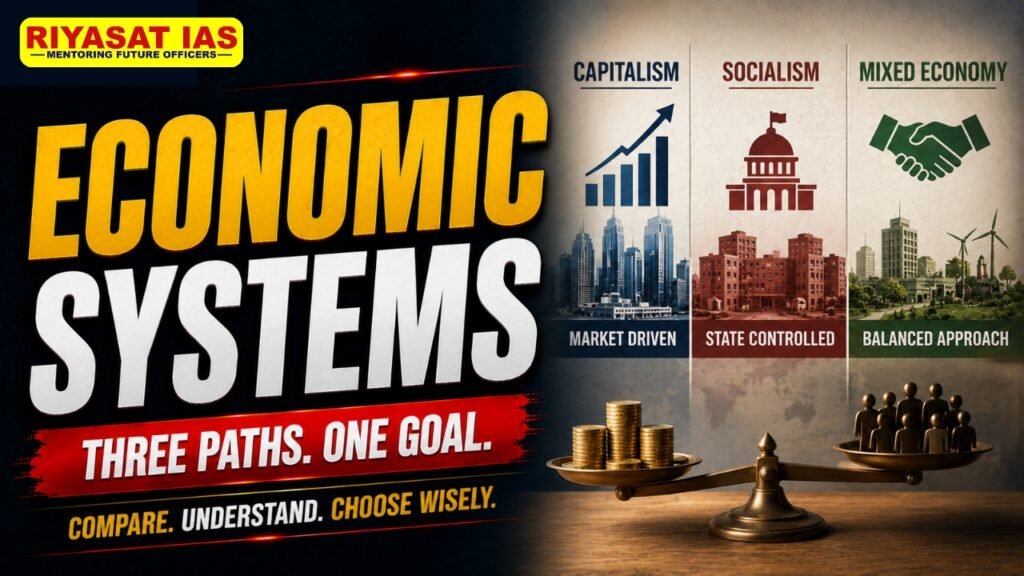
Different countries adopt different economic systems based on their historical experiences, political ideologies, and developmental objectives. Broadly, economic systems are classified into capitalist, socialist, and mixed economies.
Types of Economic Systems
• Capitalist Economy: Economic activities are primarily guided by market forces, private ownership, competition, and the profit motive.
• Socialist Economy: Major economic resources are owned or controlled by the state, with production and distribution guided through central planning.
• Mixed Economy: Combines private enterprise and market mechanisms with government intervention, regulation, and welfare measures.
Capitalist Economy
A capitalist economy, also known as a market economy, is a system in which the means of production are primarily owned and controlled by private individuals and firms. Economic decisions are largely determined by demand, supply, prices, and competition.
Features of Capitalist Economy
• Private Property: Individuals and firms can own productive assets and property, including land, houses, stocks, and bonds.
• Profit Motive: Production and investment decisions are primarily influenced by the objective of earning profits.
• Price Mechanism: Prices are largely determined by market forces of demand and supply.
• Economic Freedom: Producers have freedom to decide what and how to produce, while consumers can choose among different goods and services.
• Competition: Competition among producers encourages efficiency, innovation, and better-quality products.
• Limited Government Role: The government generally focuses on maintaining law and order, protecting property rights, enforcing contracts, and regulating markets.
Advantages of Capitalist Economy
• Promotes Innovation: Competition and the profit motive encourage technological advancement and innovation.
• Improves Efficiency: Market competition encourages firms to use resources efficiently.
• Encourages Entrepreneurship: Individuals have greater freedom to establish businesses and pursue investment opportunities.
• Provides Consumer Choice: Consumers can choose from a wide range of goods and services.
Disadvantages of Capitalist Economy
• Economic Inequality: Unequal ownership of wealth and productive assets can create significant income and wealth disparities.
• Risk of Monopoly: Excessive concentration of economic power can result in monopolies and reduced competition.
• Social Inequality: Market-based allocation may make essential goods and services less accessible to poorer sections.
Examples
Singapore and Hong Kong are examples of economies with strong market-oriented characteristics.
Socialist Economy
A socialist economy, also known as a planned or command economy, is a system in which major means of production are owned or controlled by the state or community. Economic decisions are primarily determined through central planning, with emphasis on social welfare and equitable distribution rather than private profit.
Features of Socialist Economy
• State Ownership: Major industries, natural resources, banks, and public utilities are generally owned or controlled by the state.
• Centralised Planning: A central planning authority determines what goods should be produced, how much should be produced, how production should take place, and how goods should be distributed.
• Welfare Orientation: Economic activities are directed towards meeting social needs and ensuring access to essential services such as healthcare and education.
• Reduction of Inequality: The system seeks to reduce income and wealth disparities through greater state control and redistribution.



• Limited Role of Market Forces: Prices and production decisions are primarily influenced by government planning rather than demand and supply.
Advantages of Socialist Economy
• Reduces Inequality: Greater state control and redistribution can promote more equitable distribution of resources.
• Universal Access: The system prioritises access to essential goods and services such as healthcare and education.
• Focuses on Social Welfare: Economic planning is directed towards broader social objectives rather than only private profit.
• Planned Resource Allocation: The government can direct resources towards sectors considered strategically or socially important.
Disadvantages of Socialist Economy
• Lower Competition: Limited competition can reduce incentives for efficiency and innovation.
• Weak Profit Incentives: Limited private profit incentives may reduce entrepreneurship and productivity.
• Administrative Inefficiency: Excessive central control can result in delays, bureaucratic rigidity, and inefficient allocation of resources.
Examples
Historical and contemporary examples associated with planned socialist systems include the former Soviet Union, Cuba, and North Korea.
Socialism in India
After Independence, India adopted several socialist-oriented economic policies while retaining private ownership and market activity.
Major measures included:
• Five-Year Plans: Used central planning to direct investment and development priorities.
• Expansion of Public Sector Enterprises: The government established and expanded enterprises in strategic and basic industries.
• Bank and Insurance Nationalisation: Major financial institutions were brought under greater government ownership and control.
• Land Reforms: Policies were introduced to address unequal land ownership and rural inequalities.
However, India did not adopt a pure socialist economy. It evolved towards a mixed economy, combining public-sector participation with private enterprise and market mechanisms.
Mixed Economy
A mixed economy combines elements of capitalism and socialism. Both the private sector and the government participate in economic activities, while market forces operate alongside government regulation, public investment, and welfare policies.
India follows a mixed economic system.
Features of Mixed Economy
• Public and Private Sector Coexistence: Both the government and private enterprises participate in production and economic activities. Strategic sectors may have significant government involvement, while private firms operate across manufacturing, trade, and services.
• Economic Freedom with Regulation: Private individuals and firms can establish businesses and earn profits, while the government regulates markets to prevent exploitation, monopolies, and unfair practices.
• Profit with Social Welfare: The private sector generally operates according to profit incentives, while the government focuses on social welfare and equitable development.
• Consumer Choice with Public Welfare: Consumers have freedom of choice, while government intervention seeks to ensure access to essential goods and services.
Advantages of Mixed Economy
• Balances Efficiency and Welfare: It combines market-driven efficiency with government intervention for social objectives.
• Encourages Private Initiative: Individuals and firms retain the freedom to invest, innovate, and undertake business activities.
• Promotes Social Welfare: Government intervention supports public services, social protection, and redistribution.
• Controls Market Failures: Regulation can address monopolies, externalities, information failures, and other market imperfections.
Disadvantages of Mixed Economy
• Excessive Regulation: Over-regulation can reduce efficiency and discourage private investment.
• Policy Conflicts: Differences between public welfare objectives and private profit motives can create tensions.
• Government Distortions: Poorly designed subsidies, controls, or regulations may distort market incentives.
Examples
India and Canada are examples of economies combining market mechanisms with significant government intervention and welfare policies.
Difference Between Capitalist and Socialist Economy
| Feature | Capitalist Economy | Socialist Economy |
| Ownership | Primarily private | Primarily state-owned |
| Main Objective | Profit maximisation | Social welfare |
| Price Determination | Market forces | Government planning |
| Competition | High | Limited |
| Role of Government | Generally limited | Dominant |
| Resource Allocation | Demand and supply | Central planning |
Comparison of Economic Systems
| Feature | Capitalist Economy | Socialist Economy | Mixed Economy |
| Ownership | Private individuals and firms | Government | Public and private sectors |
| Main Objective | Profit maximisation | Social welfare | Growth with welfare |
| Price Determination | Market forces | Government | Market forces + Government intervention |
| Role of Government | Limited | Dominant | Moderate and regulatory |
| Competition | High | Limited | Regulated competition |
| Resource Allocation | Market mechanism | Central planning | Market mechanism with government intervention |
India as a Mixed Economy
India’s economic system combines market-oriented policies with government intervention and social welfare objectives. Economic reforms since 1991 have increased the role of private enterprise, competition, foreign investment, and market forces.
At the same time, the government continues to play an important role in areas such as infrastructure, social welfare, public health, education, strategic industries, and economic regulation.
Thus, India’s economic model seeks to balance economic efficiency, private initiative, social justice, and inclusive development.
Conclusion
An economic system determines how a society uses its scarce resources to organise production, distribution, and consumption. While capitalism emphasises private ownership, market forces, competition, and profit, socialism focuses on state ownership, central planning, and social welfare.
A mixed economy attempts to combine the strengths of both systems by allowing market-based economic activity while using government intervention to address market failures, promote welfare, and reduce inequality. Most modern economies operate with varying degrees of both market mechanisms and government intervention, making the mixed economy an important model for balancing economic growth with social welfare and stability.
Frequently Asked Questions (FAQs)
What is an Economic System?
An economic system is the method through which a society organises the production, distribution, and consumption of goods and services and allocates scarce resources.
What are the three main types of Economic Systems?
The three broad types are capitalist economy, socialist economy, and mixed economy.
What is a Capitalist Economy?
A capitalist economy is based primarily on private ownership, market forces, competition, economic freedom, and the profit motive.
What is a Socialist Economy?
A socialist economy is an economic system in which major means of production are owned or controlled by the state, with economic decisions guided largely by central planning and social welfare objectives.
What is a Mixed Economy?
A mixed economy combines private enterprise and market mechanisms with government intervention, regulation, and welfare policies.
Is India a Capitalist or Socialist Economy?
India follows a mixed economy. It allows private enterprise and market-based economic activities while maintaining significant government involvement in regulation, public services, infrastructure, and social welfare.
What is the main difference between Capitalism and Socialism?
The primary difference lies in ownership and resource allocation. Capitalism relies mainly on private ownership and market forces, while socialism emphasises state ownership and central planning.
What are the advantages of a Mixed Economy?
A mixed economy seeks to combine the efficiency and innovation of markets with government intervention to promote social welfare, reduce inequality, and address market failures.
Why did India adopt a Mixed Economy after Independence?
India adopted a mixed economic model to combine economic growth and private initiative with social justice, public investment, planned development, and welfare objectives.
What are the major features of India’s Mixed Economy?
India’s mixed economy is characterised by coexistence of public and private sectors, market-based activity, government regulation, public investment, and social welfare programmes.




 Ravi Raaz
 Hassan Khan
 Shadab Ali