
Introduction
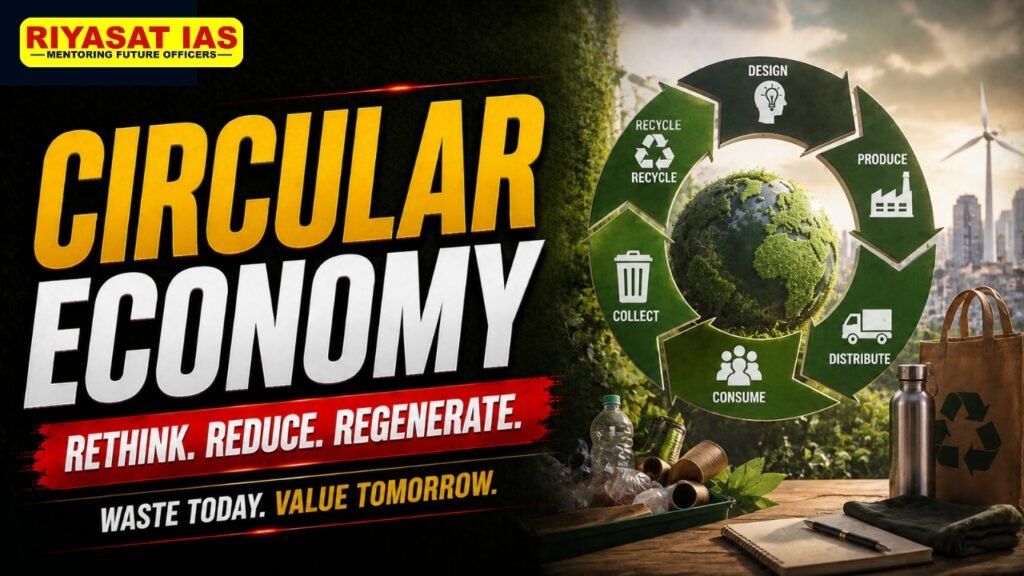
The Circular Economy is an economic model that aims to minimise waste, conserve natural resources, and keep products and materials in use for as long as possible. It provides an alternative to the traditional linear economy, which follows a “take-make-dispose” approach and often leads to resource depletion, waste generation, and environmental degradation.
The circular economy promotes reuse, repair, refurbishment, remanufacturing, recycling, and resource recovery while encouraging sustainable production and consumption. It is increasingly important for India as the country seeks to balance economic growth with resource efficiency, climate action, and environmental sustainability.
The concept is closely aligned with the Sustainable Development Goals (SDGs), particularly responsible consumption and production, climate action, sustainable cities, and sustainable industries.
Circular Economy: Meaning
A circular economy is an economic system designed to eliminate waste and pollution, keep products and materials in continuous use, and regenerate natural systems.
Unlike the linear model, where resources are extracted, converted into products, consumed, and discarded, a circular economy seeks to close material loops through maintenance, reuse, repair, refurbishment, remanufacturing, and recycling.
The central objective is to decouple economic growth from the continuous consumption of finite natural resources.
Core Principles of Circular Economy
• Eliminate Waste and Pollution: Products and production processes should be designed to minimise waste, pollution, and harmful emissions from the outset.
• Keep Products and Materials in Use: Products should remain useful for as long as possible through repair, reuse, refurbishment, remanufacturing, and recycling.
• Regenerate Natural Systems: Economic activities should support ecosystem restoration, biodiversity conservation, renewable energy use, and sustainable resource management.
• Close Material Loops: Materials recovered from used products should be returned to production processes instead of being discarded.
• Design for Longevity: Products should be designed for durability, repairability, disassembly, and resource recovery.
Circular Economy vs Linear Economy
The fundamental difference between the two models lies in how resources are used and managed.
| Feature | Linear Economy | Circular Economy |
| Basic Model | Take–Make–Dispose | Reduce–Reuse–Recover |
| Resource Use | Primarily based on extraction | Focuses on efficient and repeated use |
| Product Life | Relatively short | Extended through repair and reuse |
| Waste | Treated largely as an end product | Minimized and converted into a resource |
| Production | Resource-intensive | Resource-efficient |
| Environmental Focus | Limited | Sustainability and regeneration |
Seven Pillars of the Circular Economy
The circular economy extends beyond recycling. Its broader framework emphasises resource efficiency, ecological protection, human well-being, and social sustainability.
• Cycle Materials at High Value: Materials should be reused at their highest possible value for as long as possible, with minimum material mixing and unnecessary transportation.
• Protect Biodiversity: Circular activities should minimise damage to ecosystems and recognise biodiversity as essential to ecological resilience.
• Use Water Sustainably: Water should be conserved, reused, and recovered efficiently while preventing pollution and protecting aquatic ecosystems.
• Preserve Society and Culture: Circular development should respect cultural values, social cohesion, and the interests of different stakeholders.
• Prioritise Human Health and Well-being: Harmful substances and unsafe practices should be eliminated or strictly controlled to protect people and the environment.
• Use Limited Resources Fairly: Scarce resources should be used efficiently to maximise social, economic, ecological, and cultural value rather than focusing only on financial returns.



Examples of Circular Economy
Electronics Industry
The electronics industry provides a practical example of circular economy principles. Products such as smartphones can be designed for easier disassembly, repair, refurbishment, and recycling.
Used devices can be refurbished for further use, while valuable materials such as metals and rare earth elements can be recovered and returned to production. This reduces e-waste, conserves resources, and lowers the environmental impact of manufacturing.
Furniture Reuse
Furniture buy-back and resale programmes provide another example of circular business models. Instead of discarding used furniture, products can be collected, refurbished, resold, or recycled, thereby extending their useful life and reducing waste.
Circular Economy and Sustainable Development
The Circular Economy is closely linked with broader sustainable development objectives because it seeks to reduce resource consumption while maintaining economic activity.
• Green Economy: Both models promote resource efficiency, environmental protection, and sustainable economic growth.
• Blue Economy: Circular principles can support sustainable use of ocean resources and help reduce marine pollution and waste.
• Sustainable Development Goals: The circular economy particularly supports responsible consumption and production, climate action, sustainable cities, and sustainable industries.
• Climate Action: Efficient resource use, recycling, reuse, and lower dependence on virgin materials can help reduce environmental pressures and emissions.
Circular Economy in India’s Economy
The circular economy has relevance across major sectors of the Indian economy.
• Manufacturing: Promotes resource-efficient production, product durability, repair, remanufacturing, and recycling.
• Agriculture: Supports composting, organic waste utilisation, nutrient recovery, and efficient resource use.
• Services: Encourages sharing platforms, product-as-a-service models, repair services, and digital platforms for resource sharing.
• Urban Economy: Supports waste segregation, recycling, composting, wastewater treatment, and efficient urban resource management.
• Digital Economy: Technologies such as Artificial Intelligence, blockchain, data analytics, and digital tracking can improve material traceability, e-waste management, reverse logistics, and resource recovery.
Benefits of Circular Economy
The circular economy generates environmental, economic, and social benefits by reducing resource consumption and improving the efficiency of production and consumption.
Environmental Benefits
• Resource Conservation: Reuse, repair, and recycling reduce dependence on virgin raw materials and help conserve finite natural resources.
• Waste Reduction: Circular production reduces the quantity of waste sent to landfills and helps recover valuable materials from discarded products.
• Lower Carbon Footprint: Efficient resource use, recycling, and remanufacturing can reduce the emissions associated with extraction and production.
• Ecosystem Protection: Reduced resource extraction and pollution can help protect biodiversity, soil, water, and other natural ecosystems.
Economic Benefits
• Lower Production Costs: Reuse, remanufacturing, and efficient resource management can reduce material and operational costs for businesses.
• New Business Models: Leasing, sharing, product-as-a-service, repair, refurbishment, and resale models create new economic opportunities.
• Employment Generation: Recycling, repair, remanufacturing, waste management, and resource recovery can generate new employment opportunities.
• Resource Security: Reducing dependence on imported and finite raw materials can strengthen economic resilience.
Social Benefits
• Affordable Products: Refurbished, repaired, and shared products can make goods more affordable for consumers.
• Healthier Environment: Reduced landfill waste, pollution, and unsafe disposal practices can improve public health and environmental quality.
• Inclusive Employment: Local repair, recycling, waste management, and resource recovery activities can generate livelihood opportunities.
Challenges in Adopting Circular Economy
The transition from a linear to a circular economy faces regulatory, technological, financial, infrastructural, organisational, and behavioural barriers.
• Regulatory Gaps: Fragmented regulations and inconsistent standards can make it difficult to establish uniform circular economy practices across industries.
• Technological Limitations: Limited recycling technologies, weak material traceability, and difficulties in designing products for circularity can slow adoption.
• Inadequate Infrastructure: Weak collection, segregation, sorting, reverse logistics, and recycling infrastructure limit efficient material recovery.
• High Initial Costs: Circular production systems may require significant upfront investment in new technologies, infrastructure, and business models.
• Complex Supply Chains: Recovering used products and materials requires coordination among manufacturers, consumers, recyclers, logistics providers, and regulators.
• Consumer Behaviour: Low awareness, limited demand for refurbished products, and reluctance to return used products can restrict circular business models.
• Material Contamination: Poor waste segregation can reduce the quality and economic value of recovered materials.
Way Forward
India needs an integrated approach combining policy reforms, technology, infrastructure, private investment, and behavioural change to accelerate the transition towards a circular economy.
• Strengthen Regulatory Framework: Develop clear and harmonised regulations, standards, and targets for recycled materials, product design, waste management, and resource recovery.
• Promote Extended Producer Responsibility: Strengthen EPR mechanisms to ensure producers remain responsible for the collection, recovery, recycling, and safe disposal of products after use.
• Develop Circular Economy Infrastructure: Invest in collection, segregation, recycling, reverse logistics, repair, refurbishment, and urban composting facilities.
• Promote Research and Development: Increase investment in advanced recycling, material recovery, renewable-energy technologies, and environmentally sustainable production processes.
• Use Digital Technologies: Employ Artificial Intelligence, blockchain, digital product tracking, and data analytics to improve traceability, material recovery, and reverse logistics.
• Encourage Circular Business Models: Promote leasing, sharing, repair, refurbishment, remanufacturing, resale, and product-as-a-service models.
• Improve Consumer Awareness: Encourage sustainable consumption, product repair, reuse, waste segregation, and responsible disposal.
• Strengthen Industry-Government Collaboration: Encourage partnerships between government, businesses, research institutions, and local communities to scale circular solutions.
Conclusion
The Circular Economy provides an alternative to the resource-intensive linear model by reducing waste, extending product lifecycles, conserving resources, and regenerating natural systems. It can simultaneously support environmental sustainability, economic resilience, innovation, and employment generation.
For India, adopting circular economy principles across manufacturing, agriculture, services, and urban systems can reduce resource dependence while supporting sustainable economic growth. A combination of effective regulation, circular infrastructure, technological innovation, responsible consumption, and industry participation will be essential for making India’s transition towards a resource-efficient and sustainable economy successful.
Frequently Asked Questions (FAQs)
What is a Circular Economy?
A Circular Economy is an economic model that minimises waste and pollution by keeping products and materials in use for as long as possible through reuse, repair, refurbishment, remanufacturing, and recycling.
What is the difference between a Linear Economy and a Circular Economy?
A linear economy follows a “take-make-dispose” model, while a circular economy seeks to reduce resource extraction and keep products and materials in continuous use.
What are the core principles of the Circular Economy?
The core principles are eliminating waste and pollution, keeping products and materials in use, and regenerating natural systems.
What are the benefits of a Circular Economy?
Major benefits include resource conservation, waste reduction, lower environmental impact, new business opportunities, employment generation, and improved resource security.
What are the major challenges to the Circular Economy?
Key challenges include inadequate infrastructure, regulatory gaps, high initial costs, technological limitations, weak reverse logistics, complex supply chains, and consumer behaviour.
How is the Circular Economy relevant to India?
It can help India reduce resource dependence, manage growing waste, improve manufacturing efficiency, create green jobs, reduce environmental pressures, and support sustainable economic growth.
What is the role of technology in the Circular Economy?
Artificial Intelligence, blockchain, digital tracking, and data analytics can improve material traceability, e-waste management, reverse logistics, recycling, and resource recovery.



 Ravi Raaz
 Hassan Khan
 Shadab Ali