
Introduction
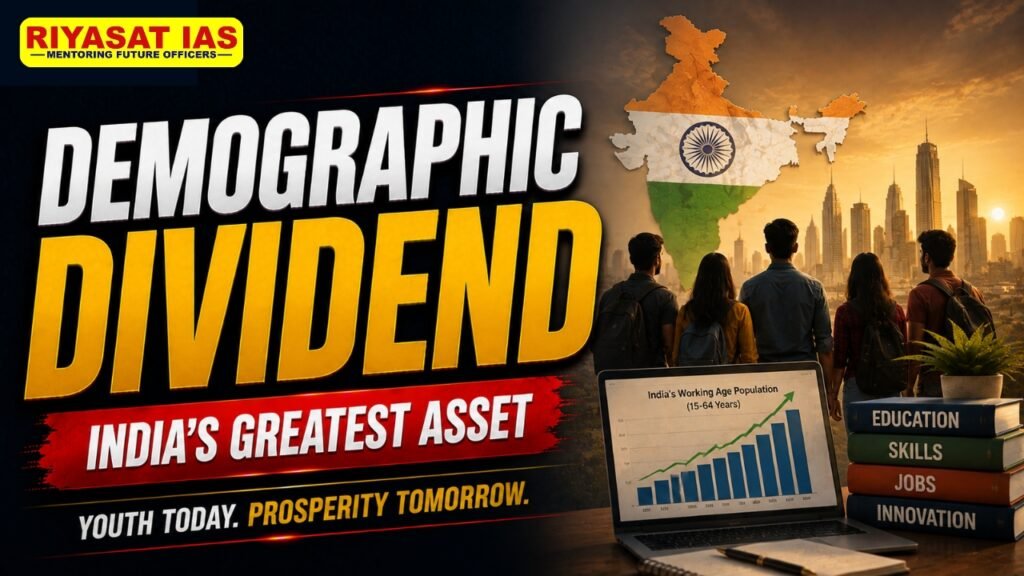
The demographic dividend refers to the economic growth potential that can arise from changes in a country’s age structure. According to the United Nations Population Fund (UNFPA), it occurs when the proportion of the working-age population (15–64 years) becomes larger than the dependent population, comprising children and the elderly.
India is one of the world’s youngest major economies. Since 2018, India’s working-age population has become larger than its dependent population, creating a significant opportunity for faster economic growth. This demographic window is expected to remain open for several decades, although its timing and duration vary across states.
For India, the demographic dividend can support higher economic growth, employment, savings, investment, and women’s workforce participation. However, this opportunity is not automatic. It can be realised only when the growing working-age population is adequately educated, skilled, healthy, and provided with productive employment.
Demographic Dividend in India
India’s demographic transition has created a large working-age population relative to dependants, providing the country with an important opportunity for economic transformation.
• Young Population: India has one of the youngest populations in an ageing world, providing a large potential workforce.
• Growing Working-age Population: Since 2018, the working-age population has exceeded the dependent population, creating favourable demographic conditions for economic growth.
• Declining Fertility: The transition towards a larger working-age population is associated with declining fertility and stabilisation of life expectancy.
• Long Demographic Window: According to the UNFPA-based material, India’s demographic dividend opportunity extends from approximately 2005–06 to 2055–56, giving India a longer window than many other countries.
• State-level Variation: The demographic dividend does not occur simultaneously across India. Different states enter and exit the demographic window at different times because of variations in fertility, mortality, and population structures.
Benefits of Demographic Dividend
A favourable age structure can create several economic and social advantages, provided the available workforce is productively employed.
• Higher Economic Growth: A larger working-age population can expand economic activity, production, and overall productivity.
• Larger Labour Force: An increase in the working-age population expands the potential labour supply and can strengthen productive capacity.
• Higher Savings and Investment: Working-age individuals are generally in their prime earning and saving years, which can increase domestic savings and investment.
• Greater Fiscal Space: A larger working population can expand the tax base and reduce the relative burden of spending on dependants, creating greater fiscal space for investment in infrastructure and human capital.
• Higher Female Workforce Participation: Declining fertility can create greater opportunities for women to participate in education, employment, and economic activities.
• Expansion of the Middle Class: Rising employment, income, and consumption can contribute to the growth of an aspirational and middle-class population.
• Industrialisation and Urbanisation: A growing working-age population can increase demand for employment and economic opportunities, accelerating industrialisation and urban development.
The experience of countries such as Japan and South Korea demonstrates how favourable demographic changes, when combined with appropriate economic policies and investment in human capital, can contribute to rapid economic transformation.



Challenges to India’s Demographic Dividend
India’s demographic advantage can become a liability if the expanding workforce is not provided with adequate skills, health, education, and employment opportunities.
• Asymmetric Demography: The growth in the working-age population is concentrated differently across states, with several poorer states expected to account for a significant share of future workforce growth. This makes employment generation and regional development particularly important.
• Skill Deficit: A growing workforce cannot generate higher productivity without appropriate skills. The mismatch between education and industry requirements can reduce employability and limit the benefits of demographic change.
• Low Human Capital: Inadequate access to quality education, healthcare, nutrition, and skill development can prevent the working-age population from becoming a productive workforce.
• Jobless Growth: Technological change, automation, deindustrialisation, and changing patterns of globalisation may limit employment creation despite economic growth.
• Informal Employment: The large informal sector is characterised by lower wages, limited social security, and employment insecurity, reducing the quality of employment available to the working population.
• Low Female Labour Force Participation: India’s demographic dividend cannot be fully realised without greater participation of women in the labour market.
• Regional Imbalances: Differences in demographic transition across states can create uneven patterns of employment, migration, infrastructure requirements, and economic growth.
What India Needs to Do
Realising the demographic dividend requires simultaneous investment in human capital, employment, health, education, skills, and urban infrastructure.
• Build Human Capital: Increase investment in quality education, healthcare, nutrition, skill development, and research to improve the productivity of the workforce.
• Strengthen Skill Development: Align vocational education and skill programmes with changing industry requirements to improve employability and reduce skill mismatches.
• Improve Education: Strengthen primary, secondary, and higher education while promoting greater collaboration between educational institutions and industry.
• Expand Healthcare: Better healthcare and nutrition can increase the number of productive working days and improve labour productivity.
• Create Productive Employment: Promote labour-intensive, export-oriented sectors such as textiles, leather, footwear, gems and jewellery, and other industries capable of generating large-scale employment.
• Promote Entrepreneurship: Support entrepreneurship and new businesses to expand employment opportunities for India’s growing workforce.
• Increase Women’s Workforce Participation: Remove barriers to women’s employment through better childcare, workplace support, safety, skills, and flexible employment opportunities.
• Manage Urbanisation: Rapid migration of young workers to cities requires adequate housing, transport, healthcare, sanitation, education, and other urban services.
• Use Population-sensitive Policies: Development planning should account for differences in demographic conditions across states so that resources and policies are aligned with local requirements.
Risk of a Demographic Disaster
The demographic dividend is an opportunity, not an automatic outcome. If India fails to provide adequate education, skills, healthcare, and productive employment, the large working-age population could create economic and social pressures instead of accelerating development.
• Poor Human Capital: Low employability and inadequate skills can prevent young people from contributing effectively to the economy.
• Unemployment and Underemployment: Insufficient job creation can turn a growing workforce into a source of economic insecurity.
• Persistent Informality: Lack of formal employment and social protection can limit improvements in income and living standards.
• Gender Exclusion: Low participation of women would leave a significant portion of the potential workforce underutilised.
• Regional Imbalance: Uneven demographic transitions can increase migration pressures and disparities between states.
Thus, the central challenge is to convert India’s demographic potential into productive human capital.
Way Forward
• Invest in Human Capital: Increase investment in education, healthcare, nutrition, vocational training, and research to improve workforce productivity.
• Create Quality Employment: Focus on labour-intensive manufacturing, export-oriented industries, services, and entrepreneurship to absorb the expanding workforce.
• Strengthen Industry-Skill Linkages: Align education and vocational training with actual industry requirements through apprenticeships and stronger academic-industry collaboration.
• Improve Women’s Employment: Expand childcare, workplace support, skill development, and safe employment opportunities to increase female labour force participation.
• Strengthen Healthcare and Nutrition: Improve healthcare infrastructure and nutritional outcomes to create a healthier and more productive workforce.
• Plan for Urbanisation: Prepare cities for rising migration by expanding affordable housing, transport, sanitation, healthcare, and social services.
• Promote Balanced Regional Development: Tailor employment, education, health, and infrastructure policies to the different demographic conditions of Indian states.
• Learn from Global Experiences: India can draw lessons from countries such as Japan and South Korea while designing policies suited to its own demographic and economic conditions.
Conclusion
India is experiencing a favourable demographic transition that provides a significant opportunity for faster economic and social development. However, a large working-age population becomes an economic advantage only when it is healthy, educated, skilled, and productively employed.
India must therefore focus on human capital, quality employment, women’s workforce participation, healthcare, skill development, and balanced regional development. If these priorities are addressed effectively, India’s demographic dividend can become a powerful driver of inclusive and sustainable economic growth. If neglected, the same demographic transition could instead create unemployment, inequality, and social pressures.
Frequently Asked Questions (FAQs)
What is demographic dividend?
Demographic dividend refers to the economic growth potential created when the working-age population becomes larger than the dependent population.
When did India’s demographic dividend begin?
According to the source material, India’s working-age population became larger than its dependent population around 2018, marking an important stage in its demographic transition.
How does demographic dividend benefit India?
It can increase the labour force, savings, investment, fiscal capacity, economic activity, and women’s participation in the workforce.
What are the major challenges to India’s demographic dividend?
The major challenges include skill shortages, inadequate human capital, jobless growth, informal employment, low female labour force participation, and uneven demographic transitions across states.
How can India realise its demographic dividend?
India needs to invest in education, healthcare, skills, employment generation, women’s workforce participation, entrepreneurship, and urban infrastructure.
What happens if India fails to utilise its demographic dividend?
If the growing working-age population is not adequately educated, skilled, and employed, India’s demographic advantage could turn into a demographic burden or disaster through unemployment, inequality, and social pressures.




 Ravi Raaz
 Hassan Khan
 Shadab Ali