
Introduction
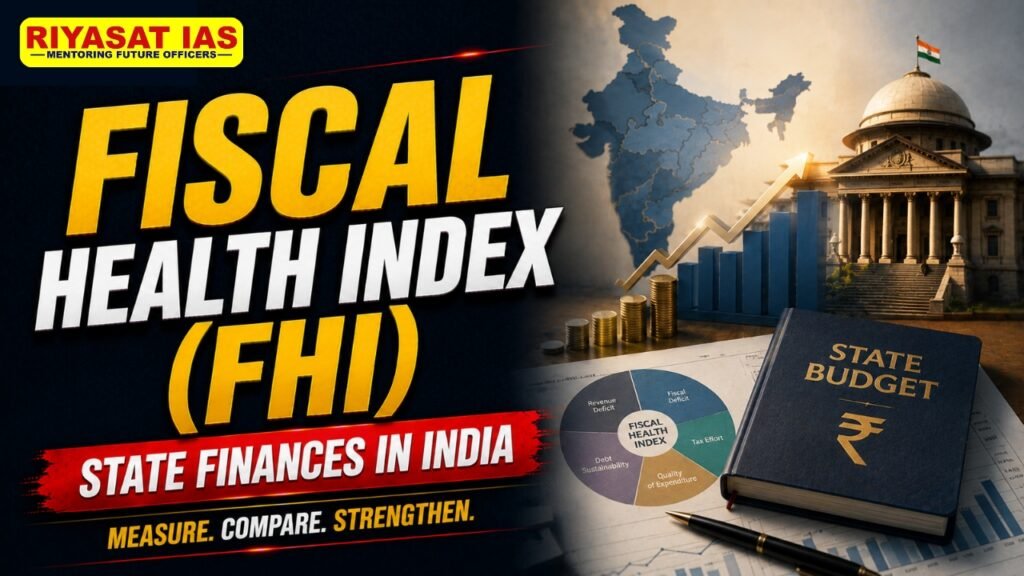
The Fiscal Health Index (FHI) developed by NITI Aayog provides a comprehensive framework to assess the fiscal performance and sustainability of Indian states. It examines how effectively states mobilise revenue, manage expenditure, control deficits, and maintain sustainable debt levels.
State finances are critical for India’s overall economic stability because states account for more than 60% of public expenditure and hold nearly one-third of general government debt. Their fiscal performance therefore has a direct impact on infrastructure development, public services, macroeconomic stability, and the achievement of Viksit Bharat @2047.
The FHI uses verified CAG data covering FY 2014–15 to FY 2023–24 and evaluates states separately as General Category States and North-Eastern and Himalayan States to enable more meaningful comparisons.
What is the Fiscal Health Index?
The Fiscal Health Index (FHI) is a NITI Aayog framework that evaluates the fiscal condition of states through multiple indicators related to revenue generation, expenditure quality, fiscal prudence, and debt sustainability.
• Objective Assessment: Measures the fiscal performance of states and identifies areas requiring policy intervention.
• Data-driven Framework: Uses a ten-year dataset based on verified CAG information.
• Peer Benchmarking: Enables comparison among states and encourages adoption of better fiscal management practices.
• Cooperative Federalism: Promotes peer learning and encourages states to improve fiscal governance.
• Differential Evaluation: Assesses General Category States separately from North-Eastern and Himalayan States to account for structural differences.
Pillars of the Fiscal Health Index
The FHI evaluates the fiscal position of states through five major pillars.
• Quality of Expenditure: Examines the balance between productive capital expenditure and committed expenditure such as salaries, pensions, and interest payments.
• Revenue Mobilisation: Measures the state’s ability to generate own tax and non-tax revenue and reduce excessive dependence on central transfers.
• Fiscal Prudence: Evaluates fiscal discipline using indicators such as fiscal deficit and revenue deficit.
• Debt Index: Assesses the overall debt burden, repayment obligations, and interest liabilities of states.
• Debt Sustainability: Examines whether economic growth and revenue generation are sufficient to support existing and future debt obligations.
Why is the Fiscal Health Index Important?
The FHI provides a systematic framework for understanding the fiscal capacity and vulnerabilities of state governments. It is particularly important because weak state finances can constrain development spending and create risks for overall macroeconomic stability.
• Strengthens Macroeconomic Stability: State-level fiscal stress can affect overall government debt and complicate national fiscal consolidation.
• Enables Performance Benchmarking: States are classified into categories such as Achievers, Front-Runners, Performers, and Aspirational States based on their fiscal performance.
• Identifies Fiscal Leaders: Among General Category States, Odisha, Goa, and Jharkhand emerge as leading performers, while Arunachal Pradesh leads among Himalayan States, according to the FHI framework provided.
• Acts as an Early Warning Tool: The index helps identify weaknesses related to debt, revenue mobilisation, and expenditure rigidity before they develop into severe fiscal stress.
Key Findings of the Fiscal Health Index
The FHI highlights significant differences in fiscal performance across Indian states.
• Strong Revenue Capacity: High-performing states generally have stronger own-tax revenue mobilisation and greater fiscal self-reliance.
• Higher Capital Expenditure: States with greater investment in infrastructure and development projects tend to demonstrate stronger long-term fiscal outcomes.



• Lower Debt Burden: Better-performing states generally maintain more sustainable debt levels relative to their Gross State Domestic Product (GSDP).
• Fiscal Stress in Some States: States such as Punjab, Kerala, and West Bengal face relatively high debt levels and significant committed expenditure pressures.
• Revenue Self-reliance Matters: Stronger own-tax revenue provides states with greater fiscal flexibility and reduces dependence on transfers from the Centre.
State Finances and Fiscal Sustainability in India
State governments are central to India’s development process because they undertake a major share of public expenditure on sectors such as healthcare, education, agriculture, infrastructure, and social welfare.
However, limited revenue autonomy, rising committed expenditure, increasing debt obligations, and off-budget liabilities continue to create fiscal pressures for several states.
Why Do State Finances Matter?
• Drive Development Expenditure: States account for more than 60% of spending on sectors such as health, education, agriculture, and infrastructure.
• Influence Fiscal Stability: States collectively account for a significant share of general government debt and therefore influence India’s overall fiscal position.
• Determine Service Delivery: State governments are the primary implementing agencies for many development and welfare programmes.
• Support Viksit Bharat: Strong state finances are essential for sustained investment in infrastructure, human capital, and regional development.
Major Challenges Facing State Finances
State-level fiscal stress arises from a combination of revenue constraints, expenditure rigidities, debt pressures, and emerging structural risks.
Revenue and Fiscal Constraints
• Shrinking Fiscal Space: Rising interest payments, salaries, pensions, and subsidies reduce the resources available for productive expenditure.
• Weak Revenue Mobilisation: Several states continue to depend significantly on central transfers because of limited own-tax bases.
• GST-related Constraints: The implementation of GST has reduced states’ flexibility over several indirect taxes, increasing the importance of other revenue sources such as excise duties, stamp duties, and taxes on petroleum products.
• Persistent Revenue Deficits: Continued borrowing for current expenditure can weaken fiscal sustainability by leaving fewer resources for asset creation.
Debt and Committed Expenditure
• High Interest Burden: Rising interest payments reduce the fiscal space available for infrastructure and human capital investment.
• Committed Expenditure: Salaries, pensions, and interest payments can consume a large share of revenue receipts in fiscally stressed states.
• Punjab’s Debt Stress: Punjab faces significant fiscal pressure, with interest payments accounting for a substantial share of its revenue receipts.
Populism and Hidden Liabilities
• Old Pension Scheme (OPS): Reverting to unfunded pension commitments can create significant long-term fiscal liabilities.
• Off-budget Borrowings: Borrowing through state-owned enterprises and special-purpose vehicles can reduce transparency in public debt reporting.
• Contingent Liabilities: State guarantees and other potential obligations can create fiscal risks that may not be immediately reflected in conventional debt figures.
Emerging Structural Risks
• Demographic Divergence: States face different demographic challenges, with some dealing increasingly with population ageing while others require greater investment in youth-oriented infrastructure and employment.
• DISCOM Losses: Persistent financial problems in power distribution companies can create additional burdens for state governments.
• Climate-related Expenditure: Increasing spending on disaster management, climate adaptation, and resilient infrastructure can place additional pressure on state budgets.
Differences in Fiscal Performance Across States
Fiscal performance varies considerably across states. States with stronger revenue mobilisation, higher capital expenditure, and sustainable debt levels generally have greater fiscal resilience.
| Fiscal Indicator | Fiscally Resilient States | Fiscally Stressed States |
| Own Tax Revenue/GSDP | 7.5–8.5% | 5–6% |
| Capital Outlay/Expenditure | 16–20% | 8–11% |
| Debt-GSDP Ratio | Below 25% | 35–48% |
| Fiscal Strategy | Capital-led Growth | Consumption-led Spending |
• Higher Revenue Capacity: States such as Gujarat, Karnataka, and Maharashtra demonstrate stronger own-tax revenue mobilisation.
• Greater Capital Formation: Higher infrastructure spending strengthens productive capacity and supports long-term economic growth.
• Better Debt Sustainability: Lower debt burdens provide greater flexibility to respond to economic shocks.
Why Strengthening State Finances is Important?
Sound state finances are essential for India’s broader fiscal stability and development objectives.
• Ensures Macroeconomic Stability: Fiscal slippages at the state level can undermine overall fiscal consolidation and increase public debt pressures.
• Strengthens Cooperative Federalism: Financially stronger states can provide better public services and participate more effectively in Centre-State development programmes.
• Supports Development Expenditure: Greater fiscal space allows states to maintain investment in infrastructure, education, healthcare, and human capital.
• Promotes Balanced Development: Stronger state finances enable investment in backward regions and help reduce regional disparities.
• Supports Viksit Bharat @2047: State governments are key implementing agencies for India’s development programmes, making their fiscal sustainability essential for achieving national development goals.
Way Forward
• Strengthen Own-Tax Revenue: Improve GST compliance, modernise property taxation, digitise land records, and broaden state tax bases to increase revenue mobilisation.
• Rationalise Committed Expenditure: Reform financially stressed DISCOMs, improve expenditure efficiency, and replace poorly targeted subsidies with Direct Benefit Transfers where appropriate.
• Adopt Medium-term Fiscal Planning: Use rolling multi-year fiscal frameworks to align expenditure, borrowing, and debt management with long-term development objectives.
• Improve Fiscal Transparency: Include off-budget borrowings, guarantees, and contingent liabilities in comprehensive public debt reporting.
• Strengthen Fiscal Responsibility Frameworks: Link additional borrowing flexibility with reforms in areas such as DISCOMs, urban governance, and revenue mobilisation.
• Consider Independent Fiscal Monitoring: Strengthen institutional mechanisms for monitoring state finances, assessing fiscal risks, and improving transparency.
• Prioritise Capital Expenditure: Protect productive investment in infrastructure and human capital while controlling unproductive revenue expenditure.
Conclusion
The Fiscal Health Index highlights the importance of fiscally resilient states for India’s overall economic stability. Strong revenue mobilisation, efficient expenditure management, sustainable debt, and transparent fiscal reporting are essential for creating adequate fiscal space for development.
As India moves towards Viksit Bharat @2047, strengthening state finances will be as important as maintaining fiscal discipline at the national level. A resilient sub-national fiscal framework can support infrastructure investment, improve public service delivery, and promote sustainable and inclusive economic growth.
Frequently Asked Questions (FAQs)
What is the Fiscal Health Index (FHI)?
The Fiscal Health Index is a framework developed by NITI Aayog to assess the fiscal performance, resilience, and sustainability of Indian states.
What are the pillars of the Fiscal Health Index?
The FHI evaluates states through five pillars: Quality of Expenditure, Revenue Mobilisation, Fiscal Prudence, Debt Index, and Debt Sustainability.
Why are state finances important for India?
States undertake a major share of public expenditure and are responsible for key sectors such as healthcare, education, agriculture, infrastructure, and social welfare. Their fiscal condition therefore directly affects India’s economic stability.
What are the major challenges facing state finances?
Major challenges include weak revenue mobilisation, high committed expenditure, rising interest payments, persistent revenue deficits, off-budget borrowings, contingent liabilities, and DISCOM losses.
What is the role of the Fiscal Health Index in cooperative federalism?
The FHI enables states to compare fiscal performance, identify weaknesses, learn from better-performing states, and adopt improved fiscal management practices.
How can states improve their fiscal health?
States can improve fiscal health by increasing own-tax revenue, improving expenditure quality, reducing unproductive spending, strengthening fiscal transparency, managing debt sustainably, and prioritising productive capital expenditure.




 Ravi Raaz
 Hassan Khan
 Shadab Ali