
Introduction
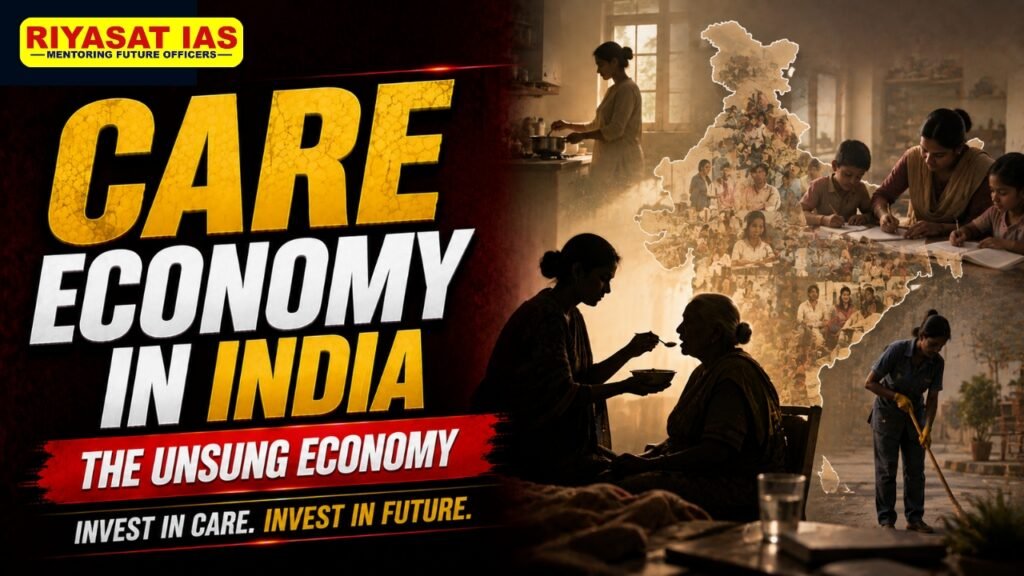
The Care Economy includes paid and unpaid activities that provide care and support to children, elderly persons, persons with disabilities, and households. It covers childcare, eldercare, healthcare, nutrition, rehabilitation, and related support services.
The Care Economy is increasingly recognised as an important part of economic infrastructure because it supports human capital, employment generation, women’s workforce participation, and inclusive growth. India’s ageing population and changing family structures are also increasing the demand for professional care services.
The Economic Advisory Council to the Prime Minister (EAC-PM) has highlighted the growing importance of the Care Economy for India’s long-term development.
Importance of the Care Economy
• Increases Female Labour Force Participation: Affordable childcare and eldercare reduce the unpaid care burden on women and enable greater participation in paid employment.
• Addresses Population Ageing: India’s growing elderly population will increase demand for geriatric care, long-term care, rehabilitation, and home-based services.
• Strengthens Human Capital: Investment in childcare, nutrition, healthcare, and education improves health, skills, productivity, and long-term economic outcomes.
• Creates Employment: Care services are relatively labour-intensive and can generate substantial employment opportunities, particularly for women.
• Supports Inclusive Growth: Accessible care services improve the well-being of vulnerable groups while enabling greater participation in economic activities.
• Recognises Unpaid Care Work: Unpaid household care contributes significant economic and social value by supporting families and enabling people to participate in paid employment, even though GDP generally excludes it.
Care Economy and Employment Generation
The Care Economy can generate significant employment because many care services require human interaction and cannot be easily replaced by automation.
• Labour-intensive Sector: Childcare, eldercare, healthcare assistance, rehabilitation, and social care require substantial human involvement.
• Women-centric Employment: Expansion of professional care services can create employment opportunities for women in childcare, healthcare assistance, elderly care, nutrition, and community-based services.



• Skilled Workforce: Growing demand for geriatric care, childcare, palliative care, rehabilitation, and allied healthcare requires trained and certified care professionals.
• Employment Multiplier: Greater investment in care services can create direct employment while enabling more women to participate in other sectors of the economy.
Challenges
• High Unpaid Care Burden: Women continue to perform a disproportionately large share of unpaid domestic and care work, limiting their participation in paid employment and skill development.
• Limited Recognition: National income and GDP calculations generally exclude unpaid care work because it does not involve market transactions, despite its significant economic and social value.
• Poor Working Conditions: Many frontline care workers, including ASHA and Anganwadi workers, face challenges related to remuneration, workload, employment security, and social protection.
• Skill Deficit: India faces shortages of trained professionals in geriatric care, childcare, palliative care, rehabilitation, and home-based care.
• Weak Regulation: Private childcare centres, eldercare institutions, and home-care services require stronger quality standards, accreditation, and regulatory oversight.
Government Initiatives
Palna Scheme: Provides crèche facilities under Mission Shakti to support childcare and enable greater participation of women in the workforce.
POSHAN Abhiyaan: Focuses on improving nutrition and early childhood development, supported by digital monitoring through the POSHAN Tracker.
Maternity Benefit (Amendment) Act, 2017: Increased paid maternity leave to 26 weeks for eligible women and provided for crèche facilities in establishments employing 50 or more workers.
Care Economy Skill Development: Specialised caregiver training can help develop a professional workforce for childcare, elderly care, rehabilitation, and other care services.
Way Forward
Recognise Care as Economic Infrastructure: Integrate care services into development planning and public investment priorities because they strengthen human capital, generate employment, and enable greater participation of women in the workforce.
Expand Public Care Infrastructure: Increase investment in affordable childcare centres, community crèches, elderly care facilities, rehabilitation centres, and community-based care services.
Professionalise Care Work: Improve wages, working conditions, social security, training, and career progression for ASHA, Anganwadi, and other care workers.
Promote Shared Care Responsibilities: Encourage parental leave, flexible working arrangements, and family-friendly workplace policies to distribute care responsibilities more equally.
Strengthen Skill Development: Expand certified training programmes in childcare, geriatric care, rehabilitation, palliative care, and allied healthcare.
Improve Regulation: Establish quality standards and accreditation mechanisms for childcare centres, eldercare institutions, home-care providers, and other care services.
Conclusion
The Care Economy is an important pillar of inclusive growth and employment. Expanding quality care services can increase female labour force participation, create jobs, strengthen human capital, and help India respond to demographic change.
India therefore needs to treat care infrastructure, skilled care workers, social security, and affordable care services as important components of its long-term development strategy.
Frequently Asked Questions (FAQs)
What is the Care Economy?
The Care Economy includes paid and unpaid activities that provide care and support to children, elderly persons, persons with disabilities, and households.
Why is the Care Economy important for India?
It can increase women’s workforce participation, generate employment, strengthen human capital, support vulnerable groups, and address the challenges of population ageing.
How does the Care Economy increase women’s employment?
Affordable childcare and eldercare reduce the unpaid care burden on women, allowing more women to participate in paid employment and economic activities.
Is unpaid care work included in GDP?
Generally, unpaid household care work is excluded from GDP because it does not involve market transactions, although it has significant economic and social value.
What are the major challenges facing India’s Care Economy?
The major challenges include unpaid care responsibilities, poor working conditions, shortage of skilled workers, limited recognition of unpaid care work, and weak regulatory mechanisms.
What are the major government initiatives related to the Care Economy?
Important initiatives include the Palna Scheme, POSHAN Abhiyaan, and Maternity Benefit (Amendment) Act, 2017, along with initiatives for caregiver skill development.




 Ravi Raaz
 Hassan Khan
 Shadab Ali