
GS-II: Polity & Governance | Transparency & Accountability | Right to Information | Fundamental Rights | Digital Governance
Context
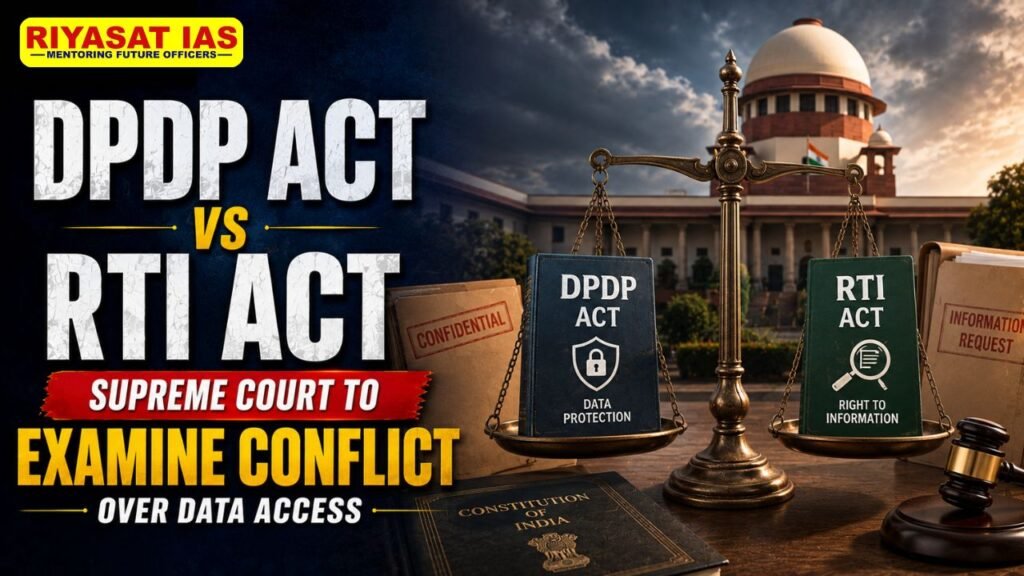
- Supreme Court agrees to examine the interaction between DPDP Act and RTI Act: The Court will consider whether the Digital Personal Data Protection (DPDP) Act, 2023 can undermine the transparency framework established by the Right to Information Act, 2005.
- Concern over broad classification of information as “personal”: The case raises the question of whether treating data broadly as personal information could create an en bloc restriction on access to information.
- Potential implications for investigative journalism: The Court will also examine whether the DPDP framework could restrict the ability of investigative journalists to access and use information in the public interest.
Core issue: RTI Act vs DPDP Act
- RTI Act promotes transparency: The RTI framework provides citizens access to information held by public authorities, subject to specified exemptions and conditions.
- DPDP Act focuses on protection of digital personal data: The 2023 law establishes a framework for processing and protecting digital personal data.
- Concern over an “en bloc embargo”: The Supreme Court noted that while the earlier RTI framework provided access subject to conditions, the DPDP framework could potentially create a much broader restriction on disclosure of personal data.
- Need for harmonisation: Since both are Central laws, the Court stressed the need to examine how the two statutes can operate together without one undermining the purpose of the other.
Supreme Court’s key observations
- RTI operates in a wider domain: Justice Joymalya Bagchi observed that the RTI law operates across a broader field, whereas the DPDP Act specifically concerns digital data.
- Different legislative objectives: The RTI Act seeks to promote transparency and accountability, while the DPDP Act seeks to protect individuals’ personal data.
- Need for “extreme circumspection”: The Court indicated that any potential conflict between the two laws must be examined carefully because both are Central legislation.
- Question of implied repeal: The Court will examine whether the restrictive approach under the DPDP Act could effectively repeal or dilute provisions of the earlier RTI framework.



Why the issue is important
- Transparency vs privacy: The case highlights the need to balance the citizen’s right to know with an individual’s right to privacy and data protection.
- Risk of weakening RTI: If personal-data exemptions are interpreted excessively broadly, legitimate requests for information could become difficult to pursue.
- Impact on investigative journalism: Journalists often rely on public records and information concerning individuals and institutions to investigate matters of public interest.
- Digitalisation changes the nature of information: As government records increasingly become digital, the boundary between information access and personal-data protection becomes increasingly important.
Significance for governance
- Protects transparency: A balanced interpretation can ensure that data protection does not become a tool for avoiding legitimate public scrutiny.
- Strengthens privacy protection: At the same time, personal information unrelated to public interest must receive appropriate protection.
- Promotes legislative coherence: Harmonising the two laws can prevent contradictory interpretations and provide greater certainty to citizens, public authorities and journalists.
Challenges
- Broad interpretation of “personal data” may restrict disclosure: Excessive classification could reduce the practical effectiveness of RTI.
- Difficulty in balancing competing rights: Privacy and transparency are both important democratic values and cannot be treated as absolute.
- Risk of chilling investigative journalism: Excessive restrictions may discourage legitimate investigations into matters of public interest.
- Overlap between legal frameworks: Both laws may apply to the same information, creating interpretational difficulties.
Way Forward
- Harmonise the two legislative frameworks: Data protection should be interpreted consistently with the transparency objectives of the RTI Act.
- Adopt a public-interest approach: Information should not be withheld merely because it contains a personal-data element when disclosure serves a legitimate public purpose.
- Ensure narrowly tailored exemptions: Restrictions should be proportionate and limited to information that genuinely requires protection.
- Preserve investigative journalism: Journalistic access to information relating to matters of public interest should receive appropriate protection within the legal framework.
Conclusion
The Supreme Court’s examination of the relationship between the DPDP Act, 2023 and RTI Act, 2005 raises a fundamental governance question: how can India protect personal privacy without weakening transparency and accountability? The objective should not be to place privacy and the right to information in opposition, but to harmonise both rights through narrowly tailored restrictions, proportionality and public-interest considerations.
UPSC Mains Practice Question
Q. The Digital Personal Data Protection Act, 2023 seeks to strengthen privacy, while the Right to Information Act, 2005 seeks to promote transparency. Discuss the challenges involved in harmonising these two objectives in a digital democracy.




 Ravi Raaz
 Hassan Khan
 Shadab Ali