
GS-II: International Relations | West Asia | India’s Foreign Policy | Regional Security | Strategic Partnerships
Context
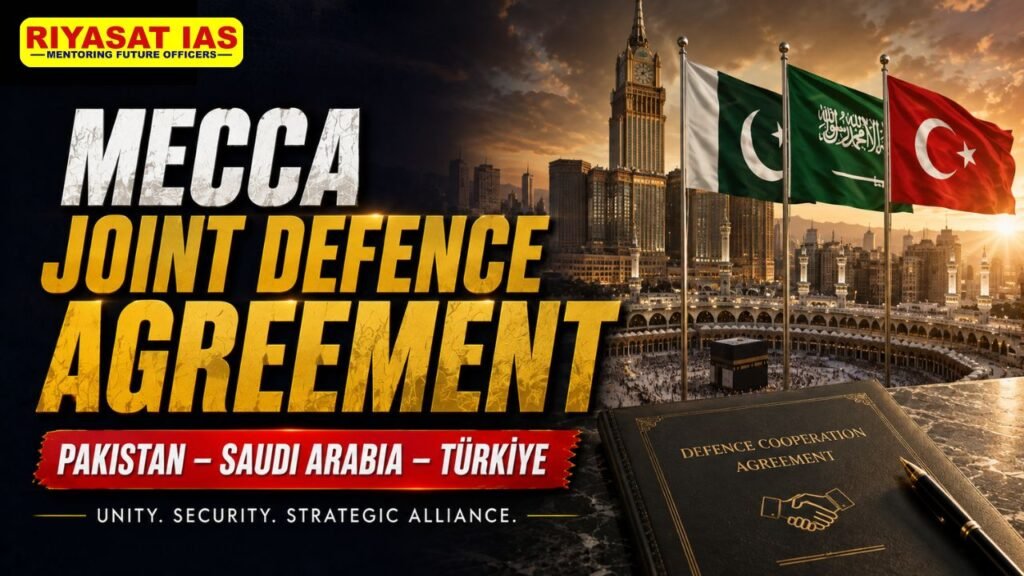
- Pakistan, Saudi Arabia and Türkiye signed the Mecca Joint Defence Agreement: The three countries signed the pact in Mecca, committing themselves to “collective defence” and “collective deterrence.”
- Agreement comes amid heightened regional tensions: The pact was signed when Saudi Arabia faces attacks from Yemen’s Houthis and West Asia remains affected by the ongoing conflict involving Iran.
- Collective defence principle: The agreement declares that an armed attack against any one of the three countries would be treated as an attack against all three, strengthening their security commitments.
Mecca Joint Defence Agreement reflects emerging trilateral security cooperation
- Three strategically important countries are involved: The grouping brings together Saudi Arabia, a major Persian Gulf power; Pakistan, a nuclear-armed South Asian country; and Türkiye, a NATO member.
- Focus on collective deterrence: The agreement seeks to strengthen the ability of the three countries to deter potential security threats through collective commitments and burden-sharing.
- Defence-oriented partnership: Türkiye has described the pact as a defence-oriented partnership that does not target any particular country.
- Broader regional objective: The agreement aims to contribute to peace, security and stability in the region and beyond.
Mecca Al-Mukarramah Summit provided the platform
- Leadership-level participation: The summit was attended by Saudi Crown Prince and Prime Minister Mohammed bin Salman, Turkish President Recep Tayyip Erdogan and Pakistani Prime Minister Shehbaz Sharif.
- Agreement signed at Al-Safa Palace: The leaders met at Al-Safa Palace in Mecca following an invitation from Saudi King Salman bin Abdulaziz.
- Regional and bilateral issues were discussed: Before signing the agreement, the leaders reviewed bilateral relations among the three countries and wider regional developments.
Strategic significance of the agreement
- Strengthens collective security: The pact creates a framework for the three countries to respond collectively to potential armed attacks.
- Enhances deterrence in West Asia: Greater security cooperation could strengthen the ability of the partners to deter external threats amid continuing regional instability.
- Promotes burden-sharing: The agreement emphasises collective security and burden-sharing, potentially allowing the three countries to coordinate their defence capabilities more closely.
- Connects different strategic regions: The partnership links the Persian Gulf, South Asia and Türkiye, creating a wider geopolitical security framework.



Why Saudi Arabia is significant in the arrangement
- Saudi Arabia occupies a strategically critical position: Its geographical location, energy resources and role in the Arab and Islamic world make its security important for regional stability.
- Growing security concerns: Attacks involving the Houthis in Yemen have highlighted the vulnerability of Gulf states to regional conflicts and missile/drone threats.
- Diversification of security partnerships: The agreement reflects Saudi Arabia’s broader effort to strengthen regional partnerships and security cooperation.
Significance for Pakistan
- Strengthens Pakistan’s strategic ties with Saudi Arabia: Saudi Arabia has historically been an important economic and strategic partner for Pakistan.
- Expands Pakistan’s regional role: Participation in a trilateral defence framework provides Pakistan with a greater role in West Asian security affairs.
- Links South Asian and West Asian security: Pakistan’s involvement creates a strategic bridge between South Asia and the Persian Gulf region.
Significance for Türkiye
- Expands Türkiye’s regional security engagement: The agreement complements Türkiye’s growing diplomatic and strategic engagement in the Middle East.
- NATO dimension: Türkiye’s participation brings a NATO member into a trilateral security arrangement involving Pakistan and Saudi Arabia.
- Emphasis on regional stability: Türkiye has presented the agreement as a mechanism for promoting regional and global peace, stability and prosperity rather than targeting a specific state.
Implications for India
- India must closely monitor evolving West Asian security architecture: Saudi Arabia is an important Indian partner, while Pakistan’s participation gives the agreement a direct South Asian dimension.
- Potential impact on India’s strategic balancing: India will need to maintain strong relations with Saudi Arabia and the wider Gulf, while managing its strategic partnership with other regional powers.
- Energy security remains crucial: Any escalation in West Asia can affect oil supplies, prices, shipping routes and India’s energy security.
- Indian diaspora and connectivity concerns: Instability in the Gulf can also affect the large Indian community, trade and remittances linked to the region.
Challenges
- Different strategic interests: Pakistan, Saudi Arabia and Türkiye have different foreign-policy priorities and regional interests.
- Complex regional geopolitics: The agreement operates in an environment marked by tensions involving Iran, Yemen, Israel and other regional actors.
- Implementation of collective defence: Translating a political commitment into concrete military coordination, interoperability and response mechanisms could be challenging.
- Risk of regional bloc formation: If interpreted as the emergence of competing security blocs, the agreement could further complicate West Asian geopolitics.
Way Forward
- Prioritise regional dialogue: The agreement should complement diplomatic efforts to reduce regional tensions rather than deepen geopolitical divisions.
- Strengthen cooperative security mechanisms: Intelligence-sharing, counter-terrorism cooperation, maritime security and crisis-management mechanisms can improve regional stability.
- Maintain inclusive regional engagement: Security partnerships should avoid unnecessary confrontation and contribute to a broader framework of regional peace and stability.
Conclusion
The Mecca Joint Defence Agreement represents an important development in the evolving security architecture of West Asia, bringing together Saudi Arabia, Pakistan and Türkiye under a collective defence framework. While it can strengthen deterrence and security cooperation, its long-term significance will depend on how effectively the three countries reconcile their different strategic interests and contribute to regional peace, stability and security.
UPSC Mains Practice Question
Q. The Mecca Joint Defence Agreement reflects the emergence of new regional security arrangements in West Asia. Discuss its strategic significance and examine its implications for India’s foreign policy and energy security.





 Ravi Raaz
 Hassan Khan
 Shadab Ali