
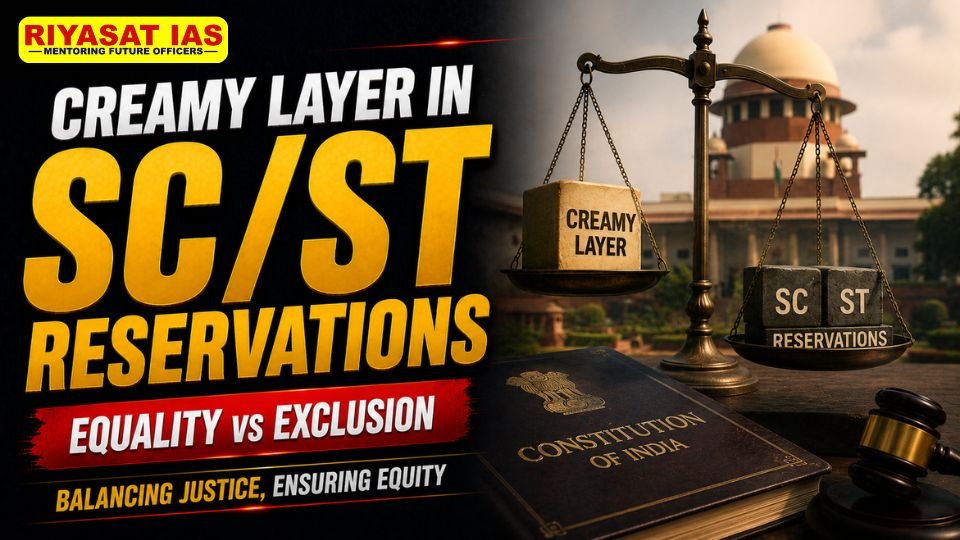
GS-II: Polity & Governance | Reservation | Social Justice | Constitutional Provisions
Context
- The concept of applying the ‘creamy layer’ principle to SC/ST reservations has recently been debated: The discussion gained prominence following observations of the Supreme Court while dealing with the issue of sub-classification within Scheduled Castes (SCs).
- The debate centres on whether the more advanced sections among SCs and STs should be excluded from reservation benefits: It raises questions about equality, social justice and the purpose of affirmative action.
Creamy layer concept aims to exclude the socially advanced among reserved categories
- The creamy layer refers to the relatively advanced and better-off sections within a reserved category.
- The objective is to ensure that reservation benefits reach the most disadvantaged members of the community.
- The concept presently applies only to Other Backward Classes (OBCs).
Creamy layer principle originated through judicial interpretation
- The Supreme Court introduced the creamy layer concept in the Indra Sawhney (1992) judgment.
- The Court held that socially advanced members of OBCs should be excluded from reservation benefits.
- The judgment clarified that the creamy layer principle did not apply to Scheduled Castes and Scheduled Tribes.
Debate on applying creamy layer to SCs and STs
- The issue arose while considering sub-classification within Scheduled Castes.
- Some judges observed that the State may consider identifying the creamy layer among SCs and STs.
- The observations have generated debate regarding the future of reservation policy for SCs and STs.



Arguments in favour of applying creamy layer to SC/ST reservations
- Reservation benefits may become concentrated among relatively advanced families within SC/ST communities.
- Excluding the creamy layer may ensure wider distribution of benefits among the most deprived sections.
- It may improve the effectiveness of affirmative action by promoting greater intra-group equity.
Arguments against applying creamy layer to SC/ST reservations
- SCs and STs continue to face discrimination based on caste and social exclusion irrespective of economic advancement.
- Reservations for SCs and STs are based primarily on historical discrimination and untouchability rather than economic backwardness.
- Applying the creamy layer principle may dilute constitutional protections provided to these communities.
Constitutional provisions relating to reservations
- Article 15(4): Special provisions for the advancement of socially and educationally backward classes, SCs and STs.
- Article 15(5): Reservation in educational institutions.
- Article 16(4): Reservation in public employment for backward classes.
- Article 16(4A): Reservation in promotion for Scheduled Castes and Scheduled Tribes.
- Article 46: Directs the State to promote the educational and economic interests of SCs, STs and weaker sections.
Significance
- The debate concerns equitable distribution of reservation benefits within SC/ST communities.
- It has implications for the future design of affirmative action policies.
- It raises important questions regarding equality, social justice and constitutional safeguards.
Challenges
- Balancing social justice with equitable distribution of reservation benefits.
- Determining appropriate criteria for identifying the creamy layer among SCs and STs.
- Reconciling historical discrimination with contemporary socio-economic advancement.
Way Forward
- Any policy change should remain consistent with constitutional principles and judicial interpretation.
- Reservation policies should continue to protect the most disadvantaged sections within society.
- The objective of affirmative action should remain the advancement of historically marginalised communities while ensuring equitable access to benefits.
Conclusion
- The debate on applying the creamy layer principle to SC/ST reservations highlights the evolving nature of India’s affirmative action framework. Any reform must carefully balance constitutional guarantees, historical discrimination and equitable distribution of reservation benefits.
UPSC Mains Practice Question
Q. The proposal to apply the creamy layer principle to Scheduled Castes and Scheduled Tribes has generated significant constitutional and social debate. Critically examine the arguments for and against such a proposal.




 Ravi Raaz
 Hassan Khan
 Shadab Ali