
GS-II: International Relations | Security | NATO | Transatlantic Relations
Context
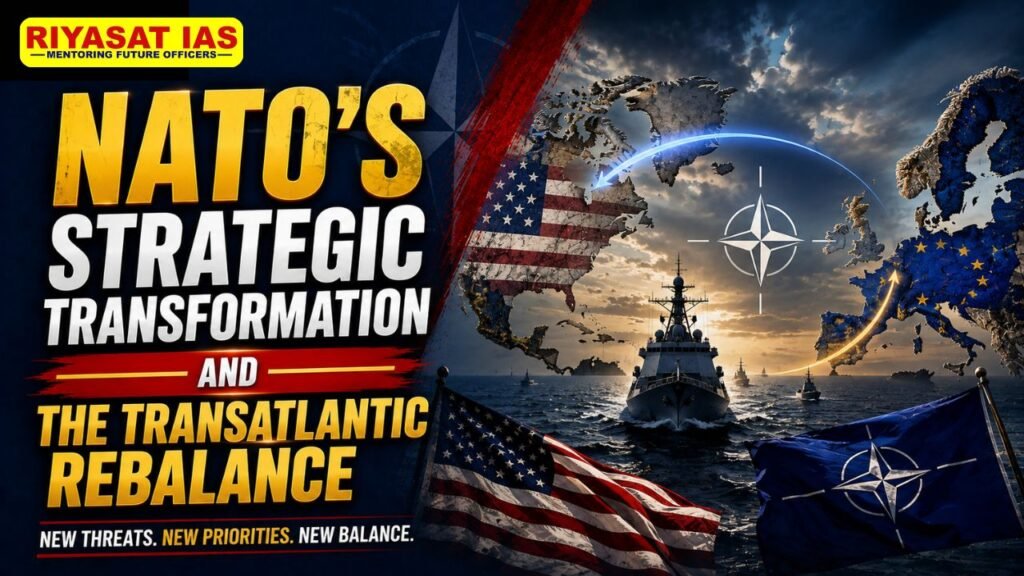
- U.S. policy shift on NATO: For the first time since NATO’s creation in 1949, the United States is asking Europe not only to increase defence spending but also to assume primary responsibility for its own security.
- Editorial’s argument: NATO is entering a new phase where Europe is expected to take greater responsibility for conventional defence while the U.S. focuses more on the Indo-Pacific. India should view this transition as a strategic opportunity.
America’s Shift
- Change in security expectations: The National Security Strategy of the United States (November 2025) reaffirmed NATO as America’s principal transatlantic alliance but stated that prosperous European allies must shoulder greater responsibility for defending Europe.
- New burden-sharing benchmark: The strategy endorsed NATO’s commitment to increase defence spending to 5% of GDP, while defining the U.S. as the Alliance’s strategic enabler, nuclear guarantor and political convener rather than its sole military backbone.
- Strategic objective: A stronger and more self-reliant Europe would allow Washington to devote greater strategic attention to the Indo-Pacific.
Evidence of Strategic Rebalancing
- Reduction in U.S. military presence: After increasing troop strength in Europe to around 100,000 following Russia’s invasion of Ukraine in 2022, the U.S. gradually reduced its presence during 2025–26 by:
- Withdrawing around 5,000 troops from Germany.
- Cancelling the planned deployment of 4,000 troops to Poland.
- Reducing Brigade Combat Teams from four to three.
- Bringing troop strength down to approximately 75,000–80,000, close to pre-Ukraine war levels.
- 36th NATO Summit (Ankara, July 2026):
- Reaffirmed commitment to Article 5.
- Pledged €70 billion in military assistance for Ukraine in 2026.
- Committed to sustaining comparable support in 2027.
- Endorsed European-led development of long-range precision strike capabilities.
- Accelerated efforts to strengthen NATO’s defence industrial base.
- Underlying message: Europe must assume greater responsibility for conventional defence as the U.S. increasingly prioritises the Indo-Pacific.



NATO’s Evolution Over Time
- NATO 1.0 (1949–1991): Relied overwhelmingly on American military and nuclear power to deter Soviet aggression and preserve transatlantic unity.
- NATO 2.0 (1991–2022): Expanded eastwards after the Cold War, incorporated former Warsaw Pact members and undertook operations in the Balkans and Afghanistan, while Europe became increasingly dependent on the U.S. for intelligence, logistics, strategic mobility and advanced military capabilities.
- NATO 3.0 (Post-2022): The Russia–Ukraine war has ushered in a more balanced partnership where Europe assumes primary responsibility for conventional defence while the U.S. continues to provide nuclear deterrence, intelligence and strategic capabilities.
Europe’s Response
- 2025 Hague Summit commitments: NATO members agreed to increase core defence spending to at least 3.5% of GDP by 2035, with progress to be reviewed in 2029.
- Germany’s defence expansion: Germany has doubled defence expenditure since 2023 and aims to achieve the 3.5% target by 2029 while rebuilding military capability.
- Russia’s military posture: Moscow has reorganised its western military posture with new headquarters, formations and bases facing NATO.
Challenges for Europe
- Dependence on U.S. capabilities: European armies continue to rely heavily on the U.S. for intelligence, surveillance, satellite support, command and control systems, strategic airlift, missile defence, long-range precision strike capabilities and the nuclear umbrella.
- Reduction in U.S. rapid reaction assets: Washington has reduced bombers, fighter aircraft, air-refuelling tankers, warships, aircraft carriers and attack submarines while deferring the deployment of Tomahawk cruise missiles to Germany.
- Capability gap: Europe’s challenge is not only expanding armed forces but also developing integrated military capabilities that have long underpinned NATO’s effectiveness.
Implications for India
- Greater U.S. focus on Indo-Pacific: A more self-reliant Europe would enable Washington to devote greater diplomatic attention, military resources and strategic investments to the Indo-Pacific.
- Scope for deeper cooperation: A stronger Europe could emerge as an important partner for India in defence manufacturing, advanced technologies, artificial intelligence, cybersecurity, semiconductors and space.
- Strategic autonomy: Closer cooperation with both the U.S. and Europe can complement India’s long-standing commitment to strategic autonomy.
Significance
- Marks a fundamental transformation in NATO’s burden-sharing model.
- Reflects the U.S. strategic shift towards the Indo-Pacific.
- Enhances Europe’s role in its own conventional defence.
- Opens new strategic and technological cooperation opportunities for India.
Challenges
- Europe’s continued dependence on U.S. strategic military capabilities.
- Replacing the integrated American military ecosystem.
- Russia’s strengthened military posture along NATO’s borders.
Way Forward
- Europe should strengthen integrated military capabilities alongside higher defence spending.
- The U.S. should continue providing strategic enablers while Europe assumes greater conventional defence responsibilities.
- India should leverage closer cooperation with both the U.S. and Europe while maintaining strategic autonomy.
Conclusion
- A new phase of NATO: NATO is evolving into a more balanced transatlantic partnership where Europe takes greater responsibility for conventional defence and the U.S. focuses increasingly on the Indo-Pacific. For India, this strategic redistribution presents opportunities to deepen defence and technology partnerships while preserving strategic autonomy.
UPSC Mains Practice Question
Q. NATO is undergoing a strategic transformation driven by changing transatlantic security priorities. Discuss the key features of this transformation and examine its implications for Europe and India.




 Ravi Raaz
 Hassan Khan
 Shadab Ali