
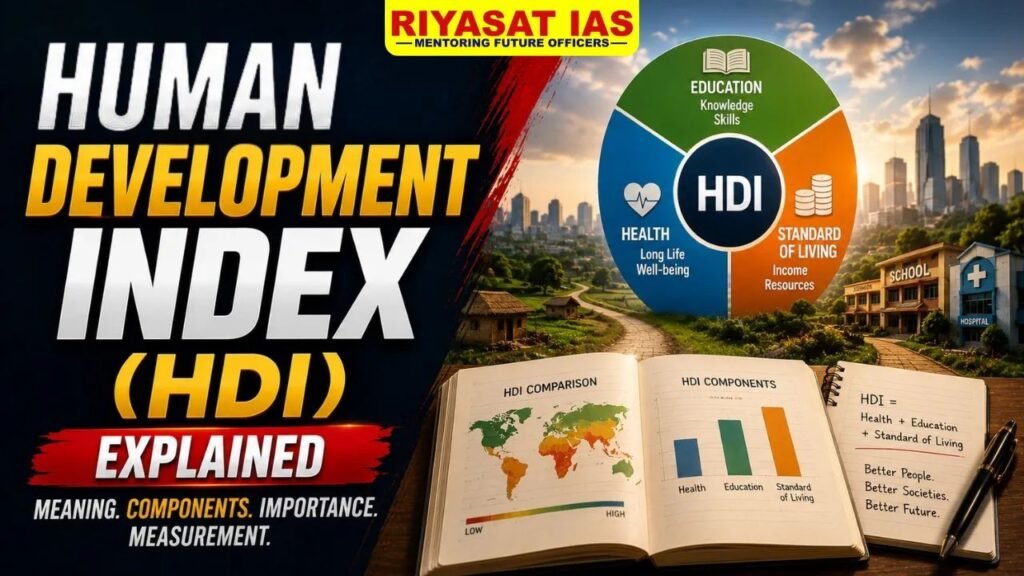
The Human Development Index (HDI) is one of the world’s most widely used indicators of development. Developed by the United Nations Development Programme (UNDP), it measures a country’s progress by considering health, education, and standard of living, rather than income alone.
Unlike GDP, which focuses mainly on economic output, HDI adopts a people-centred approach by assessing whether economic growth translates into better living conditions and greater opportunities for people.
Why is HDI Important?
The Human Development Index is frequently asked in UPSC Prelims, GS Paper II, GS Paper III, Essay, and Interview. It helps evaluate development from a broader perspective than economic growth alone.
The topic is closely related to:
- Human Development
- Economic Development
- Inclusive Growth
- Sustainable Development Goals (SDGs)
- Poverty and Inequality
- Health and Education
- United Nations Development Programme (UNDP)
What is Human Development Index (HDI)?
The Human Development Index (HDI) is a composite index that measures the average achievement of a country in three key dimensions of human development:
- A long and healthy life
- Access to knowledge
- A decent standard of living
Instead of judging development solely by income, HDI evaluates whether people have the capabilities and opportunities to lead productive and fulfilling lives.
Purpose of HDI
The primary objective of HDI is to provide a broader measure of development than GDP or per capita income.
It is based on the idea that people are the real wealth of a nation. Therefore, development should be assessed by expanding people’s capabilities, opportunities, and quality of life rather than by measuring economic output alone.
HDI helps governments, researchers, and international organisations compare development levels across countries and identify areas requiring policy intervention.
Dimensions of Human Development Index
HDI measures development through three equally important dimensions.
| Dimension | Indicator Used |
| Health | Life Expectancy at Birth |
| Education | Expected Years of Schooling and Mean Years of Schooling |
| Standard of Living | Gross National Income (GNI) per capita (PPP) |
1. Health
The health dimension measures the ability of people to live long and healthy lives.
Indicator Used
- Life Expectancy at Birth
Higher life expectancy generally reflects better healthcare, nutrition, sanitation, and living conditions.
2. Education
Education measures access to knowledge and the accumulation of human capital.
Two indicators are used:
- Expected Years of Schooling: Number of years a child entering school is expected to complete.
- Mean Years of Schooling: Average years of education completed by adults aged 25 years and above.
Together, these indicators measure both current and future educational attainment.
3. Standard of Living
The standard of living is measured using Gross National Income (GNI) per capita expressed in Purchasing Power Parity (PPP) terms.
GNI per capita reflects the average income available to residents after adjusting for differences in the cost of living across countries.
How is HDI Calculated?
HDI combines the three dimension indices into a single composite score.
The calculation involves:
- Converting each indicator into a standardised index.
- Combining the Health, Education, and Income indices.
- Calculating a composite HDI value ranging from 0 to 1.



A higher HDI score indicates a higher level of human development.
Note: UNDP periodically updates the methodology and publishes the latest technical details in the Human Development Report.
Range of HDI
HDI values range between 0 and 1.
- Closer to 1: Higher human development.
- Closer to 0: Lower human development.
This standardised scale enables meaningful comparison of development across countries.
Categories of Human Development
Based on HDI scores, UNDP classifies countries into four broad categories:
- Very High Human Development
- High Human Development
- Medium Human Development
- Low Human Development
These categories help compare development levels and monitor long-term progress.
Importance of Human Development Index (HDI)
The Human Development Index (HDI) has transformed the way development is measured by shifting the focus from economic growth to people’s well-being. It enables governments and international organisations to evaluate whether economic progress is improving the quality of life.
Why is HDI Important?
Measures Human Development: Assesses development through health, education, and income rather than economic output alone.
Provides a Broader Perspective: Recognises that development is about expanding people’s capabilities and opportunities.
Enables International Comparison: Allows meaningful comparison of development levels across countries.
Supports Policy Formulation: Helps governments identify gaps in education, healthcare, and living standards.
Tracks Development Progress: Monitors changes in human development over time.
Supports Sustainable Development Goals (SDGs): Assists countries in measuring progress towards global development targets.
Complements GDP: Provides a more comprehensive assessment of development when used alongside economic indicators.
HDI vs GDP Per Capita
Although both HDI and GDP per capita are used to assess development, they measure different aspects of a country’s progress.
| Basis | Human Development Index (HDI) | GDP per Capita |
| Meaning | Measures overall human development. | Measures average economic output or income per person. |
| Focus | Health, education, and income. | Income and production only. |
| Nature | Composite social and economic indicator. | Purely economic indicator. |
| Purpose | Evaluates quality of life. | Measures economic performance. |
| Scope | Broad and people-centred. | Narrow and income-based. |
| Published By | UNDP | National statistical agencies and international organisations. |
Example
Two countries may have similar GDP per capita, yet one may have a higher HDI due to better healthcare, education, and life expectancy. This shows why HDI provides a more comprehensive measure of development.
Limitations of HDI
Although HDI is one of the most widely used development indicators, it cannot capture every aspect of human well-being.
Major Limitations
Ignores Income Inequality: HDI uses average values and does not reflect disparities within a country.
Limited Coverage of Education: It measures years of schooling but does not assess the quality of education.
Does Not Capture Gender Disparities: Gender inequality is measured separately through the Gender Inequality Index (GII).
Excludes Multidimensional Poverty: Poverty involving nutrition, sanitation, housing, and other deprivations is measured separately through the Multidimensional Poverty Index (MPI).
Does Not Measure Environmental Sustainability: HDI does not account for climate change or environmental degradation.
Limited Institutional Assessment: Governance, political freedom, human rights, and quality of institutions are not included.
Because of these limitations, UNDP publishes several complementary indices alongside HDI.
Related Human Development Indices
To provide a more comprehensive assessment of development, UNDP publishes additional indices that complement HDI.
Inequality-adjusted Human Development Index (IHDI)
- The IHDI adjusts HDI by considering inequalities in health, education, and income.
- A large gap between HDI and IHDI indicates greater inequality within a country.
Gender Development Index (GDI)
- The GDI compares the Human Development Index of females and males to assess gender gaps in human development.
Gender Inequality Index (GII)
The GII measures gender inequality based on:
- Reproductive health
- Women’s empowerment
- Labour market participation
Lower gender inequality results in better development outcomes.
Planetary Pressures-adjusted HDI (PHDI)
- The PHDI adjusts HDI by considering environmental pressures such as carbon emissions and material consumption.
- It highlights whether development is environmentally sustainable.
Human Development Report 2025
- The Human Development Report (HDR) is the flagship publication of the United Nations Development Programme (UNDP).
- The latest edition, Human Development Report 2025, focuses on the opportunities and challenges created by Artificial Intelligence (AI).
Theme
“A Matter of Choice: People and Possibilities in the Age of AI.”
The report examines how AI can accelerate human development while addressing concerns related to inequality, employment, governance, and access to technology.
India’s Performance in HDI
India has made steady progress in human development over the years through improvements in healthcare, education, financial inclusion, and social welfare.
Major factors contributing to India’s progress include:
- Expansion of school enrolment and literacy.
- Improvement in life expectancy.
- Growth in per capita income.
- Better access to healthcare and sanitation.
- Increased financial inclusion through digital initiatives.
Despite this progress, challenges such as inequality, malnutrition, regional disparities, learning outcomes, and gender inequality continue to affect India’s human development.
Conclusion
The Human Development Index (HDI) is a comprehensive measure of development that evaluates a country’s progress through health, education, and standard of living. By going beyond income-based measures such as GDP, it provides a more people-centred assessment of development. Although HDI has certain limitations, it remains an important tool for comparing countries and guiding policies aimed at achieving inclusive and sustainable development.
Frequently Asked Questions (FAQs)
1. What is the Human Development Index (HDI)?
The Human Development Index (HDI) is a composite indicator developed by the United Nations Development Programme (UNDP) to measure development based on health, education, and standard of living.
2. Who publishes the Human Development Index?
The United Nations Development Programme (UNDP) publishes the Human Development Index through its annual Human Development Report.
3. What are the three dimensions of HDI?
HDI measures:
- Health
- Education
- Standard of Living
4. Which indicators are used to calculate HDI?
HDI is calculated using:
- Life Expectancy at Birth
- Expected Years of Schooling
- Mean Years of Schooling
- Gross National Income (GNI) per capita (PPP)
5. What is the difference between HDI and GDP?
GDP measures economic output, whereas HDI measures overall human development by considering health, education, and income.
6. Why is HDI considered a better indicator of development than GDP?
HDI provides a broader assessment of development because it evaluates people’s health, education, and living standards rather than income alone.
7. What are the limitations of HDI?
HDI does not fully capture inequality, environmental sustainability, governance, political freedom, or multidimensional poverty.
8. What is the Human Development Report?
The Human Development Report is an annual publication of UNDP that presents HDI values, country rankings, and global development trends.


 Ravi Raaz
 Hassan Khan
 Shadab Ali