
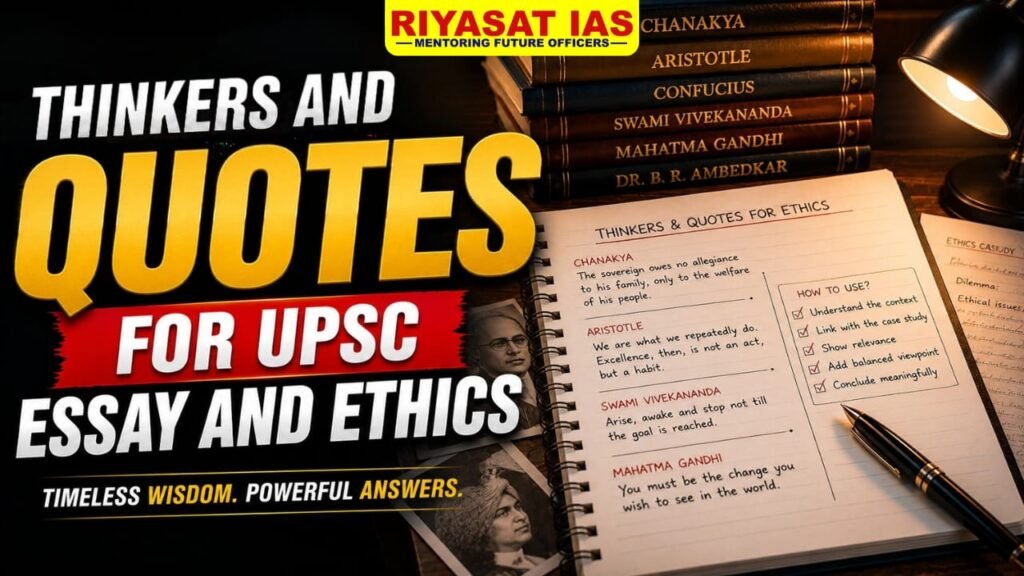
Thinkers and their frameworks strengthen UPSC Essay and Ethics answers when you apply them, not just cite them. For example, merely mentioning Rawls adds little value. In contrast, using his veil of ignorance to evaluate a policy demonstrates analytical thinking and earns better marks.
This guide gives you the most versatile thinkers for UPSC Essay and Ethics, the specific frameworks to use (not biographical summaries), and the application technique that converts a name-drop into analytical evidence.
The Application Rule: Framework First, Quote Second
Avoid citing the thinker first. However, many aspirants name the thinker, quote them, and move on, but this approach earns only name-recognition marks. Instead, first apply the thinker’s framework to the specific situation. Then, cite the thinker to support your analysis. As a result, your answer demonstrates analytical thinking rather than mere recall. PSC rewards framework application, not just the mention of famous names.
Avoid simply quoting a thinker. Instead, apply the idea to your argument. For example, rather than writing, “As Amartya Sen said, development is freedom,” explain that Sen’s Capability Approach shifts the focus from income to people’s real opportunities. Evaluate a policy by asking whether it expands capabilities such as health, education, and political participation—not just whether it increases GDP or income. This approach turns a quote into analytical evidence.
The Most Versatile Thinkers for UPSC Essay and Ethics
| Thinker | Core Framework (One Sentence) | Best For | Sample Application Sentence |
| Immanuel Kant | Act only on principles you could universalise; treat all persons as ends, never merely as means | Ethics case studies (duty, integrity, probity); Essay on governance, justice, rights | ‘The principle of universalisability prohibits preferential treatment in administration — an officer who accepts a bribe would be acting on a principle that, if universalised across all officers, would destroy the institutional trust that makes governance possible.’ |
| John Stuart Mill | Greatest happiness for the greatest number; liberty limited only to prevent harm to others | Ethics case studies (competing interests, policy trade-offs); Essays on freedom, policy, development | ‘Mill’s harm principle suggests that restrictions on individual liberty require justification as harm prevention — policy X, while limiting freedom of Y, demonstrates this justification through Z.’ |
| Aristotle | Virtue ethics — character virtues (courage, justice, prudence, temperance) as foundation; golden mean between extremes | Ethics Section A (emotional intelligence, character); Essays on leadership, governance | ‘Aristotle’s concept of practical wisdom (phronesis) is precisely what distinguishes a competent administrator from a great one — the ability to discern the right action in complex, context-specific situations that rules cannot anticipate.’ |
| John Rawls | Justice as fairness; the veil of ignorance test; difference principle — inequalities justified only if they benefit the least advantaged | Ethics (social justice, equity, affirmative action); Essays on inequality, development, democracy | ‘Rawls’ difference principle evaluates affirmative action not by whether it is formally equal but by whether it benefits the least advantaged — a test that the present policy meets by [specific mechanism].’ |
| Amartya Sen | Capability approach — development as expanding human freedoms and capabilities, not merely income | Ethics (development ethics, human dignity); Essays on poverty, development, justice, HDI | ‘Sen’s capability framework reframes development as what people can be and do, not merely what they have — measured not by GDP but by whether citizens can participate in public life, maintain their health, and pursue their version of a meaningful life.’ |
| Mahatma Gandhi | Means and ends must both be pure; ahimsa as the foundation of politics; swaraj as self-governance at all levels | Ethics (means-ends relationship, ahimsa, trusteeship); Essays on India, democracy, economic development | ‘Gandhi’s insistence that political ends cannot justify immoral means — that a freedom built on violence carries the seeds of future injustice within it — remains the most powerful critique of consequentialist approaches to political action.’ |
| B.R. Ambedkar | Constitutional morality over social morality; annihilation of caste; fraternity as the foundation of democracy | Ethics (social justice, constitutional values); Essays on democracy, caste, Indian society | ‘Ambedkar’s distinction between constitutional morality and social morality is crucial here — the Constitution prescribes a standard of justice that demands active dismantling of inherited social hierarchies, not merely formal legal equality.’ |
| Rabindranath Tagore | Human dignity and universal humanity; education as liberation; critique of narrow nationalism | Ethics (human dignity, education); Essays on culture, nationalism, humanity, creativity | ‘Tagore’s vision of the truly free human being — one who transcends the boundaries of nation, community, and creed to recognise the universal in the particular — remains a productive corrective to the exclusionary tendencies that formal nationalism often produces.’ |
| Want weekly feedback on whether your thinker applications are analytical or decorative? → Explore Essay and Ethics Mentorship at Riyasat IAS |



The Most Useful Quotes: Criteria and Examples
Thinkers and their frameworks can significantly strengthen UPSC Essay and Ethics answers. However, you must apply them instead of merely citing them. For example, simply mentioning Rawls adds little value. In contrast, using his veil of ignorance to evaluate a policy demonstrates analytical thinking. As a result, your answer earns higher marks.
| Thinker | Useful Formulation (Under 20 Words) | Where to Apply | Application Sentence |
| Gandhi | ‘Be the change you wish to see in the world’ | Essays on leadership, character; Ethics on personal integrity | Applied: ‘Gandhi’s maxim captures the logical foundation of leading by example — an administrator who demands integrity from subordinates while compromising their own simultaneously destroys the credibility that leadership requires.’ |
| Ambedkar | ‘Constitutional morality is not a natural sentiment — it has to be cultivated’ | Essays on Indian democracy, constitutionalism; Ethics on governance values | Applied: ‘Constitutional morality requires active cultivation because it demands overriding social customs that have centuries of emotional and cultural weight — which is why institutions, education, and consistent enforcement, not exhortation, are the instruments through which it develops.’ |
| Rawls | ‘Justice is the first virtue of social institutions, as truth is of systems of thought’ | Essays on justice, governance, institutions; Ethics on institutional design | Applied: ‘For Rawls, institutions that produce efficient outcomes without just processes are not simply imperfect — they are fundamentally misdirected, in the same way a logically consistent system built on false premises is not simply incomplete but inverted.’ |
| Kant | ‘Act so that you treat humanity never merely as a means but always at the same time as an end’ | Ethics case studies (human dignity, coercion, exploitation); Essays on rights | Applied: ‘This formulation prohibits using citizens as instruments of policy outcomes — however efficient or beneficial — and grounds the right to informed consent, public participation, and dignified treatment in administrative procedures.’ |
Frequently Asked Questions
How many thinkers should I cite in a single essay?
Two to three thinkers applied analytically produces stronger essays than five to six cited superficially. An essay that opens with Rawls’ veil of ignorance, develops the argument through Sen’s capability framework, and closes with Gandhi’s means-ends principle has three well-integrated analytical tools. An essay that mentions eight thinkers without applying any of them has eight decorative citations. Quality of application trumps quantity of citations in every evaluation context.
Is it better to memorise exact quotes or be able to paraphrase accurately?
Accurate paraphrase is more reliably useful than memorised quotes. Paraphrase avoids misquotation (which undermines credibility), allows you to tailor the formulation to the specific argument (which a fixed quote cannot), and takes less memorisation effort. For the small number of formulations where the exact wording is particularly powerful (Ambedkar on constitutional morality, Kant’s categorical imperative formulation), a short, precise version under 20 words is worth memorising. For all other thinkers, deep understanding of the framework is more valuable than quotation accuracy.
Can I cite Indian thinkers beyond Gandhi and Ambedkar?
Yes — and doing so adds distinctiveness to answers. Kautilya (Arthashastra) on statecraft and governance ethics; Swami Vivekananda on service as spiritual practice (relevant for public service motivation); Rammohan Roy on social reform ethics; Nehru on scientific temper and secularism as constitutional values; Lokmanya Tilak on rights and political participation. Use these where they genuinely apply to the argument — not as exotic alternatives to Western thinkers but as authentic expressions of India’s ethical tradition in governance.
Conclusion
Apply thinkers and quotes analytically in UPSC Essay and Ethics. Connect them to specific arguments, use them to strengthen your claims, and explain their relevance in two or three sentences. Study eight key thinkers—Kant, Mill, Aristotle, Rawls, Sen, Gandhi, Ambedkar, and Tagore—in depth. Learn their core frameworks and practise applying each to two or three governance issues. This approach prepares you far better than memorising twenty thinkers superficially. UPSC rewards application, not the accumulation of names.
| Riyasat IAS Mentorship — Personal Guidance for UPSC CSE Direct mentorship from Riyasat Ali Sir │ Hindi & English Medium │ 100% Online — Apply Now |


 Ravi Raaz
 Hassan Khan
 Shadab Ali