
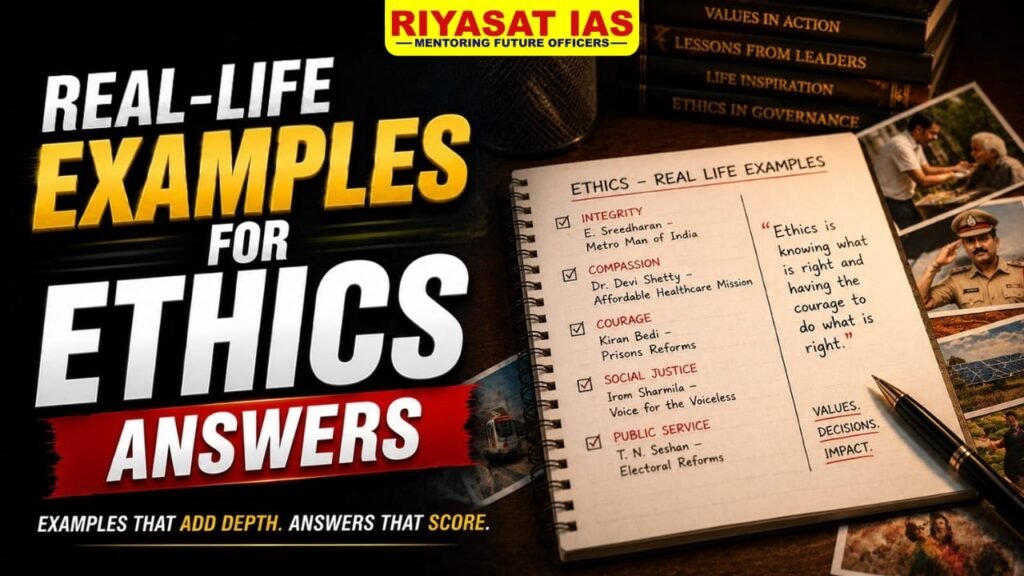
Real-life examples in UPSC GS Paper 4 answers do what abstract ethical theory cannot: they make the argument concrete, demonstrate that the aspirant can apply ethical concepts to actual governance situations, and signal the analytical habit of connecting principles to practice that civil service demands.
The challenge is not finding examples — governance failures, administrative integrity cases, and public service dilemmas occur regularly and are reported in quality newspapers. The challenge is using them in the specific way that earns marks: not as illustrations that sit beside the argument, but as applied evidence that advances it.
The Difference Between Illustrating and Applying
An example used as illustration: ‘Integrity is important in civil service. For example, officer X refused a bribe in the Y case, showing that integrity matters.’
Use real-life examples as applied evidence. For instance, Officer X demonstrated probity by refusing a bribe despite intense personal pressure in the Y case. This action reflects Kant’s principle in practice: the officer followed a maxim that could be universalised without contradiction and upheld institutional trust instead of sacrificing it for personal gain. This case shows why duty-based ethics provides a stronger foundation for civil service integrity than consequentialist calculation alone.’
The second uses the same example to: name a principle (Kant’s universalisability), connect the principle specifically to the governance case, and draw an implication for the broader ethical argument. This is applied evidence, not illustration.
Category 1: Historical Administrative Integrity Examples
| Example | Ethical Concept Illustrated | How to Apply Analytically |
| T.N. Seshan — Election Commission reforms in the 1990s | Courage of conviction, institutional integrity, rule-based governance | Applied: ‘Seshan’s use of the Election Commission’s constitutional independence to enforce the Model Code of Conduct despite political pressure demonstrates that courage of conviction — acting on institutional duty regardless of personal consequence — is the foundation of regulatory impartiality under Article 324.’ |
| E. Sreedharan — Delhi Metro project management | Professional integrity, accountability, public service commitment | Applied: ‘Sreedharan’s refusal to compromise safety standards under budget and deadline pressure, accepting project delays over certification shortcuts, illustrates the virtue ethics principle that professional integrity is not situational — it applies most crucially precisely when compromise is most tempting.’ |
| P.C. Alexander — Civil service independence | Non-partisanship, impartiality, separation of civil service from political pressure | Applied: ‘Alexander’s maintenance of civil service independence despite political pressure demonstrates the constitutional value embedded in Articles 309–311 — the service protections designed precisely to enable the impartial, non-partisan administration that democratic governance requires.’ |



Category 2: Contemporary Governance Failure Examples
Use contemporary governance failures as well as positive role models. They show the consequences of unethical conduct and help you identify the specific ethical principles that decision-makers violated.
| Governance Failure Type | Ethical Principle Violated | How to Apply Analytically |
| Regulatory capture (regulator joining regulated industry) | Conflict of interest, probity, institutional independence | Applied: ‘The pattern of regulators joining regulated industries immediately after retirement creates a structural conflict of interest that undermines the institutional trust fundamental to regulatory effectiveness. Rawls’ veil of ignorance test would prohibit this practice — no one designing just regulatory institutions would choose a system where the regulator’s future career depends on the regulated industry’s approval.’ |
| Excessive secrecy in welfare scheme implementation | Transparency, accountability, right to information | Applied: ‘Opacity in welfare scheme implementation — evidenced in [specific context] — violates the transparency principle that Article 19(1)(a) and the RTI Act together establish as a constitutional norm. Mill’s harm principle supports mandatory disclosure when secrecy causes demonstrable harm to the intended beneficiaries.’ |
| Police brutality or custodial violence | Human dignity, proportionality, rule of law | Applied: ‘Custodial violence violates the constitutional principle of human dignity (Francis Coralie Mullin, 1981) and Kant’s categorical imperative simultaneously — treating persons as objects of coercive force violates the duty to treat humanity as an end in itself, which no institutional objective can override.’ |
| Want to build a personalised real-life examples bank for your Ethics preparation? → Explore Ethics Mentorship at Riyasat IAS |
Category 3: Current Affairs Ethics Examples
Current affairs examples in Paper 4 show that the aspirant maintains an integrated ethical awareness of contemporary governance — connecting current events to ethical frameworks in the same way that current affairs integrates with static knowledge in GS Papers 2 and 3. Examples from the preparation year:
- Data privacy breaches and the ethical obligation to protect citizen data (Information Privacy as a component of dignity — Article 21)
- Whistleblower protection cases — the tension between institutional loyalty and the public duty to disclose wrongdoing (Whistle Blowers Protection Act 2014)
- Environmental clearance controversies — the intergenerational equity principle (DPSP Article 48A) in conflict with immediate economic development interests
- AI and algorithmic decision-making in governance — accountability, transparency, and the right to explanation as emerging ethical governance requirements
- Disaster relief distribution — equity and impartiality in emergency allocation when resources are scarce
For each current affairs example: note the situation, the ethical principle it engages, the constitutional or legal grounding, and the two-sentence analytical application. This format makes the example usable in an answer under time pressure.
How to Build and Maintain Your Ethics Examples Bank
Build 15–20 entries organised by ethical concept — not by date or news topic. The organisation principle: what ethical concept does this example most clearly illustrate? File it under that concept (integrity, impartiality, transparency, courage of conviction, human dignity, etc.). When writing a Section A answer on integrity, you can immediately locate the 3–4 examples under ‘integrity’ in your bank and choose the most appropriate.
Update the bank monthly with 1–2 new contemporary examples. Do not accumulate examples without applying them: every new example should include a two-sentence analytical application written at the time of entry — not retrospectively before the examination.
Frequently Asked Questions
Should real-life examples come only from Indian governance, or can international examples be used?
You can use both, but prioritize Indian governance examples because they better match the civil service context of the UPSC examination. International examples work best when they illustrate a universal ethical principle that has clear governance application — Nelson Mandela on reconciliation, Lee Kuan Yew on technocratic governance ethics, or international environmental governance cases. They should be used sparingly alongside Indian examples, not as primary evidence.
Can I use fictional examples (from literature or cinema) in Ethics answers?
Sparingly, and only for Section A conceptual answers — never for case studies. Literary or cinematic examples can illustrate an ethical concept effectively when combined with a governance application (‘The moral dilemma of choosing between individual loyalty and institutional duty, illustrated through [character] in [work], mirrors the administrative situation where…’). Case studies should use real governance examples; fictional examples in case studies suggest an inability to connect ethics to actual administrative practice.
How specific do examples need to be? Do I need to know exact names and dates?
Sufficiently specific to be citable — the officer’s name, the institution, and the approximate period is enough. Exact dates are not necessary; exact case names are valuable but approximate descriptions work (‘the Chief Election Commissioner’s enforcement of the Model Code of Conduct in the 1990s’ is specific enough without remembering the exact election year). The analytical application of the example matters more than the precision of its citation.
Conclusion
Real-life examples earn marks in UPSC Ethics answers when they are applied as analytical evidence — connected explicitly to an ethical principle, shown to engage that principle in a specific governance context, and used to draw an implication for the answer’s argument. Building an examples bank of 15–20 entries organised by ethical concept, with a two-sentence analytical application for each, gives you a ready toolkit of evidence that converts abstract ethical theory into the concrete, governance-grounded arguments that GS Paper 4 rewards.
| Riyasat IAS Mentorship — Personal Guidance for UPSC CSE Direct mentorship from Riyasat Ali Sir │ Hindi & English Medium │ 100% Online — Apply Now |


 Ravi Raaz
 Hassan Khan
 Shadab Ali