
Introduction
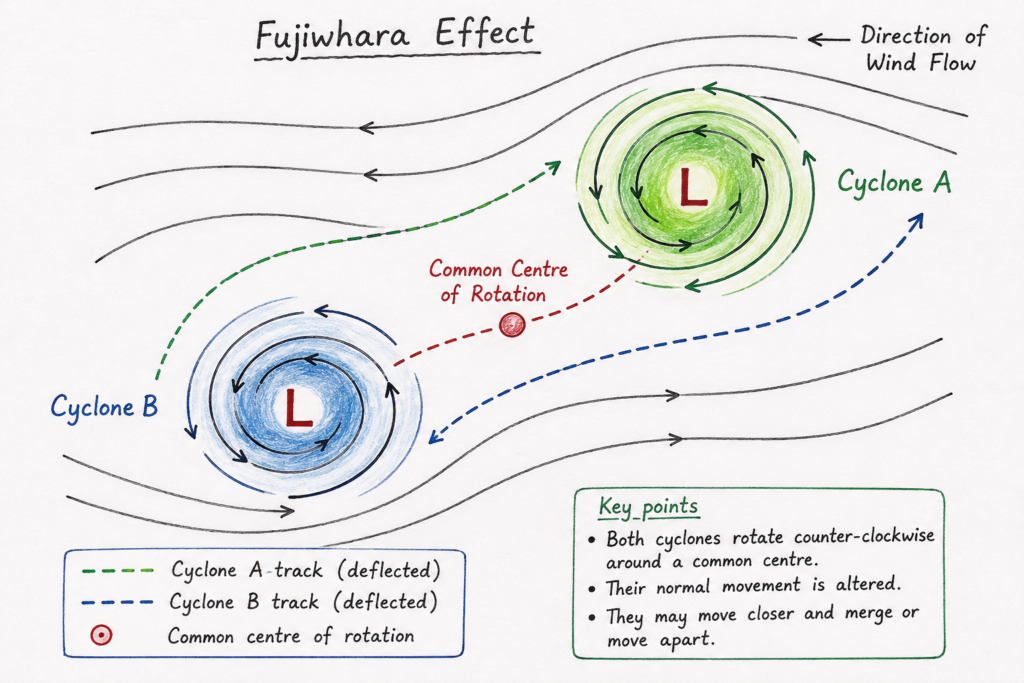
The Fujiwhara effect, first described by Japanese meteorologist Sakuhei Fujiwhara in 1921, refers to the interaction between two nearby cyclonic systems of similar size and intensity. Under favourable conditions, the systems begin to rotate around a common centre.
Impact on Movement
- Mutual rotation: The two cyclones influence each other’s circulation and may orbit around a common point.
- Change in track: Their normal movement can be altered, resulting in curved, looping or unpredictable tracks.
- Change in speed: One or both systems may slow down or change direction.
- Merger: If the systems come sufficiently close, the stronger cyclone may absorb the weaker one, producing a larger circulation.
- Separation: In some cases, the interacting systems may move apart after influencing each other’s paths.
Impact on Intensity
- Weakening: Interaction can disturb the circulation and produce vertical wind shear or oceanic cooling, reducing the energy available for intensification.
- Intensification: A merger or favourable interaction may also consolidate circulation and produce a stronger system.



Conclusion
Thus, the Fujiwhara effect can significantly alter both the track and intensity of tropical cyclones, making their behaviour more difficult to predict. Understanding such interactions is therefore important for cyclone forecasting, disaster preparedness and coastal risk reduction.
5. “Tundra regions are ecologically fragile but economically important.” Examine this statement critically. (Answer in 150 words)
Introduction:
Tundra regions occur mainly in the Arctic and high-altitude areas and are marked by extreme cold, permafrost and a short growing season. These conditions make them highly fragile, but their resources give them growing economic importance.
Ecological fragility
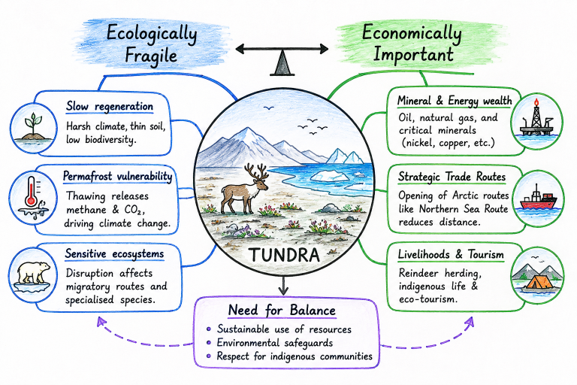
- Slow recovery: Sparse vegetation and harsh climatic conditions mean that even minor disturbance can take decades to recover.
- Permafrost vulnerability: Rising temperatures can thaw permafrost, releasing methane and CO₂ and creating climate feedback.
- Sensitive biodiversity: Species such as polar bears, Arctic foxes and reindeer depend on specialised habitats and seasonal migration routes.
Economic importance
- Minerals and energy: Arctic tundra contains important reserves of oil, natural gas and minerals such as nickel and copper.
- Transport: Melting sea ice is increasing interest in routes such as the Northern Sea Route.
- Livelihoods and tourism: Reindeer herding and nature-based tourism support local communities.
Conclusion:
Thus, the tundra represents a delicate balance between resource potential and ecological vulnerability. Economic activities should therefore follow strict environmental safeguards, indigenous participation and sustainable practices.




 Ravi Raaz
 Hassan Khan
 Shadab Ali